


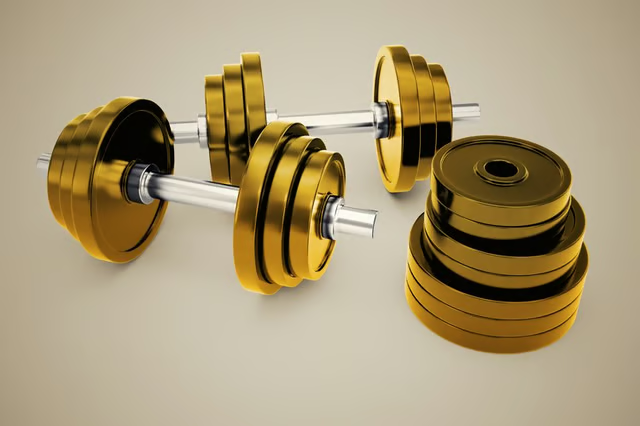
One of the events at the first modern Olympic Games in 1896, Olympic weightlifting now requires competitors to perform two lifts: the snatch and the clean and jerk. Both movements involve lifting the bar overhead with the maximum amount of weight. Bars used in Olympic competitions must meet certain specifications.
International Weightlifting Federation
The International Weightlifting Federation is the governing body for the sport of Olympic weightlifting. Founded in 1905, the IWF is located in Budapest. Barbells to be used in the Olympic Games and other IWF events must be approved and licensed, according to IWF rules. Manufacturers apply and pay a fee for licensing. For the Olympic Games, the IWF executive board selects a barbell from the currently licensed companies.
Men's Bar Specifications
The men's bar weighs 20 kg and is 2,200 mm long, which is a little more than 7 feet. The center of the bar is 1,310 mm long and each sleeve at the end of the bar is 415 mm. The sleeves are 50 mm, or 2 inches, in diameter, and the center of the bar has a 28-mm diameter. The center of the bar has three knurled areas, two long sections on each end and a short, 120 mm knurled area in the middle.
Women's Bar Specifications
The women's bar is lighter, 15 kg, and shorter, 2,010 mm, than the men's bar. The center of the bar is 1,310 mm and each sleeve at the end of the bar is 320 mm. The sleeves are the same thickness as the men's bar, 50 mm, but the center of the women's is not as thick, 25 mm. The knurling pattern is different. Two long, 440 mm, knurled areas on the ends, are separated by a non-knurled, 420 mm, area in the center.
Other Parts of Bar
The IWF breaks the bar down into three distinct parts: the bar, the discs and the collars. The collars hold the weight discs in place and weigh 2.5 kg each. The discs are available in 10 weights: .5 kg, 1 kg, 1.5 kg, 2 kg, 2.5 kg, 5 kg, 10 kg, 15 kg, 20 kg and 25 kg. The discs are color-coded red, blue, yellow, green or white depending on the weight. The largest discs, above 10 kg, have a diameter of 450 mm with a plus or minus 1 mm tolerance.