
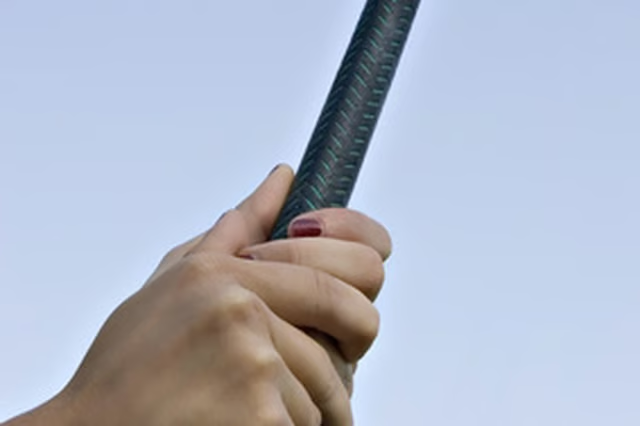
Anybody who plays golf wants to perfect their swing and hit the ball as far and straight as possible with every club. But a good golf swing starts with a good grip. Your hands are the only part of you in contract with the club, and finding the right grip is critical in making solid, repeatable swings. Three types of grips are generally considered the standard, but a fourth, the double overlap, has crept into the discussion because it's used by one of the world's top players.
The Big Three
Watch any kid picking up a golf club, and you're likely to see grip the first grip—the 10-finger grip. It's by far the easiest to understand; hold the club in all 10 fingers as you would a baseball bat. The second is most widely used by the world's professionals: the Vardon or overlapping grip, in which the pinkie finger of the right hand (for right-handed players) overlaps the index finger of the left. The third version is the interlocking grip, in which the right pinkie is interlaced between the left forefinger and middle finger. It's not as popular but has a major selling point—the two most successful players in history, Jack Nicklaus and Tiger Woods, use it.
The Newcomer
The double overlap grip has gotten attention recently mostly because it's used by PGA Tour player Jim Furyk, who has more than $45 million in career earnings. He won the U.S. Open in 2003 and remains a weekly tour contender. With a double overlap, the pinkie and ring finger on the right hand overlap the index and middle finger on the left, sliding down one slot from a standard overlapping grip.
Full Swing Benefits
One advocate of trying a double overlap grip is David Leadbetter, considered one of the top instructors in the world. Leadbetter says excess tension in a standard grip inhibits a player's ability to cock his wrists at the top of the backswing, with much of that tension coming from the fingers in the middle of the grip--the left forefinger and the right pinkie and ring finger. A double overlap removes a finger from the club, decreasing tension in the middle of the grip and increasing grip pressure elsewhere. Leadbetter says for some, this will lead to reduced tension in the grip and an improved swing.
Short Game and Practice
Short-game guru Dave Pelz, who counts three-time Masters champion Phil Mickelson among his clients, says holding the club in a "death grip" is a major reason his students hit poor "pitch shots"—played from well inside 100 yards when trying to get the ball close to the hole. Pelz says a double overlap grip again addresses the culprit—too much hand pressure and tension while holding the club—and allows you to feel the clubhead doing the work instead. He suggests using a double overlap grip at least for practice to get a feel for the proper swing before returning to your normal grip.