
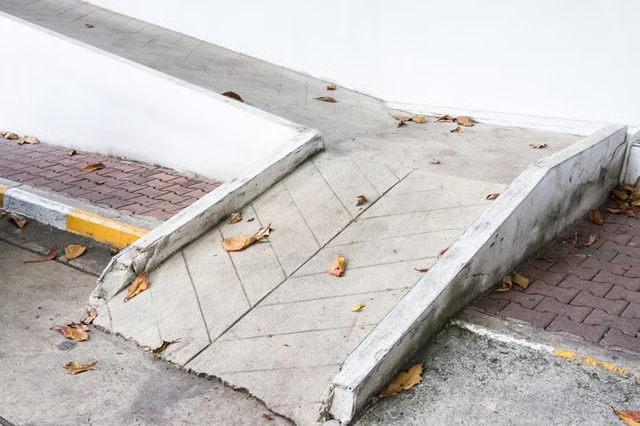


Wheelchair ramps have to follow not only state and federal laws, but the laws of physics as well. If a ramp is too steep, the person using the wheelchair won’t be able to use the ramp without falling over. The ramp incline in degrees is the same as the angle formed where the ramp hits the ground. The whole setup forms a right triangle, so you can find the ramp incline in degrees by finding the inverse sine of two of the sides.
Measure the ramp and the height from the very top of the ramp to the ground.
Draw the ramp, ground and steps as a right triangle. The “back” side will be a line drawn from the ground to the point where the ramp meets the top of the incline.
Label as much as you can on this triangle -- the 90-degree angle where the ground meets that line, the length of the ramp and the length of the ground from the imaginary line to where the ramp meets ground level.
Divide the height of that “back” line by the length of the ramp. Say you’ve got a ramp that’s 12 feet long that rises up 3 feet. 3 divided by 12 equals 0.25.
Plug this number into a calculator.
Look for the button that has either SIN^-1 on it, or above it. Chances are you’ll find SIN^-1 written on the calculator above the SIN button.
Hit the “2nd” key if necessary, or whichever key on your particular calculator that allows you to use the secondary functions listed above the regular keys.
Hit the SIN^-1 button. The answer is the number of degrees of the ramp incline. In this example, SIN^-1(0.25) equals approximately 14.5 degrees. Allegro Medical notes this is a fairly steep incline meant for only unoccupied chairs, for example, those that are being loaded into a van.
Tips
The formula you’re using is similar to the “SOH” portion of SOHCAHTOA, the trigonometric formula you learned back in high school. The “back” of the triangle is the opposite side, and the diagonal ramp is the hypotenuse. The difference is that you’re using SIN^-1 instead of SIN. Math Is Fun explains that the SOH formula tells you what the opposite divided by the hypotenuse would be if you found the sine of the angle, but in this case that value is already a known quantity. To go the other way and find the angle, you have to use the inverse sine, or SIN^-1.