
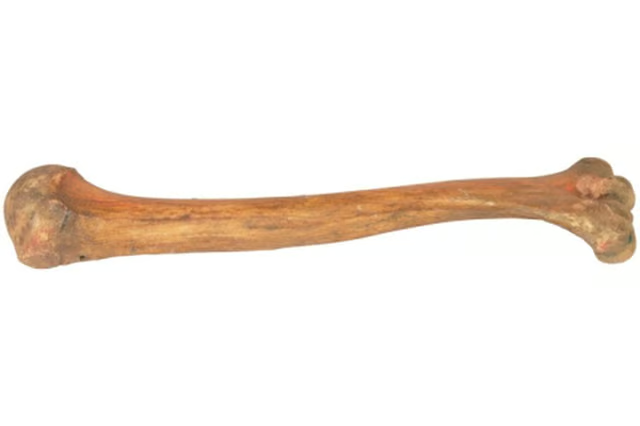
The femur is the largest bone in the human body. The femur carries the weight of the entire body, and you can't move your body without it. The femur starts at the hip in a socket joint, and travels down to the knee joint. Gerard J. Tortora and Bryan Derrickson, authors of "Principles of Anatomy and Physiology," state that bone degradation typically starts at the end points of the bone, and you want to keep your femur strong as it is connected to the two problematic areas of the hip and knee.
Size
According to Tortora and Derrickson, the adult female femur bone has an average length of 17 to 18 inches, and an average diameter of 1 inch. The average weight of a adult female femur is 261 g, which equals out to roughly 9.2 oz.
Strength
The American College of Sports Medicine states that the typical healthy adult female femur can support 30 times the weight of the body. The amount of weight your femur can support depends on your level of physical activity, if you perform resistance exercises and your diet. Your femur can support more than 30 times your body weight if you are physically active, partake in resistance training and have a healthy intake of calcium, vitamin D and phosphorus.
Increasing Femur Strength and Integrity
The American College of Sports Medicine suggests resistance training to increase both the strength and thickness of your bones. Resistance training applies unusual stress and stimulus onto your bones, which increases cellular activity within the bone matrix in order to adapt to the new stresses. The National Strength and Conditioning Association suggests using free weight exercises that load the spine and hips to encourage bone growth in the femur.
Osteoporosis/ Osteopenia
Many health organizations, such as the National Strength and Conditioning Association and the American College of Sports Medicine, report on the importance of considering your bone health as a woman, and partaking in exercises that load your bones. The National Women's Health Information Center states that women are at a much greater risk for developing osteoporosis than males due to the female genetic make up, hormone levels and physiological set-up of a woman's body. You should incorporate resistance training into your exercise routine in order to maintain bone strength and integrity. Daily activities of living will become greatly affected if your femur--as the largest bone in the human body and necessary for all leg actions--begins to suffer from osteoporosis.