
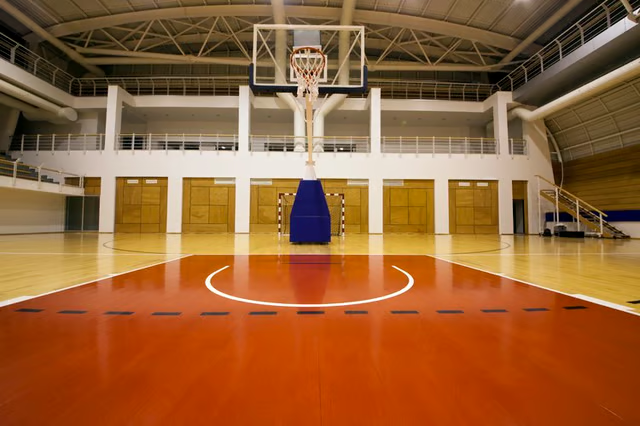

If you have watched a professional basketball game since 1997 or a college basketball game since 2012, you may have noticed a semi-circle in the foul lane under the basketball hoop near the baseline. This area on the basketball court is known as the restricted zone.
According to NBA and college basketball rules, if a defensive player is inside the restricted zone, an offensive player who makes contact with him cannot be called for a charging foul. This rule change was added to make the game safer, more fair and easier to referee.
muratsenel/iStock/Getty Images
Understanding Charging
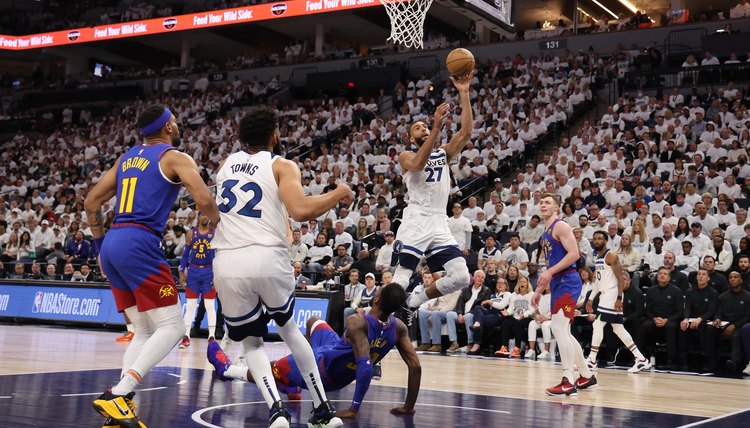
A charging foul is an offensive foul that occurs when illegal contact is made by pushing, moving or charging into a stationary defender. This collision most often occurs when a player in possession of the ball is dribbling and driving to the hoop and "charges" into an opposing player near the basket.
The defensive player must be set in position and cannot move laterally in order for a charge to be called on the opposing team’s player. A charging call results in a change of possession and counts as a personal foul toward the player who committed the violation.
muratsenel/iStock/Getty Images
The NBA and WNBA
Prior to the addition of the restricted area semi-circle in 1997, professional defensive players were planting themselves close to the basket, compromising the safety of offensive players trying to attack the basket and score.
To remedy this situation, the NBA rules committee voted to add a 4-foot semicircle, or half-circle, inside the foul lane with its apex 3 feet from the center of the basket. If an offensive player makes contact with a defensive player in this restricted no-charge semi-circle, it is now a defensive blocking foul resulting in the offensive player heading to the free throw line.
The same rules apply in women’s professional basketball.
muratsenel/iStock/Getty Images
College Basketball
In 2009, college basketball experimented with dotted semi-circles under the backboard to determine if the restricted area was a good idea for their game. Two years later, the NCAA once again experimented with a 2-foot wide circle, which was determined to be way too small for officials to make consistent charging calls.
After the 2010-2011 season, the NCAA voted to add a 3-foot arc, which was implemented at the beginning of the 2011-2012 season. Currently, defensive players with even a foot inside of the restricted area are not able to draw offensive charging fouls when an offensive player is making a move to the hoop.
International and Amateur Rules
The International Basketball Federation, more commonly known as the FIBA, is the organization that governs international competition. FIBA rules are employed during competitions such as the Olympic games.
In 2008, the FIBA announced its adoption of the restricted area arc and copied the NBA's restricted area rules. Other than the NCAA, other amateur basketball organizations such as the National Federation of State High School Associations, which makes the rules for high school hoops, have not yet adopted the restricted area rule.