
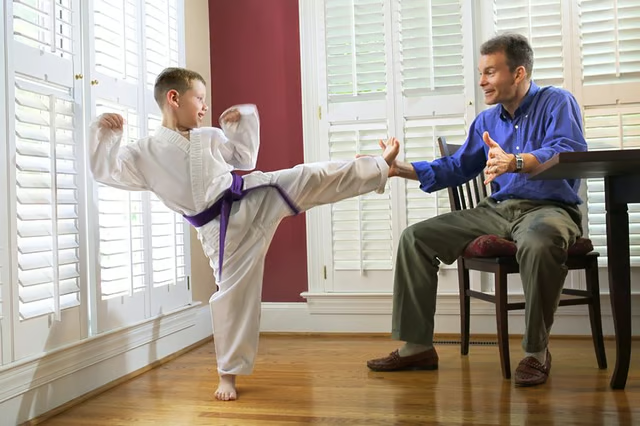
Martial art styles teach children and amatuer martial artists lessons about self-defense, confidence, respect and discipline. Two well-known forms of martial arts are karate and tae-kwon-do and they can benefit your child physically and mentally. The main difference is karate focuses on traditional self-defense maneuvers, while taekwondo often focuses on competition skills. Here are the differences between karate vs taekwondo.
History of Karate vs Taekwondo
Karate developed hundreds of years ago on the Japanese island of Okinawa. Japan forcibly occupied Okinawa in 1609 and confiscated all weapons. Okinawans fought back with their bare hands and feet. Those striking, blocking and kicking methods were refined and karate was born. Taekwondo originated in Korea. The first documented evidence of Korean martial arts dates back to the hand techniques of the hwarang warriors in the 6th century. Taekwondo was officially formed in 1955. Karate is translated as “empty hand” and taekwondo means “way of the foot and fist.”
Similarities of Karate and Taekwondo
Both are considered “hard styles” of martial arts. This means force is used against force. For example, if someone punches you, you respond with a strong block, then follow with a counter punch or kick. Initially, children typically block foam training equipment instead of actual punches. Both teach a series of punches, blocks, elbow strikes and kicks. Many of these techniques are included in choreographed stances called “kata” in karate and “poomse” in taekwondo. Both taekwondo and karate emphasize physical conditioning and teach a child how to understand the practical applications of techniques.
Kicking in Taekwondo Vs Karate
Your child will learn several more kicking techniques in taekwondo than in karate. In addition to basic kicks, this Korean art teaches several flashy spinning and jumping kicks. Children usually enjoy all the drills in which they repeatedly kick pads. Taekwondo's fast foot techniques are often deceptive and trick opponents into leaving themselves open to attacks. They are very similar to the Chinese technique of Kung Fu. Karate has more of a balance between kicks and strikes. Karate's kicks focus on self-defense applications, whereas many advanced taekwondo kicks are most useful in tournament fighting.
Tournaments in Taekwondo Vs Karate
The difference in fighting styles is evident at tournaments. In traditional karate tournaments, punches and kicks earn the same amount of points. Therefore, karate competitors typically use their fists and feet equally. However, a taekwondo competition rewards kicks with big points and hand strikes are rarely used. Taekwondo sparring became an official Olympic sport in 2000, thanks to the world taekwondo federation. Both have an emphasis on takedowns as well in tournaments.
Weapons in Taekwondo Vs Karate
Karate and taekwondo have a much different emphasis on weapons training. Traditional Okinawan weapons are usually an important part of a karate school's curriculum. In karate, your child will likely learn how to use padded versions of weapons such as nunchaku and bo staff. The nunchaku is two short sticks connected by a rope or chain. Taekwondo classes occasionally offer weapons training, but those lessons are typically considered a special addition to the core curriculum. Children often find this part exciting since several television characters, animated and otherwise, use these weapons.