
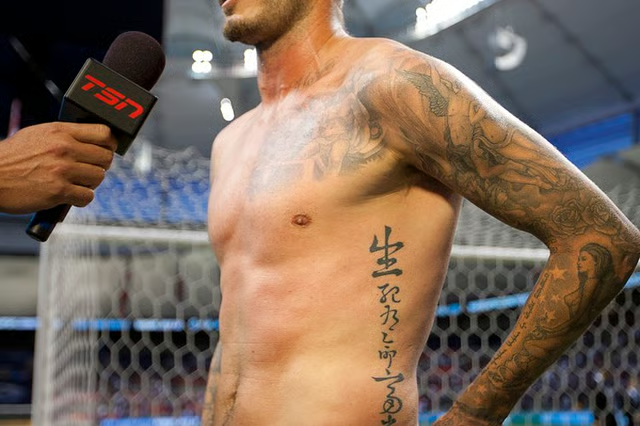


The muscles used to play soccer can pay off handsomely -- both on and off the field. David Beckham employs his eight-pack abs to make $44 million a year as a pitchman -- by taking his Paris Saint-Germain jersey off. Even if that’s not in your zone of reality, an understanding of soccer anatomy can help you realize that the game involves more than a strong kicking foot, and the best way succeed in the game is to attain total-body strength.
Arms and Shoulders
Beckham instinctively shows off his no-body-fat upper body, which you might not think of as the place to start in terms of soccer musculature. But sports physiologist Donald T. Kirkendall kicks off the first chapter of his cornerstone text, “Soccer Anatomy,” with the arms. He acknowledges that while everyone looks at soccer as a leg game, players weaving in close quarters and taking quick shots really heavily on balance -- with the arms crucial to this. The triceps and biceps act to control the elbow, which can be strengthened by dips, curls and triceps extensions. The wheelbarrow exercise and arm wrestling with a teammate can help sculpt the deltoid, the muscle at the top of the shoulder.
Upper Body
The neck muscles -- including the primary flexor, the sternocleidomastoid -- play a role in heading the ball. Pullups strengthen the rhomboids, the trapezius group and latissimus dorsi of the back, important to prevent back pain created from running up and down often-rough outdoor grass fields; if pullups are too tough for you at first, try the prone dumbbell fly instead. The erector spinae of the lower back benefit from lumbar extensions.
Core
Next are the core muscles of the lower back, abdomen and hips, which in all sports -- soccer is no exception -- provide the essential kinetic chain between the upper and lower body, as well as the essential ability to twist on the field. The iliopsoas group and hip flexors control the hip flexion, and the glutes -- which can be strengthened with barbell good mornings -- control hip extension as you run. The abdominal muscles provide crucial support for the vertebral column throughout its movement in all planes, with the situp remaining a classic valuable exercise for this area.
Legs
The quadriceps, hamstrings, calf and shin muscles control the movements of your knees, ankles and toes. Leg presses and leg extensions provided targeted work for these muscles, but you should also explore more explosive and demanding body-weight and free-weight exercises such as the squat, step-ups, forward lunges and box jumps, as well as the Romanian deadlift, Kirkendall advises.