
2027 Women's World Cup European play-offs explained: Path 1 mismatches
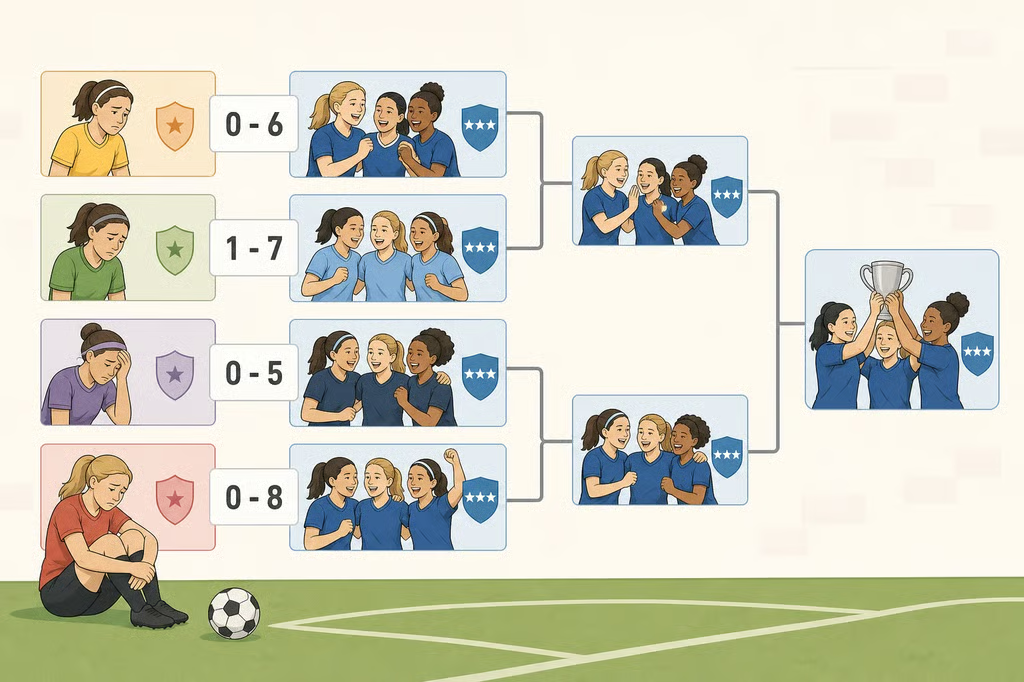
England’s 8-1 aggregate win over Greece was one of six of the clearest one-sided ties in the first round of the 2027 Women’s World Cup European play-offs. Sweden beat Lithuania 15-0, the Republic of Ireland defeated Kazakhstan 12-0, and the Netherlands eliminated Hungary 11-0, results that raise a reasonable question: are the Women’s World Cup qualifying play-offs rewarding strong league-phase teams, or simply creating mismatches?
The answer is not that European women’s football lacks competitive depth. The first-round results point to something narrower. The largest margins were concentrated in Path 1, where teams from League A faced opponents from League C. That does not prove the structure caused every result, but it does show why UEFA’s allocation of teams deserves closer examination. UEFA reported the first-round results this week, while BBC Sport described the ease of England’s progress as evidence that the current structure may be inefficient.
The stakes are substantial. Denmark, France, Germany and Spain were the only League A group winners to qualify directly, leaving Europe’s remaining seven World Cup places and one inter-confederation play-off place to be settled through two rounds of home-and-away ties. UEFA confirmed that structure this week.
The format matters because a team can perform strongly against elite opposition, miss out on first place, and then be sent into a tie against a much weaker side. England’s route makes that tension especially easy to see.
How the 2027 Women's World Cup European play-offs work

The European qualification system begins with a league phase divided into Leagues A, B and C. Only League A group winners qualify automatically. The other teams are sorted into two first-round paths, each containing eight two-legged ties.
Path 1 includes the four League A runners-up and four League A third-place teams. They face the six League C group winners and the two highest-ranked League C runners-up. The League A teams are seeded, which means they host the second leg. The eight Path 1 winners advance to the next round. UEFA outlined those matchups this week.
Path 2 uses the remaining League A teams and the strongest League B group winners. The four League A fourth-place teams and four League B group winners play the teams that finished second and third in the League B groups. As in Path 1, the seeded teams host the return leg. This gives the full first round a clear hierarchy: Path 1 places League A teams that narrowly missed direct qualification against League C opposition, while Path 2 creates matchups across the lower end of League A and the upper levels of League B.
That distinction is essential. Without Path 2, the first-round results can look like a general failure of the entire play-off system. With it, the pattern is more specific. The most severe scorelines came largely from the path that paired high-level League A teams with League C group winners and runners-up.
All 16 first-round winners then enter round two. They are drawn into eight ties between 26 November and 5 December. The winners are not simply ranked by the order in which they finish. UEFA ranks the eight round-two winners, and the seven best-ranked teams qualify directly for the 2027 World Cup. The remaining winner goes into the inter-confederation play-offs in February. UEFA confirmed the ranking condition this week.
That final detail changes the meaning of round two. Winning the tie remains the immediate requirement, but the eventual reward also depends on how the eight winners rank against one another. A team can survive both rounds and still face a different qualification outcome from another winner.
What the first-round results show

The scorelines are striking, but they need to be read as a pattern rather than a single verdict.
Sweden defeated Lithuania 15-0 on aggregate. The Republic of Ireland beat Kazakhstan 12-0, the Netherlands defeated Hungary 11-0, Iceland beat Croatia 9-0, Norway eliminated Romania 8-0, and England progressed against Greece 8-1. UEFA published those results this week.
Those are not isolated pairings between evenly matched teams that happened to become lopsided. The Netherlands finished second in its League A group behind France, while Norway finished behind Germany. Both then entered Path 1, where they faced League C opponents. The Netherlands’ 11-0 aggregate win over Hungary and Norway’s 8-0 victory over Romania show how a team can be strong enough to compete in the top league but still encounter a very different level of opposition in the play-offs. BBC Sport made that comparison yesterday.
England’s 8-1 win over Greece belongs to the same pattern. England won 3-1 away and completed the tie with a 5-0 home victory. The result was comfortable enough for BBC Sport to characterize the structure as inefficient, but that criticism should be directed at the pairing mechanism, not at Greece’s participation. Greece qualified for the play-offs through the league system available to it. The issue is whether that system placed two teams with too much separation in competitive level into the same knockout path.
The rest of the first round provides an important counterweight. Poland drew 3-3 on aggregate with Belgium and advanced 4-3 on penalties after extra time. Slovenia recovered from a 3-3 first-leg draw against Türkiye, then won the return leg 2-0 for a 5-3 aggregate victory. Scotland beat Czechia 5-2, while Ukraine defeated Slovakia 4-1. UEFA reported those outcomes this week.
That spread matters. The play-offs did produce competitive ties, including one decided by penalties. The evidence therefore does not support saying that the whole format is broken or that every lower-ranked team was badly mismatched. It supports a more limited conclusion: the largest margins were concentrated in Path 1, where the league structure placed many established League A teams against League C opposition.
England shows the cost of missing direct qualification
England is the clearest example of the format’s competitive trade-off.
The Lionesses finished second in League A3 behind Spain on a head-to-head tiebreaker. They beat Spain 1-0 at Wembley, collected 15 points in the group, and won seven of their eight qualifying matches. Only Germany, Switzerland and Hungary finished the league phase with more points, although Switzerland and Hungary played in lower leagues with different schedules. BBC Sport reported those figures yesterday.
The numbers show why league totals need context. England’s 15 points came from a group containing the world champions, while Switzerland and Hungary competed in groups that did not include a team from the world’s top 45 ranked nations. Comparing the totals without accounting for the opponents would make England’s position look less impressive than it was.
Still, the rules reward group winners, not the strongest runner-up across all groups. Spain took the automatic place, and England entered Path 1. Greece was the opponent, and England advanced without serious danger over the two legs.
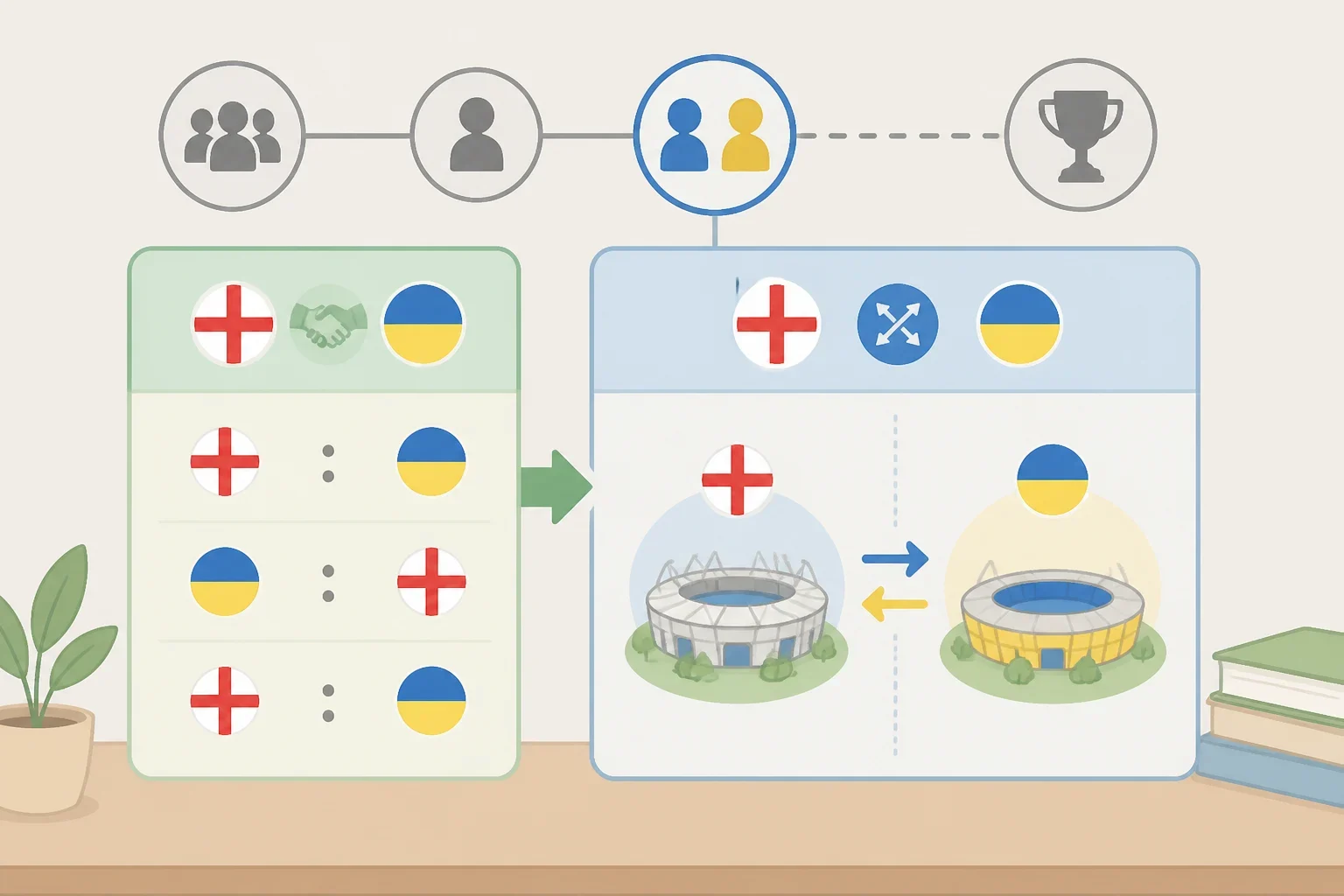
The next pairing makes the schedule feel even more repetitive. England will face Ukraine in round two, a team it already beat twice in the league phase by an aggregate score of 9-1. England could therefore need to beat Ukraine for a third time to move on, with a fourth meeting possible because the tie is played over two legs. BBC Sport reported the pairing yesterday.
That is not automatically unfair. Ukraine earned its place in the bracket, and knockout football can produce repeat opponents for legitimate sporting reasons. But it does raise a question about what the system is trying to measure. If the aim is to identify Europe’s best World Cup representatives, repeating a mismatch may tell readers more about the bracket than about the teams’ relative level.
England manager Sarina Wiegman has not treated the issue as something she can settle herself. After England’s first-round win, she said the team wanted to qualify directly but was now focused on Ukraine. She also said UEFA would review whether the system works or should be changed. BBC Sport reported those comments yesterday.
Her earlier frustration was understandable. Five wins and 15 points in a group with the world champions did not earn England direct qualification. At the same time, the format had already made the rule clear before the campaign began: winning the group was the decisive target.
What should UEFA change?

The strongest case is for a targeted review, not for abandoning play-offs.
One option would be to adjust Path 1 so that League A runners-up face stronger opponents from League B before the bracket reaches League C. That could reduce the chance of elite teams meeting the lowest-ranked play-off entrants, although it would also make qualification harder for developing nations. A system built only around closer scorelines could remove meaningful opportunities for lower-ranked teams to face leading opponents.
Another option would be to give more weight to league-phase performance when assigning seeds or round-two advantages. England’s group record shows the appeal of that approach. A runner-up that finishes with a strong points total against elite opposition could receive a more favorable route without receiving automatic qualification. The trade-off would be added complexity and the need to compare teams that played different groups.
UEFA could also examine whether direct qualification should extend beyond the four group winners. That would reduce the number of strong League A teams entering round one, but it would leave fewer places to be decided through the play-offs. The competition would become simpler, yet the league phase would carry more weight and the knockout bracket would contain fewer obvious mismatches.
There is no perfect solution because the format is balancing several goals at once: rewarding group winners, preserving access for teams from lower leagues, producing enough matches, and filling 11 European World Cup places plus one inter-confederation place. Removing one imbalance can create another.
The broader development picture also deserves separate consideration. A FIFPRO report published three years ago found that 29% of surveyed players received no compensation for World Cup qualifying, while 66% had to take unpaid leave or vacation from another job. Those findings covered qualifying worldwide, not this UEFA competition, so they do not establish that investment gaps caused the 2026 European scorelines. They do show why a scoreline problem cannot be treated as a bracket problem alone.
European women’s football has also become more competitive at tournament level. The 2023 World Cup expanded from 24 to 32 teams, yet England needed a 1-0 win over debutants Haiti in the group stage and faced a difficult quarter-final against Colombia. BBC Sport used those matches as evidence that qualification results and tournament competitiveness can look very different.
FIFA has announced that the 2031 Women’s World Cup will expand from 32 to 48 teams. That may change the number and distribution of qualifying places, which makes a permanent redesign of the European route harder to assess now. A larger finals tournament could ease access for some teams, but it could also alter the strength of the field and the value of each qualifying place. BBC Sport noted yesterday that it is too early to know how that expansion will affect competitive balance.
The narrow case for reform
The first round does not show that European women’s football has stopped developing. It shows that the current allocation can put teams from very different competitive levels into the same path, especially when League A runners-up and third-place teams are matched with League C opposition.
That is enough to justify a review of Path 1 seeding and the way strong league-phase performances are rewarded. It is not enough to conclude that play-offs should disappear. Poland’s penalty win over Belgium and Slovenia’s comeback against Türkiye demonstrate that the bracket can produce genuine contests, while the heavier results identify a specific area for adjustment.
The next evidence will arrive in round two, scheduled between 26 November and 5 December. England’s tie against Ukraine is particularly useful to follow because it places a strong League A runner-up against a team it already defeated twice in the league phase. UEFA listed the window this week, while BBC Sport reported yesterday that England’s first leg is away on 1 December and the return is at Wembley on 5 December.
The fairest judgment for now is a restrained one: the 2027 European Women’s World Cup qualification format is not uniformly uncompetitive, but its first path has produced enough predictable-looking mismatches to warrant a structural rethink. The question is not whether every tie should be close. It is whether the bracket can better reward high-level league-phase performance without closing the door on the rest of Europe.