
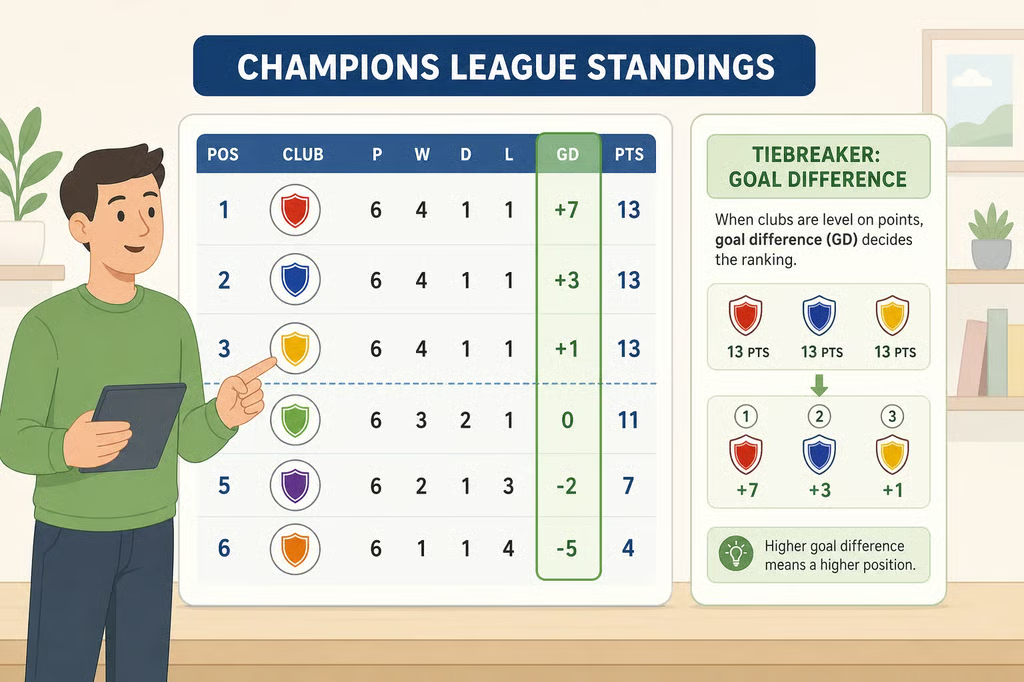
When Champions League clubs are level on points, UEFA starts with goal difference to determine which team ranks higher. Since the competition adopted its 36-team league phase in 2024/25, every club has played eight different opponents while appearing in the same overall standings.
The 2026/27 Champions League regulations set out the full tiebreak order. During Matchdays 1–7, UEFA uses five criteria to separate teams with the same number of points. Once all eight league-phase matches are complete, five additional criteria are available if the first five still cannot break the tie.
How UEFA breaks ties before Matchday 8
During Matchdays 1–7, clubs level on points are separated in this order:
- Goal difference in the league phase
- Goals scored in the league phase
- Away goals scored in the league phase
- Wins in the league phase
- Away wins in the league phase
Goal difference is calculated by subtracting goals conceded from goals scored. A club that has scored 14 goals and conceded eight, for example, has a goal difference of +6.
If clubs remain level on all five criteria before the league phase is finished, they receive equal ranking and are displayed alphabetically by abbreviated club name. UEFA’s current standings explainer makes clear that alphabetical order is only a way to display teams that cannot yet be separated by the sporting criteria.
The reference to away goals can be confusing. UEFA abolished the old away-goals rule for two-legged knockout ties beginning with the 2021/22 season. Away goals no longer determine the winner of a knockout tie that finishes level on aggregate, but away goals scored across the league phase still count as the third standings tiebreaker. UEFA explains the distinction in its away-goals rule guidance.
Why head-to-head no longer applies
Under the old Champions League format, 32 clubs were divided into eight groups of four, with every team playing the other three clubs in its group home and away. The current league phase gives clubs a different set of opponents.
The 36 teams are divided into four seeding pots, and each club faces two teams from each pot — one at home and one away — under UEFA’s league-phase draw rules.
Head-to-head results are not among UEFA’s league-phase tiebreakers. When clubs finish with the same number of points, their overall goal difference across the league phase is considered first instead.
Example: How goal difference breaks a tie
Suppose Club A and Club B both have 12 points after six league-phase matches.
Club A has scored 11 goals and conceded six, giving it a +5 goal difference. Club B has scored nine and conceded seven, leaving it at +2. Club A therefore ranks higher despite the clubs having identical point totals.
Now suppose both clubs have a +5 goal difference. Goals scored becomes the next tiebreaker. If Club A has scored 14 and Club B 11, Club A remains higher. If they are also level on goals scored, UEFA moves to away goals, followed by wins and away wins.
A goal can therefore influence more than the result of one match. When several clubs finish close together on points, scoring or conceding one more goal can change their final position in the table.
How league-phase rank affects qualification
Final position in the 36-team standings determines how — or whether — a club reaches the knockout phase:
- 1st–8th: Advance directly to the round of 16
- 9th–24th: Enter the two-legged knockout phase play-offs
- 25th–36th: Are eliminated from European competition
Position also matters within those qualifying bands. Clubs finishing ninth through 16th are seeded in the knockout phase play-offs against clubs ranked 17th through 24th. In principle, the seeded club hosts the second leg.
The top eight are seeded when they enter the round of 16 and, again in principle, play the return leg at home. League-phase position can continue to matter even deeper into the tournament.
Under UEFA’s 2026/27 knockout draw rules, the teams ranked first through fourth are seeded to play the second leg at home in the quarter-finals, while the teams ranked first and second retain that advantage in the semi-finals.
If one of those seeded teams is eliminated, the club that beats it takes over that seeding position along the same bracket path. UEFA does not recalculate those positions after each round.
Goal difference affects these later advantages only indirectly. Its importance comes from helping determine the final league-phase rank from which qualification and seeding are set.
The extra tiebreakers after Matchday 8
Once all eight league-phase matches have been played, UEFA can use five more criteria if teams remain tied after goal difference, goals scored, away goals, wins and away wins.
The remaining tiebreakers are:
- Collective points earned by the club’s league-phase opponents
- Collective goal difference of those opponents
- Goals scored collectively by those opponents
- Lower disciplinary-points total
- Higher UEFA club coefficient
The first three of these look at how each tied club’s eight opponents performed across the league phase.
If those criteria still fail to separate the teams, disciplinary records come next. A yellow card counts as one disciplinary point, while a red card or an expulsion for two yellow cards in the same match counts as three. Cards shown to players and team officials are included.
Only after all of those criteria remain level does UEFA turn to the clubs’ UEFA coefficients.
Goal difference is the first number to check
For teams level on Champions League points, goal difference provides the quickest answer in most cases. If that number is the same, goals scored comes next, followed by away goals, wins and away wins.
After the league phase is complete, UEFA can go further into opponent results, discipline and club coefficient to establish a final ranking. With those standings deciding direct qualification, play-off seeding and home-leg advantages later in the competition, even a narrow goal-difference margin can have consequences beyond one place in the table.