
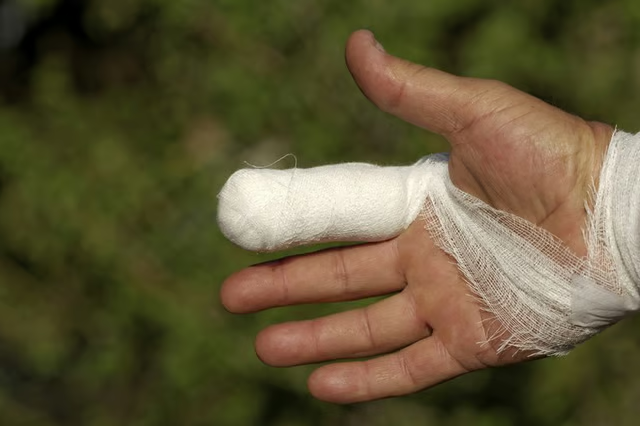
Finger injuries are common among baseball players of all ages because of how much you rely on your fingers in the sport. An injured finger can mean anything from a nasty blister to a torn ligament, a dislocation, a sprain, or a completely broken bone, and each of these ailments requires a healing process that will allow the player to return to play with no limitations as soon as possible.
In regards to a broken finger specifically, recovery time can vary- it’s partly based on the severity of the fracture.
Severe finger fractures can take longer to heal and rehabilitate than minor injuries, but recovery time is also affected by your body’s response to treatment. The rate of healing in one person isn’t always the same in another, so your doctor can best tell you when you can expect to return to playing baseball — or any other activity, for that matter.
NagyDodo/iStock/Getty Images
Timing and Immobilization
Orthopedics tell most people they need to wear a splint on their broken finger to immobilize the finger bone for roughly three weeks, according to the American Academy of Orthopaedic Surgeons; if the break is severe, however, you may need to wear the splint or brace for longer, sometimes upward of six weeks. Even baseball players should follow these standard guidelines for recovery.
NagyDodo/iStock/Getty Images
Surgery
If the fracture is too severe to merely splint, or the fracture radiates into the joint, your healthcare provider may suggest surgery to correct the injury. In this situation, your orthopedic surgeon will realign the bone and then keep the alignment in place with pins or screws.
Recovery for this procedure may take longer than the three to six weeks already mentioned.
Care
During the course of your recovery, your doctor will likely ask you to return to the office periodically for checkups. At these times, x-rays are taken to determine the progress of healing. Your doctor can then tell you whether the splint or brace should be worn for three or closer to six weeks. The same applies for surgical recovery.
NagyDodo/iStock/Getty Images
Rehabilitation
After the splint or brace is removed, your doctor may then suggest rehabilitation, also known as physical therapy. This often entails hand exercises.
One of the more common is a ball squeeze, where you place a ball in the palm of your hand and then tighten your grip, holding for about five seconds. Release and repeat for a total of 10 repetitions, three times a day.
This activity is often combined with finger extensions, where you extend your finger wide and then place the hand against a solid surface. As before, hold for five seconds and release. Repeat for a total of 10 repetitions, three times a day.
Recommendation
If you injure your finger playing baseball, immediately apply an ice pack and take some ibuprofen to help reduce inflammation, and seek medical attention if you feel it is necessary.
Instead of focusing your attention on the timeline of recovery, rely on the markers of your recovery, recommends the Sports Science Orthopaedic Clinic. Don’t be tied to three to six weeks. Playing baseball too soon after the fracture can exacerbate your injury and sideline you for longer than if you waited for your symptoms to improve and the full range of motion to return to the affected digit.