
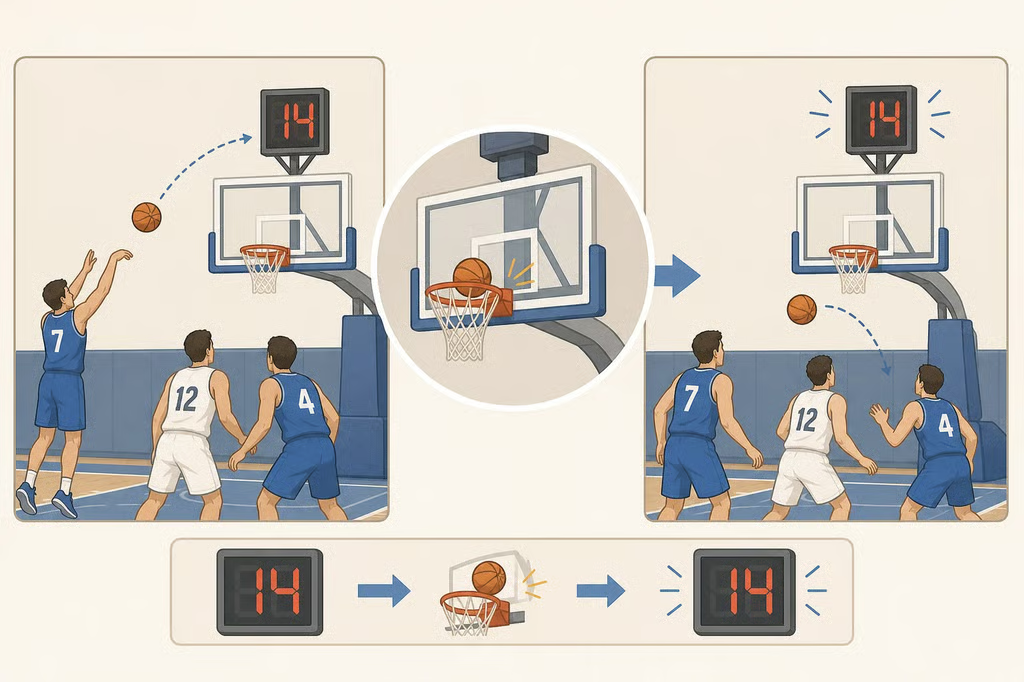
A player misses a jumper, a teammate grabs the rebound, and the shot clock suddenly shows 14 seconds instead of 24. That's no mistake. Under NBA rules, a team that recovers its own missed shot after the ball touches the rim gets 14 seconds to attempt another shot, rather than a fresh 24-second possession.
The NBA shot clock normally gives a team 24 seconds to attempt a field goal after gaining possession. The ball must leave a player's hand before time expires and subsequently touch the rim or go in to avoid a violation. However, the league's official Rule 7 establishes shorter resets for certain plays, including offensive rebounds.
The distinction matters because an offensive rebound gives a team another chance to score without awarding it another full 24 seconds. Defensive rebounds, air balls, fouls and late-game situations can produce different results.
When the NBA shot clock resets to 14 seconds
The NBA adopted the shorter reset beginning with the 2018 preseason, ahead of the 2018–19 regular season. Previously, teams received another 24 seconds after an offensive rebound. The change shortened that window, encouraging quicker second-chance possessions and limiting how much time a team could consume after a missed shot.
According to the NBA's September 21, 2018, rule-change announcement, the 14-second reset had already been used in FIBA competition, the WNBA and the NBA G League before its adoption by the NBA.
The rule applies in three main situations:
- Offensive rebounds: The offense is first to recover a missed field goal that touched the rim or a missed free throw that remained in play.
- Defensive loose-ball fouls: The defense commits a loose-ball foul immediately after such a miss, and the offense inbounds the ball in the frontcourt.
- Out-of-bounds plays: The offense retains possession after the ball goes out of bounds immediately following a qualifying miss.
These situations give the offense another opportunity to score, but only 14 seconds to organize its next attempt. The shorter reset also affects clock management, particularly when a team is protecting a narrow lead.
A defensive rebound means 24 seconds
When the defense secures a rebound, possession changes teams and the shot clock normally resets to 24 seconds. It doesn't matter whether the previous team had six seconds or 20 seconds remaining.
For example, imagine the Lakers miss a jumper with five seconds left on their shot clock. If the Celtics grab the defensive rebound, Boston receives a fresh 24 seconds to begin its possession.
But if a Lakers player collects the missed shot after it touches the rim, Los Angeles receives only 14 seconds to attempt another shot.
The difference becomes especially important during close games. A team holding a small lead cannot use another full 24 seconds every time it grabs an offensive rebound. It must decide what to do with the ball sooner.
Why rim contact matters
An offensive rebound doesn't automatically trigger a 14-second reset. For a missed field goal, the ball generally must contact the rim before the offense regains possession.
Suppose a player shoots with 19 seconds remaining, the ball hits the rim, and a teammate grabs the rebound. The shot clock resets to 14 seconds, even though 19 seconds remained before the attempt.
Now consider the same play with only three seconds left. If the shot touches the rim and the offense recovers it, the clock again resets to 14 seconds.
The reset therefore isn't an additional 14 seconds added to the previous reading. It establishes a new 14-second window following the qualifying play.
Missed free throws work similarly when the ball remains live. If the shooting team recovers a missed free throw that stays in play, the clock resets to 14 seconds. This typically concerns a missed final free throw that players are allowed to rebound.
The NBA's rule also covers certain live balls that contact the offensive team's basket ring, even when the play is not an ordinary missed field-goal attempt. The key is whether the play meets the rule's rim-contact and possession conditions.
Why air balls don't reset the shot clock
An air ball is a shot that misses the basket and rim entirely. If the offense recovers it, the shot clock does not reset simply because the team regained control.
The same principle applies when a defender blocks a shot before it reaches the rim.
For example, a player attempts a jumper with 10 seconds remaining. A defender blocks the shot, and the offensive team recovers the ball. Because the attempt never touched the rim and the defense never gained possession, the offense must work with the time remaining rather than receive a fresh 14 seconds.
A defender merely touching or deflecting the ball also does not necessarily create a new possession. The opposing team must actually gain possession for the normal 24-second reset to apply.
This explains why a blocked shot can leave the clock running while a missed jumper that hits the rim produces a reset.
NBA shot clock reset rules at a glance
The following situations summarize how the NBA handles common rebounds, fouls and interruptions.
| What happens | Shot clock result |
|---|---|
| Defense gains possession | Resets to 24 seconds |
| Offense recovers a missed field goal that touched the rim | Resets to 14 seconds |
| Offense recovers a missed free throw that remains live | Resets to 14 seconds |
| Qualifying defensive loose-ball foul after a miss, with a frontcourt inbound | Resets to 14 seconds |
| Offense retains possession after the ball goes out of bounds immediately following a qualifying miss | Resets to 14 seconds |
| Offense recovers an air ball or a shot blocked before reaching the rim | No reset |
| Qualifying defensive frontcourt foul or violation | Remaining time or 14 seconds, whichever is greater |
| Defensive personal foul resulting in a backcourt inbound | Resets to 24 seconds |
Not every defensive foul automatically resets the clock to 14 seconds. Certain frontcourt fouls and violations follow a different procedure.
If the defense commits a qualifying frontcourt foul with 18 seconds remaining, the offense generally keeps those 18 seconds. If only eight seconds remain, the clock resets to 14.
This prevents a routine defensive foul from reducing the offense's available time when more than 14 seconds remain.
Backcourt situations work differently. When a defensive personal foul results in the ball being inbounded in the backcourt, the offense receives a fresh 24 seconds under the applicable rule.
What happens in the final 24 seconds?
The shot clock operates differently near the end of a quarter or overtime period.
When 24 seconds or fewer remain in a period, the shot clock does not operate following a change of possession. Instead, the game clock becomes the controlling time limit.
For example, if a team secures a defensive rebound with 15 seconds remaining in the fourth quarter, it can use the remaining game time without a separate shot clock.
However, the shot clock can be reactivated at 14 seconds if the offense subsequently regains possession following a qualifying missed shot, live missed free throw or related play covered by the offensive-rebound reset rule. The game clock still determines when the period ends, even if time remains on the shot clock.
For players and coaches, the shorter reset rewards quick decisions after offensive rebounds. A rebounder may have an immediate scoring opportunity, but passing the ball back outside to reorganize the offense leaves less time than a standard possession.
The central distinction is straightforward: A defensive rebound normally gives the new offensive team 24 seconds, while recovering a qualifying missed shot gives the original offense 14. Once that difference is clear, the clock changes during rebounds, blocked shots and late-game possessions become much easier to follow.