
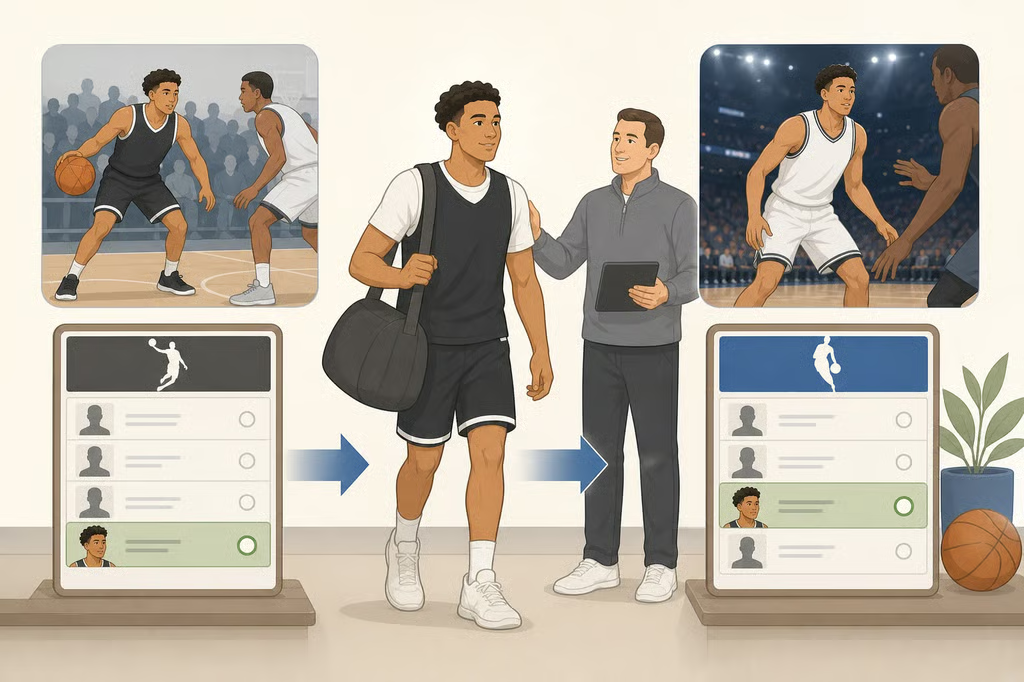
An NBA two-way contract gives developing basketball players a chance to compete in both the NBA and the G League without occupying one of a team's 15 standard roster spots. For the 2026-27 season, a full-season two-way deal pays approximately $678,882, but players can spend no more than 50 regular-season games on their NBA team's Active List.
For rookies, undrafted prospects and other eligible players trying to establish themselves, a two-way contract can be an important opportunity. Teams gain roster flexibility, while players get NBA exposure and regular competition in the G League. But the arrangement comes with restrictions on salary, eligibility, game availability and postseason participation that separate it from a standard NBA contract.
How NBA two-way contracts work
NBA teams can carry up to 15 players on standard contracts and three additional players on two-way deals, creating a maximum of 18 roster spots. Two-way players can move between their NBA club and its G League affiliate throughout the regular season.
The arrangement began under the NBA's 2017 collective bargaining agreement (CBA), initially with two two-way roster spots per team. The 2023 agreement expanded that allowance to three, as explained in the NBA G League's official two-way contract guide.
Two-way contracts can last one or two seasons and cannot include an option year. They are generally available to players with three or fewer years of NBA service, although a narrow exception permits certain players with four years of service to sign a one-year deal.
That exception applies when a player previously spent an entire NBA season on a roster without appearing in a regular-season, play-in or playoff game.
Another restriction prevents teams from keeping the same player on two-way contracts for more than three salary-cap years. A player who reaches that limit with one franchise may still qualify for a two-way deal elsewhere, provided he meets the league's service-time requirements.
How much do NBA two-way players make in 2026-27?
A full-season NBA two-way contract pays approximately $678,882 in 2026-27, up from $636,435 in 2025-26.
The salary is calculated at half the NBA minimum for a player with no previous years of service. That minimum stands at $1,357,763 for 2026-27, according to SalarySwish's minimum-salary calculator.
Players receive one salary covering their time in both leagues, rather than separate NBA and G League paychecks. Their compensation does not increase simply because they spend more time with the NBA club.
The full-season figure is also different from the amount a player is guaranteed to receive. Two-way contracts have salary-protection provisions, and a player who is waived before the applicable guarantee date may receive less than the full-season amount.
Players who sign after the regular season begins receive prorated compensation based on the remaining days. Their NBA game allowance is reduced as well.
The financial difference between two-way and standard contracts can be substantial. A player who signs a standard NBA minimum deal becomes eligible for a higher salary based on his years of NBA service, along with the roster privileges attached to a standard contract.
How the NBA's 50-game limit works
A two-way player who signs before the season begins can be on his NBA team's Active List for up to 50 regular-season games. The limit counts games in which the player is available to participate, not just games in which he actually gets on the court.
For example, suppose a two-way player is active for 35 NBA games but enters only 20. He has used 35 of his 50 permitted Active List games, leaving 15 available.
The NBA's CBA 101 guide establishes this restriction and explains how the allowance is prorated for contracts signed during the season.
A player who joins a team midway through the schedule does not automatically receive the full 50-game allowance. Instead, the limit is adjusted according to the days remaining in the regular season.
Reaching the ceiling does not end the player's basketball season. He can continue competing for his G League affiliate because those games do not count toward the NBA limit.
However, the team cannot place him on its NBA Active List for additional games while he remains on the same two-way contract. To continue using him in that capacity, it must sign or convert him to a standard NBA deal.
Why teams with fewer than 15 players face another limit
The individual 50-game restriction is only part of the equation. NBA teams carrying fewer than 15 standard-contract players face a separate limit involving their two-way players.
Under the league's Under-Fifteen Game rule, teams can accumulate no more than 90 combined two-way Active List appearances in games played with fewer than 15 standard-contract players.
Each active two-way player counts separately toward that allowance. If a team has one two-way player active, it uses one unit. Two active players use two units, while three use three.
Consider a team carrying 14 standard-contract players that activates all three of its two-way players for 30 games. Those appearances would exhaust the team's 90-game allowance, even though each player had individually used only 30 of his permitted 50 games.
The team would need to restore its standard roster to 15 players before continuing to use those two-way players on its Active List.
This creates a trade-off for franchises that leave a standard roster spot vacant to manage payroll. Carrying fewer players can reduce salary expenses, but it can also limit how often a team can use its developmental players.
Can two-way players compete in the NBA playoffs?
Two-way players cannot participate in NBA postseason games while remaining on two-way contracts. They may travel and practice with their teams, but they are not eligible for the postseason roster.
To become eligible, a player must sign or be converted to a standard NBA contract before the start of his team's final regular-season game.
That deadline can influence late-season roster decisions. A two-way player who contributes meaningful minutes during the regular season might still be unavailable for the playoffs unless his team promotes him in time.
How two-way players earn standard NBA contracts
NBA teams hold the exclusive right to negotiate standard contracts with their own two-way players. They can also convert an existing two-way agreement into a standard contract of the same length at the player's applicable NBA minimum salary.
Either move ends the original two-way contract and places the player on the standard roster, subject to the team's available roster space and applicable league rules.
John Tonje offers a recent example of how players move between the two leagues. On July 25, 2026, the Portland Trail Blazers announced his signing after he spent the previous season appearing in six NBA games for Boston and 29 G League games split between Salt Lake City and Maine.
Tonje averaged 18.1 points per game in the G League during 2025-26, compared with 2.5 points in limited NBA appearances. His experience shows how a player can receive substantial developmental minutes while continuing to pursue a larger NBA role.
Two-way contracts do not guarantee a promotion. Teams must weigh a player's performance, development, roster needs and available salary-cap flexibility before offering a standard deal.
For players trying to establish themselves professionally, the arrangement provides NBA exposure and a chance to prove themselves through regular competition in the G League. But securing a permanent roster spot ultimately depends on turning that opportunity into consistent performance at the NBA level.