
- Causes of Hip Pain Besides Arthritis: 3 Conditions to Know
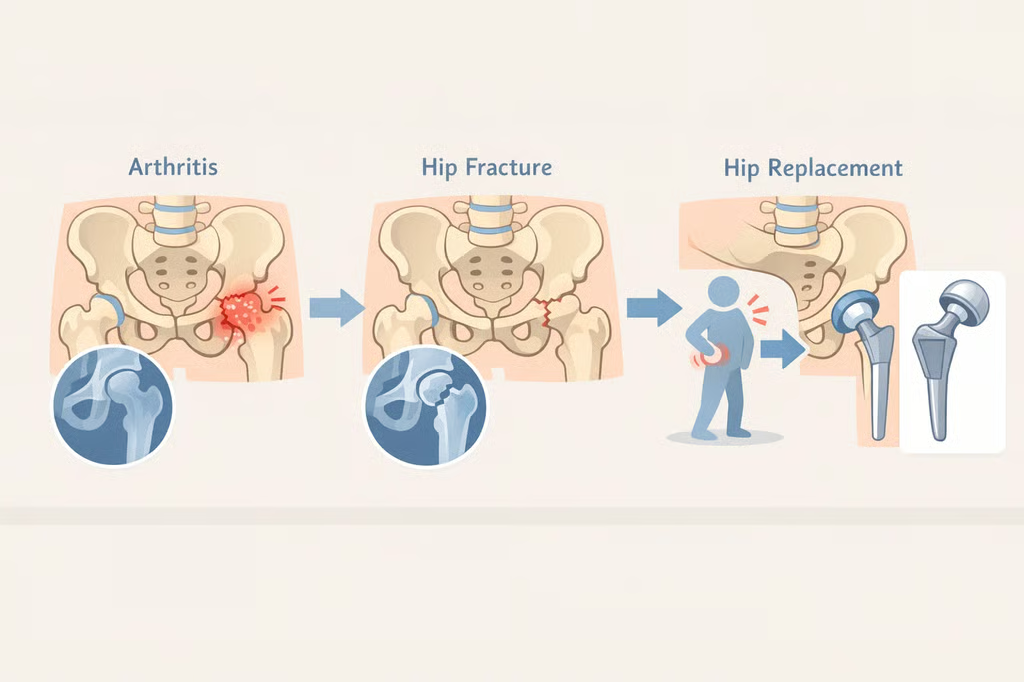
- Three hip conditions that may require joint replacement
- Femoroacetabular impingement: a structural cause of hip pain in young adults
- Osteonecrosis (avascular necrosis of the hip): a diagnosis separate from arthritis
- Trauma-related hip damage: injuries NIAMS recognizes as a path to replacement
- Information to share during an evaluation
- Next step for hip pain that doesn't fit the arthritis story
Causes of Hip Pain Besides Arthritis: 3 Conditions to Know
Not every hip that eventually gets replaced got there through years of slow cartilage wear. Among the causes of hip pain besides arthritis, three non-arthritis causes of hip pain have enough documented evidence to walk through here: femoroacetabular impingement, a structural mismatch between the femur and hip socket; osteonecrosis, a bone condition treated as its own diagnosis; and injuries tied to past trauma. The evidence is more detailed for femoroacetabular impingement than for the other two, and this article sticks to what's actually documented rather than filling gaps with guesswork. NIAMS also names rheumatoid arthritis and congenital hip disorders as recognized paths to hip replacement, but those work through different mechanisms and belong in their own explanation (NIAMS; StatPearls).
One of these three pathways needs a note up front. Femoroacetabular impingement isn't a separate track that skips arthritis entirely. It's a documented risk factor for developing hip osteoarthritis later on, which makes the line between "not arthritis" and "arthritis" more of a timeline than a hard boundary (StatPearls).
Three hip conditions that may require joint replacement
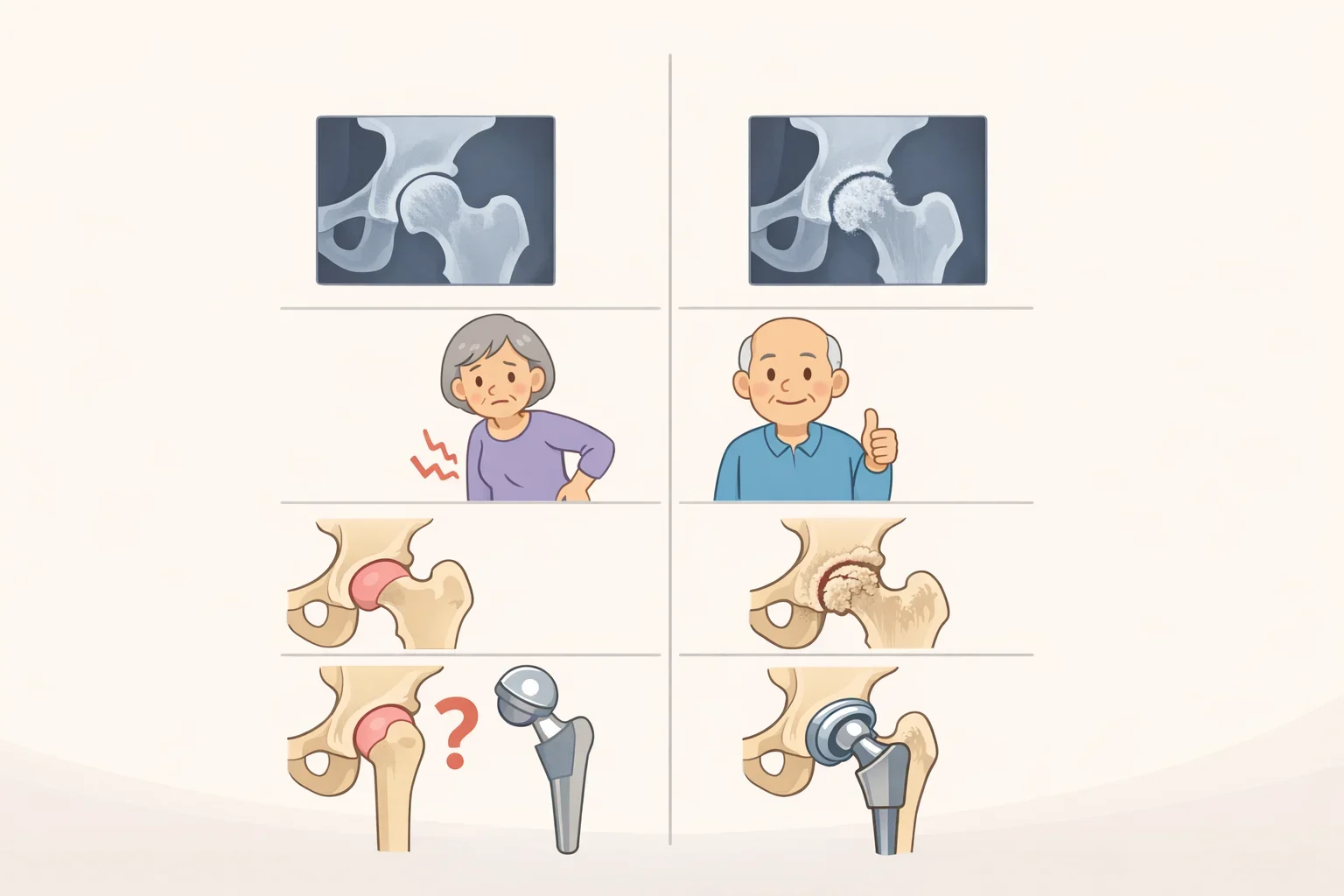
An imaging finding, a symptom, joint damage, and a hip replacement are four different things, and mixing them up is where a lot of hip pain confusion starts. A cam or pincer bone shape can show up on an X-ray in someone with no pain at all. A diagnosis of FAI or osteonecrosis doesn't automatically mean the joint is already damaged, and joint damage doesn't automatically mean surgery is next.
NIAMS describes the actual trigger for replacement plainly: when joint pain keeps limiting daily activity despite other therapies, a doctor may recommend surgery (NIAMS). That's the decision principle NIAMS lays out for hip replacement, whatever the underlying pathway. A structural finding is not the same as a symptom, and a symptom is not the same as confirmed damage severe enough to need a new joint.
Femoroacetabular impingement: a structural cause of hip pain in young adults
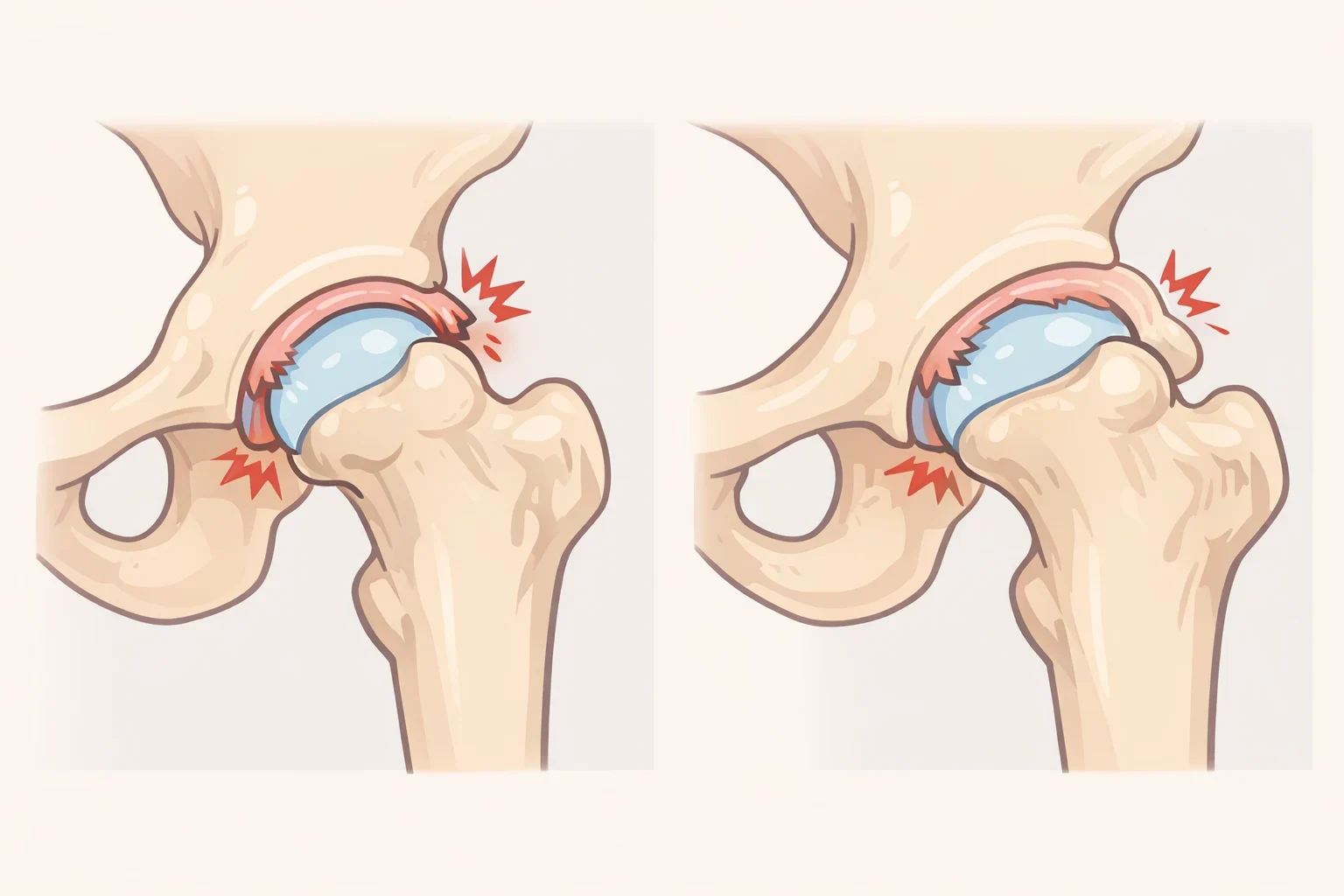
Femoroacetabular impingement, or FAI, is an increasingly recognized source of hip pain in young adults and a known risk factor for later hip osteoarthritis (StatPearls). It starts with an abnormal shape to the femur, the hip socket (acetabulum), or both, causing the bones to rub against each other during certain hip movements.
Two bone shapes describe the abnormality. A cam lesion is a bony bump where the femur's head meets its neck. A pincer lesion is extra bone overhanging the socket rim. A person can have either shape alone or both together, and the mixed pattern is the most common one seen in people who have symptoms. Both shapes show up on a standard X-ray (StatPearls).
Over time, that repeated rubbing wears cartilage and tears the labrum, the ring of cartilage lining the socket. That injury is the documented mechanism connecting FAI to secondary hip osteoarthritis, not a separate condition that bypasses arthritis (StatPearls). Clinically, FAI often shows up in adolescents and young adults before arthritis appears on imaging, part of why hip pain in someone in their 20s or 30s sometimes gets waved off as unlikely.
The prevalence numbers deserve a careful read, because two different measurements get confused easily. FAI's estimated prevalence in the general adult population runs 10% to 15%, and that figure should not be treated as the same thing as the prevalence of cam or pincer bone shapes visible on imaging. A separate meta-analysis found cam-shaped bone in 37% of people with no symptoms at all, and pincer-shaped bone in 67% (StatPearls). Cam morphology was also more common in athletes than non-athletes in one reported comparison, 54.8% versus 23.1%, and pincer lesions were present in 49.5% of the athletic population studied. Many people carry these bone shapes without ever developing pain.
Treatment and what the evidence does and doesn't show about replacement
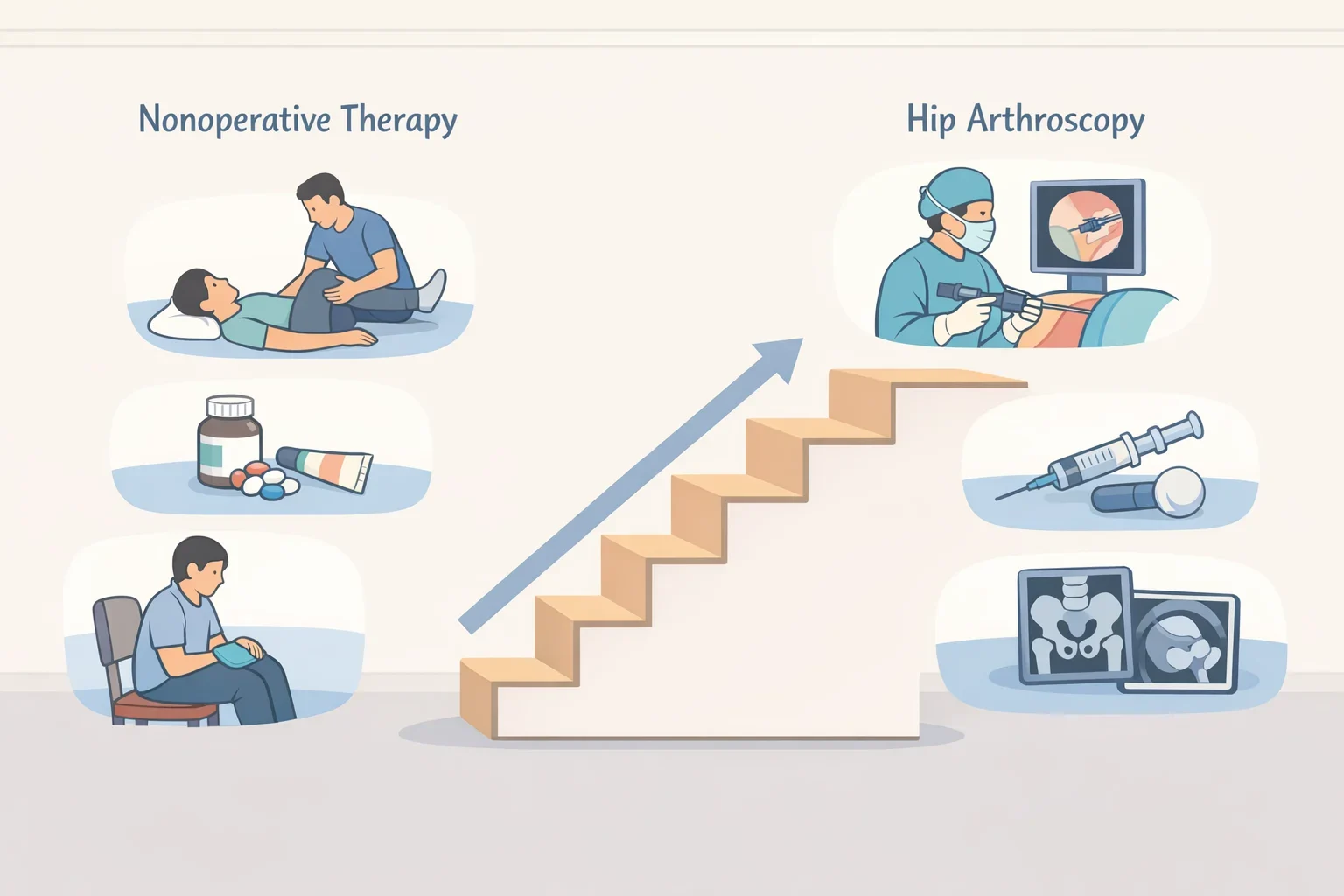
Nonoperative care comes first. Surgery, whether open or arthroscopic, gets considered only after conservative treatment hasn't worked and pain is affecting daily life. StatPearls describes arthroscopy as increasingly common and notes that it may involve fewer complications than open surgery, though that comparison isn't presented as settled (StatPearls).
Does surgery actually change the long-term outlook? A 2025 systematic review included six studies comparing hip arthroscopy against nonoperative treatment and reported some evidence that arthroscopy may be associated with lower rates of arthritis progression and later conversion to hip replacement, with the review's overall evidentiary rating listed as Level III even though the individual studies ranged from Level I to Level III (systematic review). A separate meta-analysis of two comparative studies found arthroscopy was associated with a 32% lower risk of radiographic osteoarthritis progression, a statistically significant result, but only a 23% lower risk of converting to hip replacement, which did not reach statistical significance (meta-analysis). Surgery showing less damage on imaging isn't the same as surgery reliably keeping someone off the replacement table.
One caveat matters for timing decisions. StatPearls advises against FAI surgery once arthritis is already visible on imaging, because those procedures don't address arthritis pain (StatPearls). That's why persistent hip pain warrants clinical evaluation rather than self-diagnosis from an imaging finding alone.
Hip pain that changes with activity, along with decreased hip function, is part of how FAI presents clinically, particularly in people with a history of high-impact or repetitive-motion sports (StatPearls). The research doesn't establish a single symptom fingerprint for FAI, so this pattern helps a doctor decide which exam findings and imaging to pursue rather than pointing to a diagnosis on its own.
Osteonecrosis (avascular necrosis of the hip): a diagnosis separate from arthritis
Osteonecrosis, also called avascular necrosis of the hip, is listed as its own underlying diagnosis behind total hip replacement, distinct from osteoarthritis (StatPearls). On average, it presents in a younger patient population than osteoarthritis, ages 35 to 50, and accounts for roughly 10% of hip replacements performed each year (StatPearls). NIAMS separately names osteonecrosis among the recognized reasons a hip replacement may eventually be needed (NIAMS).
That age profile and that share of annual replacements are what the available sources establish here. They don't detail how osteonecrosis develops, how it progresses, or what nonsurgical management involves, and they don't establish when a specific case warrants surgery. That's a determination for an orthopedic evaluation, not something this article can generalize from age or symptoms alone. The age range is still worth knowing, since hip pain in a 35- to 50-year-old shouldn't get dismissed as unlikely simply because that person seems younger than the typical arthritis patient.
Trauma-related hip damage: injuries NIAMS recognizes as a path to replacement
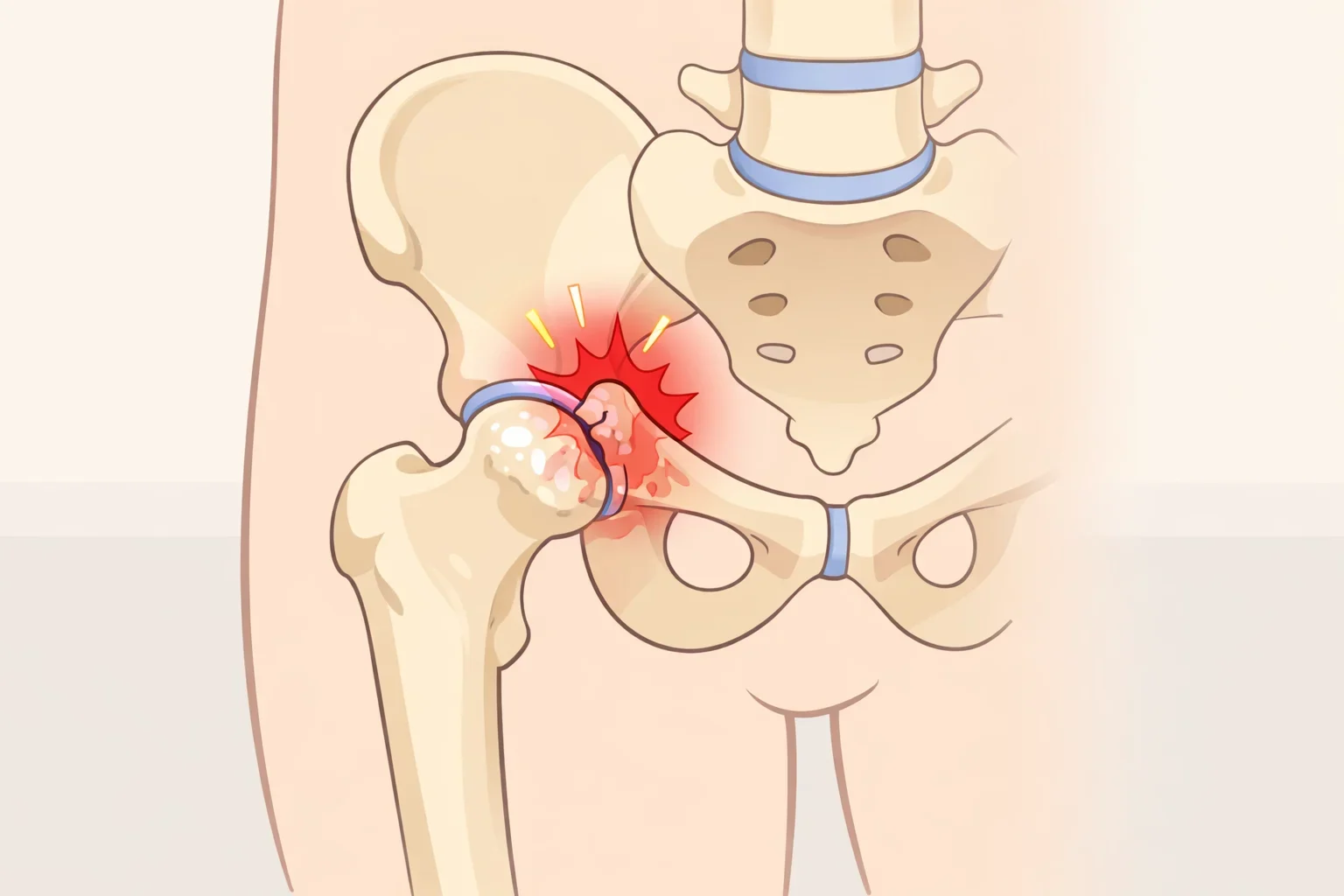
NIAMS lists injuries or fractures caused by trauma or disease as a distinct, recognized reason a hip replacement may eventually be needed, separate from osteoarthritis (NIAMS).
That single line is what the available research supports for this pathway. It doesn't quantify how often trauma leads to eventual replacement, over what time span, or through what specific joint mechanism, so this section stays close to that documented point rather than sketching a timeline the research doesn't cover.
Practically, a prior hip fracture is relevant information to provide when discussing hip symptoms, because NIAMS specifically identifies trauma-related injuries and fractures as possible reasons for replacement. The available sources don't say how soon symptoms typically appear after an injury or how urgent a new injury is, so those questions are for a doctor to sort out directly.
Information to share during an evaluation
None of the three pathways above are self-diagnosable from a symptom list. This isn't a diagnostic checklist; it's a starting point for the conversation with a clinician.
History that may help a clinician narrow things down:
- When the pain started, and whether it followed an injury or came on gradually
- Which activities or movements bring it on or make it worse
- Whether overall hip function has changed
- Any past hip fracture or other significant hip injury
- Any previous hip imaging or treatment already tried
What the research reviewed here specifically establishes: FAI can cause hip pain and decreased function in young adults and is a documented risk factor for later osteoarthritis; osteonecrosis is a recognized underlying diagnosis behind hip replacement, distinct from osteoarthritis; and trauma or fractures are a recognized indication for eventual replacement (StatPearls; StatPearls; NIAMS). A clinician, working from that history plus an exam, determines whether further evaluation or imaging is appropriate.
Next step for hip pain that doesn't fit the arthritis story
Hip damage that eventually leads to joint replacement can start with structural impingement, osteonecrosis, or a trauma-related injury or fracture, alongside routine osteoarthritis. Whichever pathway is involved, the decision to move forward with replacement comes down to function rather than diagnosis alone: NIAMS notes that when joint pain keeps limiting daily activity despite other therapies, a doctor may recommend surgery (NIAMS).
These three pathways aren't the only non-arthritis causes of hip damage, either. Rheumatoid arthritis and congenital hip disorders are also documented underlying diagnoses behind hip replacement and call for their own evaluation (StatPearls).
For hip pain that's persistent, worsening, or limiting daily movement, the next step is a clinical evaluation, not a guess based on age, symptoms, or a single imaging finding. Bring the activities that reproduce the pain, when it started, and any past hip injury to that appointment, and let the exam decide what happens from there.