
August 2026 Night Sky Events: Eclipse, Perseids, Planets
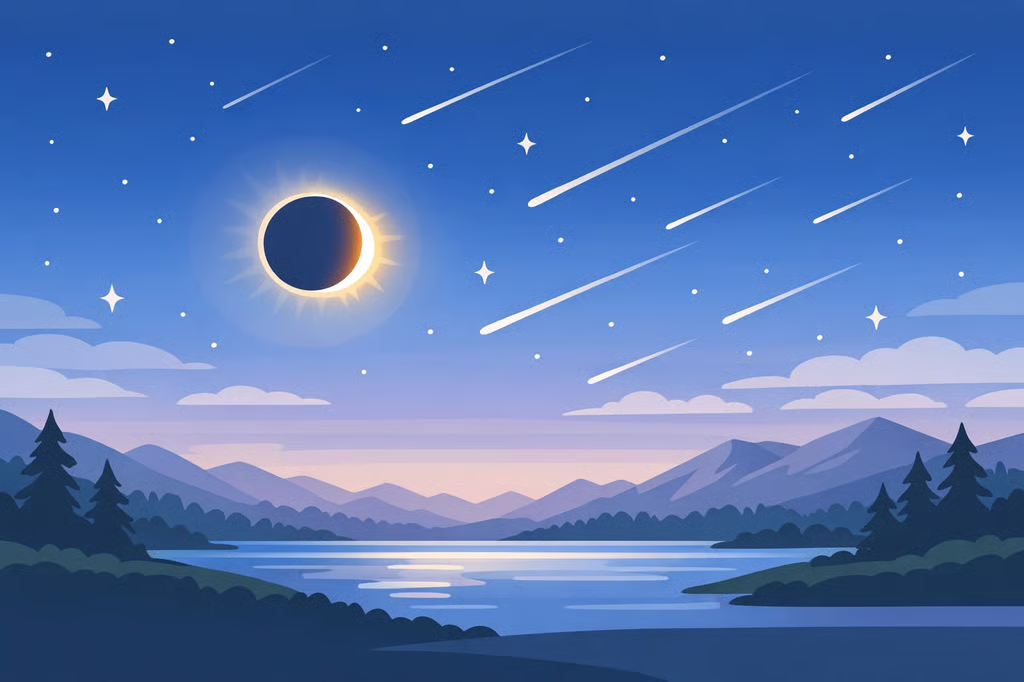
August 2026 packs in two rare skywatching moments within hours of each other, plus four planet sightings worth marking on a calendar. On Aug. 12, 2026, the Moon's precise alignment with the Sun and Earth produces a total solar eclipse, and because that same new Moon reflects almost no sunlight, the sky stays dark enough later that night to make one of the year's better meteor showers easier to see (EarthSky's August guide; NASA's eclipse guide). Those are two separate effects of the same lunar phase, not one connected event, and this August 2026 stargazing guide sorts out what to watch, when, and how to do it without hurting your eyes.
This is written for casual observers, not astronomers with backyard telescopes. It covers safe eclipse viewing, the Perseid meteor shower 2026 peak window, and four planet sightings you can catch with your own eyes and a clear view of the horizon.
Why the eclipse and the Perseids share a date but not a cause
The new Moon behind the eclipse falls at 17:37 UTC on Aug. 12, and that exact alignment between Earth, the Moon and the Sun is what blocks the Sun's face (EarthSky's August guide). The path of totality sweeps across Greenland, Iceland, northern Russia, the Atlantic, Spain and a small corner of Portugal, while a much broader partial eclipse reaches parts of the northern U.S., most of Canada, much of Europe and northwestern Africa (NASA's eclipse guide). Local timing shifts across that path: the eclipse begins as the day starts in northern Russia, crosses near midday there, reaches Greenland and Iceland by late afternoon, and hits Spain and Portugal shortly before sunset (NASA's eclipse guide).
The Perseids run on a completely different mechanism. Meteor showers happen when Earth passes through the debris trail a comet or asteroid left behind, and that crossing lands on roughly the same date every year no matter what the Moon is doing (NASA's skywatching guide). What changes year to year is how much moonlight interferes with the view. A new Moon contributes almost no light to the sky, so this year's peak happens to fall under dark conditions purely by coincidence of the calendar, not because the eclipse caused it.
How to safely view the August 2026 total solar eclipse
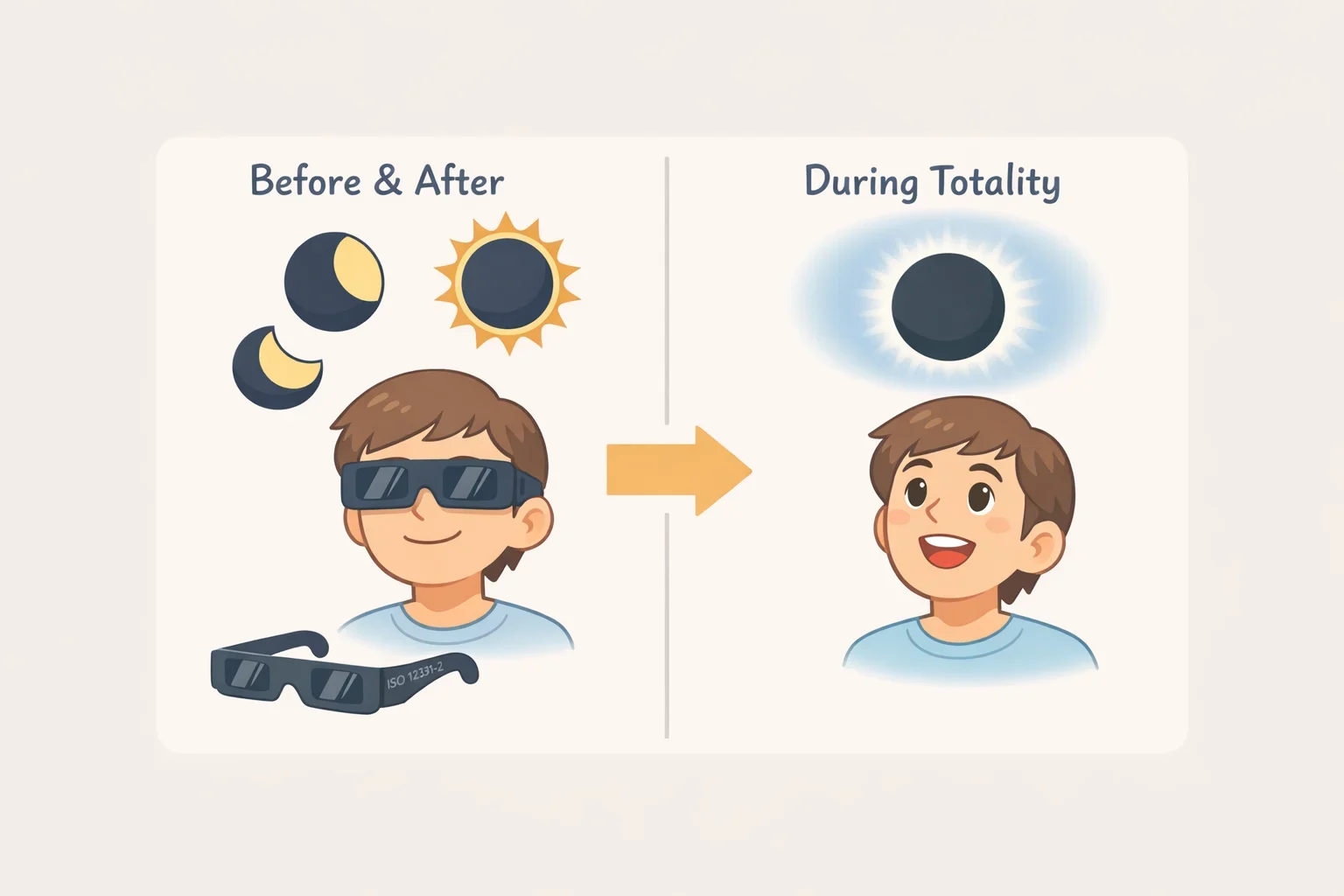
Totality itself passes fast. Most observers on the path will see the Sun fully blocked for under two minutes, and even near the centerline in Greenland, Russia or the North Atlantic, it tops out around two and a half minutes (NASA's eclipse guide).
Local timing varies enormously depending on where you are:
Location Partial begins Maximum Coverage Partial ends Madrid, Spain 7:36 p.m. 8:32 p.m. 99% 9:16 p.m.* London, U.K. 6:17 p.m. 7:13 p.m. 91% 8:06 p.m. Berlin, Germany 7:15 p.m. 8:08 p.m. 85% 8:38 p.m.* New York, N.Y. 1:07 p.m. 1:54 p.m. 9% 2:38 p.m. Toronto, Canada 12:55 p.m. 1:40 p.m. 8% 2:23 p.m. Detroit, Mich. 1:03 p.m. 1:36 p.m. 3% 2:08 p.m.
(An asterisk means the eclipse ends after local sunset, a sunset eclipse for much of western Europe and Africa.) (NASA's eclipse guide)
Only the brief window of totality is safe to view with bare eyes. Everywhere else, and during the entire partial phase before and after totality, the Moon never fully covers the Sun, so eye protection stays on the whole time (NASA's eclipse guide). A 99% partial eclipse, like the one Madrid will see, is still a partial eclipse. This table covers only a handful of cities, too; for exact local times anywhere else, check the fuller city list and interactive map on NASA's eclipse page rather than guessing from the nearest one listed here (NASA's eclipse guide).
Outside totality, ISO 12312-2–compliant eclipse glasses or a handheld solar viewer are the standard; ordinary sunglasses, no matter how dark, don't protect your eyes (NASA's eclipse guide). Eclipse glasses also don't make it safe to look at the Sun through a camera lens, telescope or binoculars. Concentrated sunlight can burn straight through the filter, so any optical device needs its own certified solar filter mounted on the front, not held up behind the eyepiece (NASA's eclipse guide). Without glasses, build a pinhole projector instead: punch a small hole in an index card, stand with the Sun at your back, and view the projected image on a nearby surface. Never look through the pinhole itself (NASA's eclipse guide).
NASA is also treating this eclipse as a research window. A WB-57 jet is set to fly at 50,000 feet and track the Sun's corona for nearly three minutes, longer than any view from the ground, while student teams in Iceland are scheduled to launch 80 balloons to study how the sudden darkness affects the lower atmosphere (NASA's eclipse research team). That work runs independent of backyard viewing, but it's a sign of how much solar researchers can learn from a few minutes of shadow.
Catching the Perseid meteor shower 2026 peak
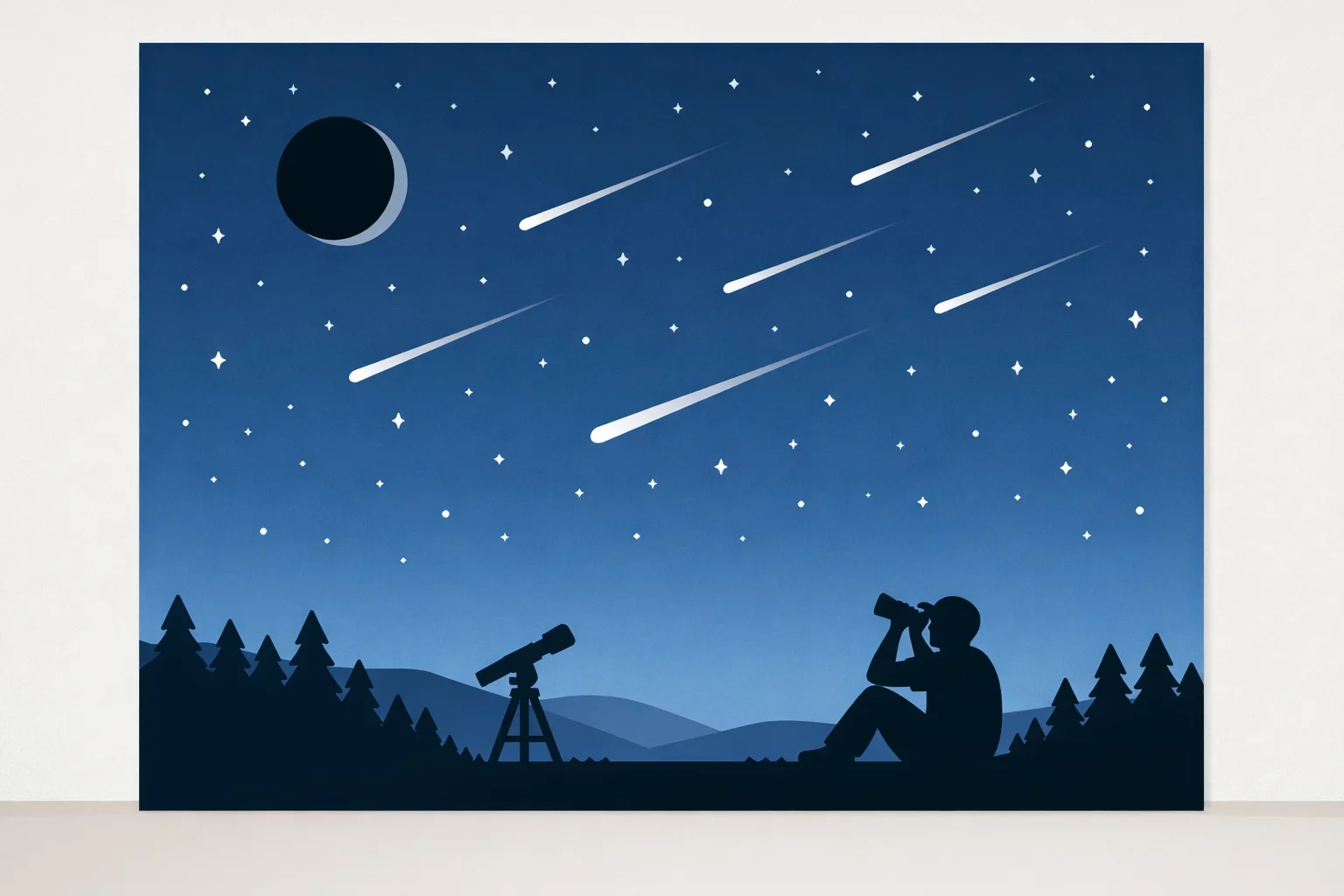
The best window for the Perseids runs after midnight through dawn on Aug. 12 and 13 (EarthSky's August guide). NASA has called the Perseids one of the best annual meteor showers, and EarthSky projects up to 90 meteors an hour under a clear, dark sky (EarthSky's August guide; NASA's 2025 August skywatching guide).
That 90-per-hour figure describes ideal dark-sky conditions, not what every backyard observer will actually count. On an ordinary clear night without a meteor shower, several meteors an hour is typical (NASA's skywatching guide); the Perseids' draw is the jump above that baseline under a genuinely dark sky, away from streetlights and with a wide-open view overhead.
This year's peak also happens to fall on the new Moon, unlike 2025's, when an 84%-full Moon washed out all but the brightest meteors during the same overnight window (NASA's 2025 August skywatching guide). Less moonlight means fainter meteors stay visible this year that would have been lost to glare last year.
There isn't much reason to bring binoculars or a telescope for this one. Meteors move fast and can streak across any part of the sky, so lie back or use a reclining chair, face away from bright light sources including your own phone, and look generally overhead rather than fixating on one spot. Give your eyes some time in the dark before expecting to see the fainter streaks, and dress for cooler pre-dawn temperatures if staying out past midnight.
Which planets are visible in August 2026
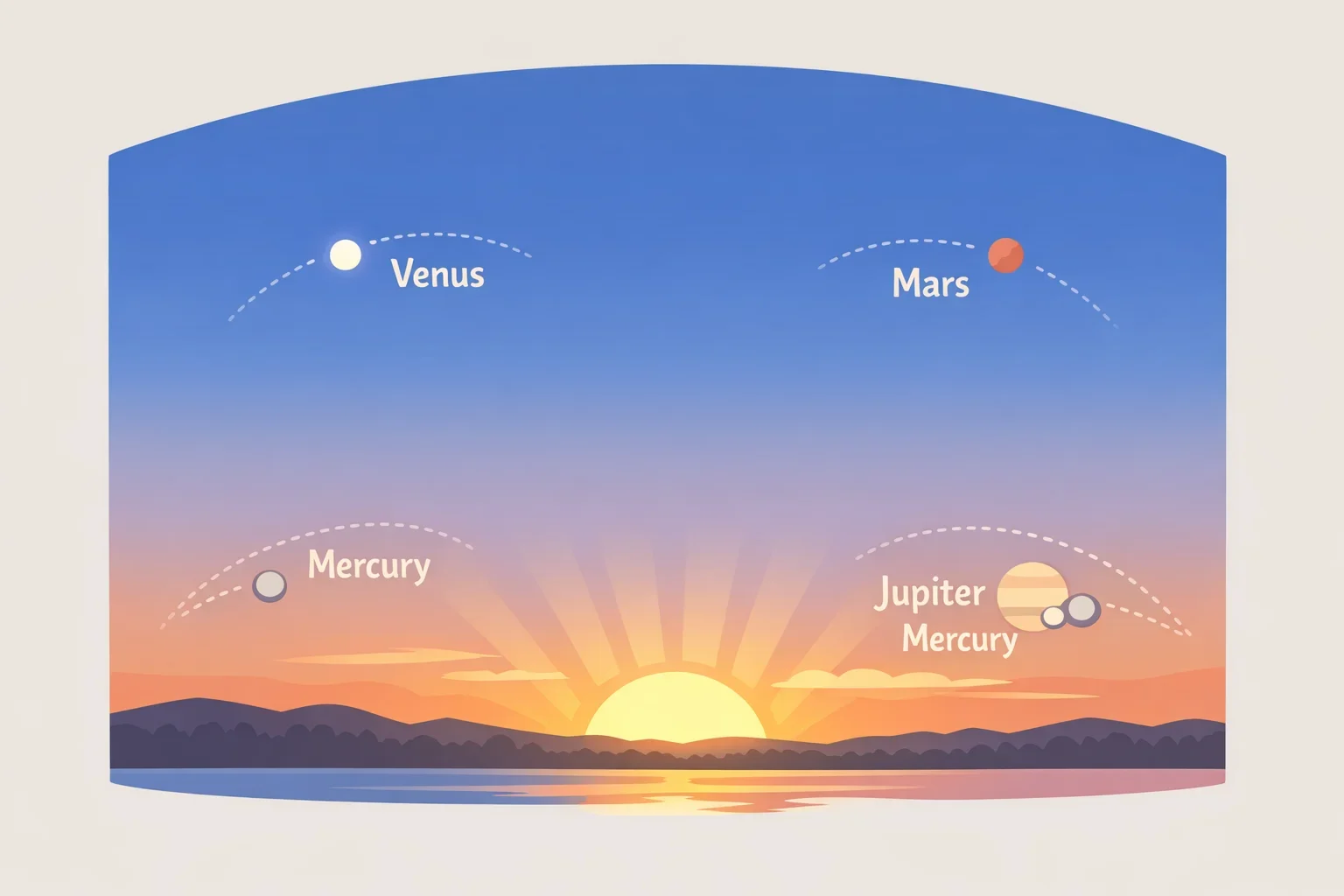
Four planets have specific, dated highlights this month, each tied to a real orbital event rather than a guess. Mercury, Venus, Mars, Jupiter and Saturn are the five planets generally easy to see without a telescope, according to NASA's skywatching guide (NASA's skywatching guide); this roundup covers the four with confirmed 2026 dates from EarthSky's current guide. Saturn is also visible in August most years, but nothing in the available 2026 listings assigns it a specific viewing window here, so a current sky chart is the better source if Saturn is the target.
Mercury reaches greatest elongation, the point in its orbit when it sits farthest from the Sun's glare and is easiest to spot, at 8 UTC on Aug. 2 (EarthSky's August guide). That's its best viewing opportunity of the current cycle. Check a current sky chart or astronomy app for the exact direction and altitude from your location, since that shifts by latitude and by whether the sighting is a morning or evening apparition.
Mars gets a moon-guided sighting during the morning hours of Aug. 9 through 11, when the waning crescent Moon passes near it, with the bright stars Castor and Pollux nearby as reference points (EarthSky's August guide). Use the Moon to locate Mars before dawn, and check a sky chart for the exact altitude at your location.
Jupiter and Mercury close to within about one full Moon's width of each other shortly before sunrise on Aug. 15, appearing in bright morning twilight (EarthSky's August guide). If using binoculars for this close pairing, use them only while the Sun is still below the horizon, keep them pointed well away from the Sun's position rather than sweeping toward it, and stop entirely before dawn brightens the sky. That's the same caution NASA gives for any optics used near the Sun during the eclipse itself, applied here because Jupiter and Mercury sit low and close to sunrise (NASA's eclipse guide).
Venus reaches its own greatest elongation the same day, Aug. 15, at 6 UTC, a separate event from the Jupiter-Mercury pairing, tied to its distance from the Sun around sunset (EarthSky's August guide). Check local sunset and twilight times to know when to start looking.
None of these four sightings requires a telescope, since all four planets are among the five NASA lists as easily observed with the naked eye (NASA's skywatching guide). Binoculars can help sharpen a close pairing like Jupiter and Mercury, but they're optional gear here, not something to buy specifically for this month.
Your August 2026 viewing checklist
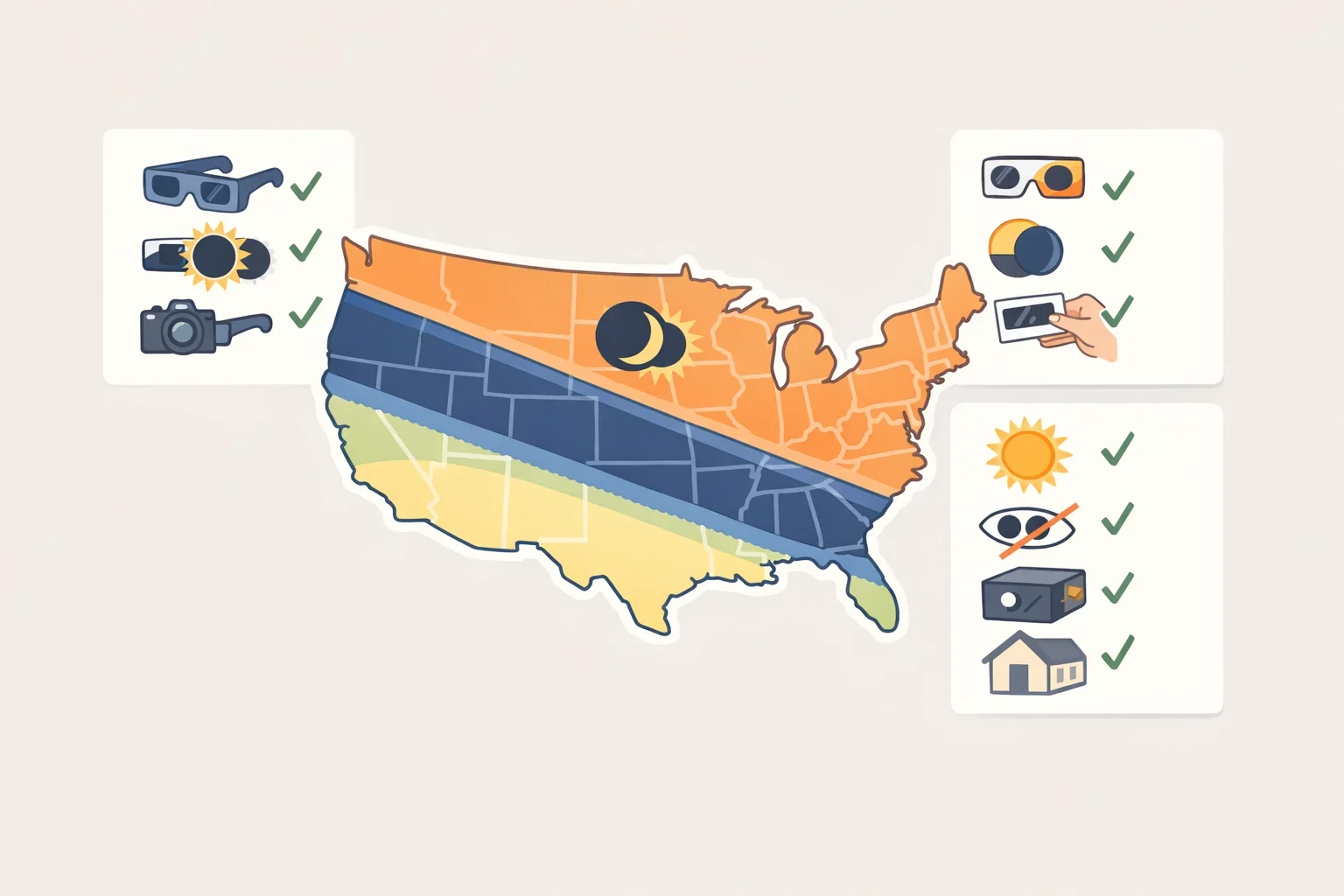
Where you live determines which of these August 2026 astronomy events matters most, so start there:
- Inside the path of totality (parts of Greenland, Iceland, northern Russia, Spain and a corner of Portugal): confirm your city's exact contact times on NASA's eclipse page, and keep ISO 12312-2–rated eclipse glasses on hand for every phase except the brief moment of totality itself.
- In the wider partial-eclipse zone (parts of the northern U.S., most of Canada, much of Europe and northwestern Africa): look up your local start, maximum and end times, and keep eye protection on for the entire event since the Sun is never fully blocked from that vantage point.
- Outside the eclipse footprint entirely: the Perseids are still worth planning around. Check the overnight forecast for Aug. 12 and 13, and if the sky looks clear, get to the darkest spot available after midnight.
- Anywhere: pull up a current sky chart or astronomy app for exact planet directions and altitudes at your location, and keep any binoculars or camera pointed away from the Sun's position whenever it's near or below the horizon before sunrise.
Whichever event fits your calendar and location, the eye-safety rule carries across all of them: never point unprotected eyes, cameras or optics at the Sun outside the brief window of totality. Everything else in this guide, from the Perseids to the planet pairings, needs nothing more than a clear night, a dark spot, and a little patience.