
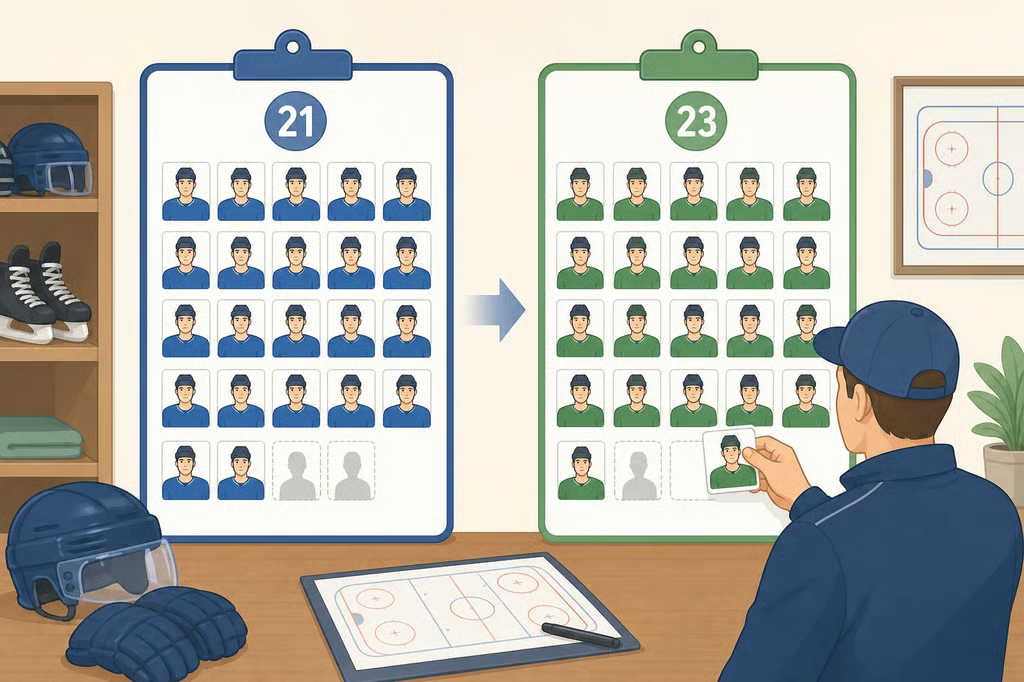
NHL 23-man roster rules: why teams carry fewer players
NHL clubs describe their opening night active roster as capped at 23 players, a figure that shows up repeatedly in team reporting, including a Seattle Kraken preview that called a 21-man roster "two fewer than the NHL maximum of 23." That's the core of NHL 23-man roster rules: a ceiling on how many players a club can formally carry once the regular season begins, not a full accounting of everyone under contract or a team's organizational depth chart. This piece draws on how teams and NHL.com report and comply with that number rather than on the NHL's own roster regulations, which weren't reviewed here.
Team filings show clubs landing on both sides of that ceiling. The Philadelphia Flyers filled every spot for last season's opener, while the Seattle Kraken said before their 2024 opener that they would likely carry just 21. The Columbus Blue Jackets saw their count shift after a waiver claim days before last season's opener, one example of how the tally can keep moving right up to the filing deadline.
The examples below show how teams build, adjust, and interpret that opening-night list, from cap planning down to a single waiver claim.
How NHL teams build toward the 23-player limit

Roster construction each fall follows a sequence Columbus described in its own reporting last season: training camp cuts narrow the group first, then a handful of waiver decisions and a final league submission set the opening night number. That's one team's account of its process, not confirmed league-wide procedure.
The Blue Jackets trimmed their camp roster to essentially its final group the weekend before last season's opener. Minnesota then claimed defenseman Daemon Hunt off waivers on a Friday, and by the following Monday, Columbus was, in the club's own words, "officially down to 23 players" ahead of that day's 5 p.m. filing deadline, according to Blue Jackets/NHL.com.
Philadelphia's filing shows what a full 23-player roster looks like in practice: 14 forwards, seven defensemen and two goaltenders, submitted as the club's active roster for last season's opener, per Flyers/NHL.com.
The count keeps moving well past opening night, too. Columbus used 32 different skaters over the 2024-25 season, per Blue Jackets/NHL.com. That figure is a better sign of what the opening 23 actually is: a starting point for a season of call-ups and assignments, not the full group a club sticks with all year.
NHL opening-night roster rules: active roster vs. game lineup
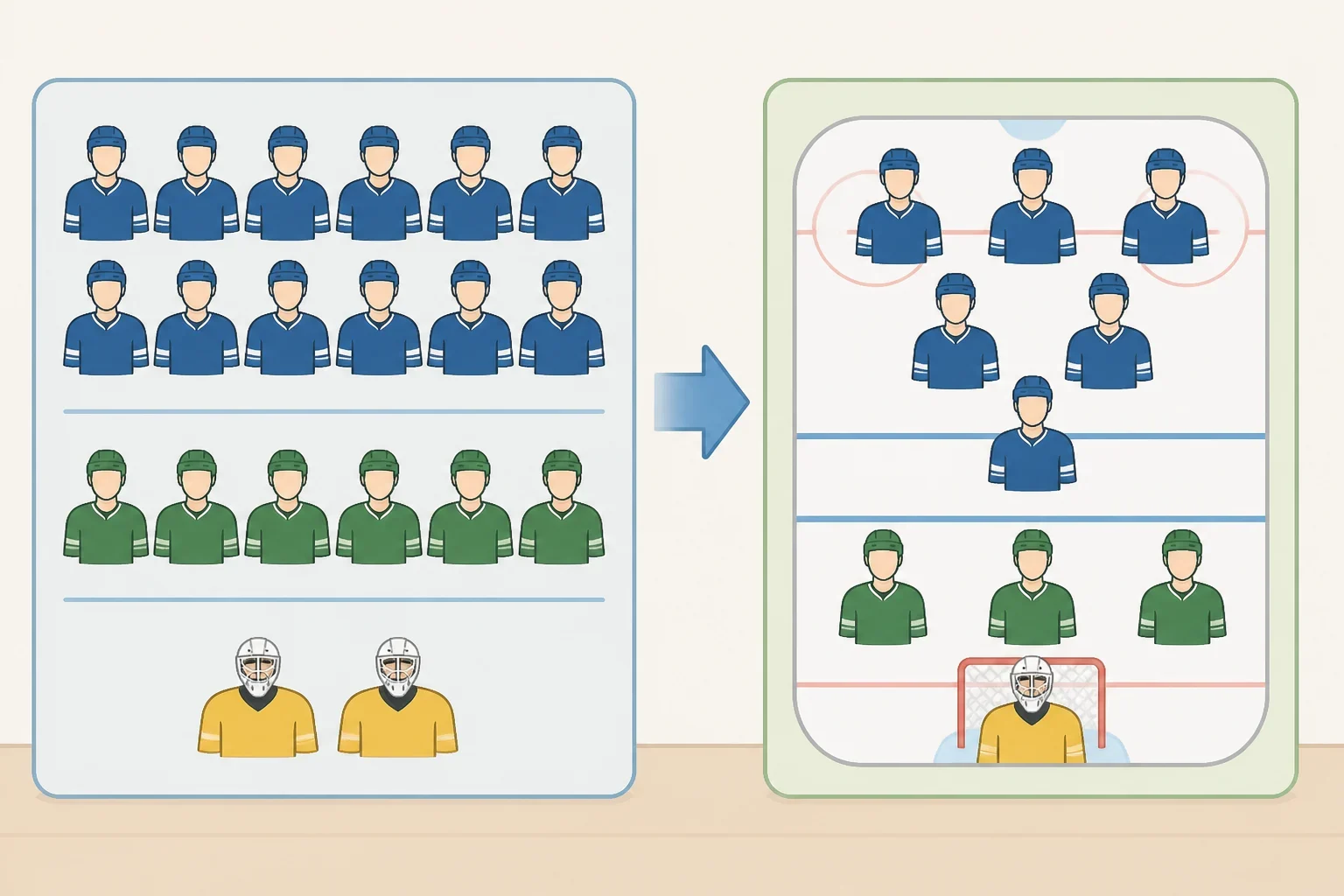
Carrying 23 players doesn't mean 23 players dress for a given game. Philadelphia's active roster carries 14 forwards and seven defensemen, more skaters than a team sends onto the ice on any single night, since some sit as healthy scratches or extra depth, per Flyers/NHL.com.
The clearest official number for a dressed lineup on record applies to the playoffs, not the regular season. Under the NHL and NHLPA's newly ratified collective bargaining agreement, a club's playoff salary cap is built around a lineup of 18 skaters and two goaltenders, according to Aird & Berlis. That figure is specific to the postseason cap framework; nothing in the available reporting spells out a matching regular-season dressed-lineup rule, so it's worth treating the playoff number as context on how the league scopes a game lineup in one setting, rather than a stand-in for regular-season practice.
Why some teams open below 23

Opening below 23 can trade a bit of immediate NHL depth for cap room, waiver flexibility or a development plan, though clubs don't all reach for the same combination.
Seattle said it would likely open the 2024 season with 21 players, two fewer than the NHL maximum of 23, in order to stay under that season's $88 million salary cap, according to Kraken/NHL.com. Carrying two fewer roster spots meant the Kraken needed players who remained exempt from waivers, able to shuttle back and forth between Seattle and AHL affiliate Coachella Valley depending on which position needed reinforcement, per the same report.
Columbus's situation with Hunt shows what can happen without that flexibility. The Blue Jackets had hoped to send him back to AHL Cleveland to keep playing games given the club's depth on defense; instead, Minnesota, the team that had originally drafted him in 2020, claimed him off waivers, and Columbus was then listed at 23 players, per Blue Jackets/NHL.com.
Development timelines add a third, separate reason. Columbus optioned the then-21-year-old prospect Luca Del Bel Belluz to AHL Cleveland last season rather than keep him on the NHL roster, citing a positional logjam and the value of steady playing time for a player still working on his strength and skating, according to Blue Jackets/NHL.com.
What's outside the active 23
A 23-player active roster is only part of what a club lists publicly. Other players may appear in separate designations, including:
- Injured Reserve (IR): players sidelined by injury who count separately from the active 23. Philadelphia listed defenseman Cam York this way for last season's opener, per Flyers/NHL.com.
- Injured Non-Roster: a further designation for injured players who don't count toward the active roster or standard IR. Philadelphia listed three players this way last season: Oliver Bonk, Rasmus Ristolainen and Ethan Samson, per the same report.
- AHL assignment: players optioned to the minors, such as Columbus's Luca Del Bel Belluz, who stay under contract but off the NHL active roster.
- Waiver claims: players who leave the organization outright once another club claims them, as happened with Daemon Hunt.
Stack those groups on top of Philadelphia's active 23 and the club's own announcement listed 27 players in total, not the active roster itself, per Flyers/NHL.com.
Cap accounting and injury designations
Salary cap math adds another layer clubs track alongside the roster count. The cap counts a player's Average Salary, the annualized value of a contract's salary and bonuses, rather than the Actual Salary paid in a given season, according to Aird & Berlis. That gap explains why a team's cap number doesn't always match what a player is actually being paid that year.
Long-Term Injured Reserve, or LTIR, works within that same cap math. A team physician must attest that a player will be unfit for at least 24 calendar days and 10 regular-season games before a club can use the exception, and the relief that follows applies to the salary cap rather than to the 23-man limit itself, based on how Aird & Berlis describes the mechanism. That relief also only kicks in once a club has actually reached its cap number; a team sitting below the cap gets no extra room from recalling a replacement, per the same source's worked example.
The system around LTIR replacements changed nine days ago, when new terms from the NHL and NHLPA's ratified collective bargaining agreement took effect on September 16, 2026. Under the updated rule, a replacement player's Average Salary is generally capped at the prior season's League Average, roughly $3.8 million based on 2024-25 figures, with limited exceptions for players ruled out for the rest of the season, according to Aird & Berlis. That changes how a club fills an injury-created opening this season; it does not, according to the cited analysis, change the 23-player active roster limit itself.
How to read a roster move

Three questions sort out what a given transaction actually means. Is the player part of the active 23, or listed separately under an injury designation or AHL assignment? Did the move involve a waiver claim, where another team could take the player outright, or a waiver-exempt reassignment that keeps him in the organization? And did cap space push the decision, either opening a roster spot or closing one?
A 23-player opening roster is the maximum documented across the team announcements cited here, not a promise that every club carries a full 23. The reason a player is missing from that list, whether it's an assignment, an injury designation, a waiver claim, or a cap decision, is what actually determines what the move means for a team's roster.