


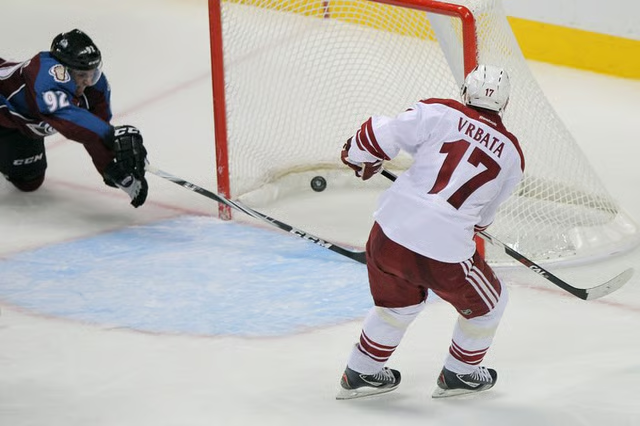
In hockey, unlike sports such as basketball and football, all goals count for a single point. But there are, nonetheless, different types of goals used for statistics in the game. There are five basic types of goals: even strength, power play, short-handed, penalty shot and empty net. On Dec. 31, 1988, Mario Lemieux became the first NHL player to score all five types of goals in a game.
Even-Strength Goal
An even-strength goal is any goal that is scored when both teams have the same number of players on the ice. Typically, this is when each team has six players on the ice, but it can also happen when the teams have offsetting penalties that leave them with fewer players on the ice but an equal number on each team.
Power-Play Goal
A power-play goal is one a team scores when the opposing team is short-handed because of a penalty. There are two types of power plays, a single-man advantage and a two-man advantage -- scoring with either advantage is considered a power-play goal.
Short-Handed Goal
A short-handed goal is the opposite of a power-play goal -- it is a goal scored by the team that is at a disadvantage because of a penalty. Short-handed goals are difficult to score because the penalized team has fewer players to work with, but a penalized team may have an opportunity for a quick rush when the opponent is changing lines or pressing the advantage in its opponent's zone.
Penalty-Shot Goal
A penalty shot can be awarded to a team if the opposing team commits certain infractions, such as covering the puck in the crease, intentionally dislodging the net or tripping a player on a breakaway. A penalty shot is awarded instead of sending a player to the penalty box in these situations. A goal scored on a penalty shot counts the same as a regular goal.
Empty-Net Goal
Although hockey teams typically will play five skaters and a goalie, there is no requirement to use a goalie, and a team can use six skaters if it opts not to have a goalie. Typically, this is a strategy only used as last resort by a team that is losing with little time left in the game. This provides the other team with the opportunity to score an empty-net goal if it can gain control of the puck.