
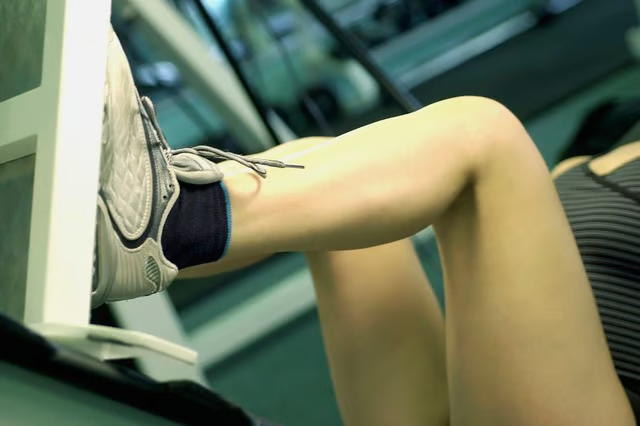


The leg press targets two groups of muscles. First, it covers your hip extensors, including the biceps femoris, gluteus maximus, semimembranosus and semitendinosus. Second, it works your knee extensors, which means your rectus femoris, plus the vastus medialis, intermedius and lateralis. In plainer terms, it works the muscles you know as calves, glutes, quads and hamstrings. The leg press is popular because it prevents the kind of upper body strain common to squats.
The Seated Leg Press and the 45-Degree Leg Press
At the gym, you are likely to encounter one of two types of leg press machines. In one, you sit in at an upright 90-degree angle and push the plate away from your body. The other is called a 45-degree leg press. When using the latter machine, your torso reclines at a 45-degree angle as you push the plate up and away from your body. The main distinction between the devices is that the 45-degree press allows your body to handle more weight. Start by placing the desired amount of weight on the plate and releasing the safety catch.
Correct Angle and Body Posture
Even though the leg press is a pretty safe machine for beginners, incorrect body posture -- that is, posture that prevents your body from assuming the designated 90- or 45-degree angle -- can hurt your back, shoulders or neck. Push your gluteus maximus all the way to the back, so your lower back isn't touching the seat. Make certain that your gluteus is touching the backrest but that your lower back is not. Failure to do this can result in lumbar strain. You should be able to reach your hand behind the lower back while you're seated in the machine. Be sure that your neck is not pushed up or out, as this may cause a strain.
Foot Position
Position your feet near the center of the plate, keeping them approximately 8 inches apart, give or take a couple of inches depending on comfort and the width of your pelvis. After getting the hang of this method, try positioning your feet higher on the plate to target your hamstrings and glutes, or lower to target the quads. Adjust your seat appropriately in either case.
Knee Safety
When you're using the 45-degree press, bring your knees down slowly and uniformly to begin the repetitions. If you're using the 90-degree seated press, pull your knees toward you. Try for fluidity and avoid jerky or jarring movements. Bring your knees toward you no farther than a 90-degree angle; any farther will upset your center of gravity and could cause injury. Raise your legs back up almost completely, taking care never to lock them or move to a full 180-degree stretch. Aim for 10 to 15 repetitions.