

Don Nelson Dies at 86: NBA Pioneer of Small-Ball
Don Nelson, the second-winningest coach in NBA history, died Sunday at age 86, his family said in a statement (AP). "On Sunday morning our beloved husband, dad, grandfather and great-grandfather Don Nelson peacefully went to be with the Lord, surrounded by his loving family," the family wrote, adding that friends and relatives had gathered around him "throughout his last week" (AP).
The family's statement did not disclose a cause of death or location, though the NBA reported he died in Frisco, Texas (NBA.com).
Nelson finished his coaching career with a 1,335-1,063 record across 31 seasons, three Coach of the Year awards and 18 playoff appearances, according to the National Basketball Coaches Association (NBCA, last year). His teams never reached the NBA Finals (NBA.com), a contrast to his playing career, in which he won five championships with the Boston Celtics.
Don Nelson's NBA coaching career and path to the sideline
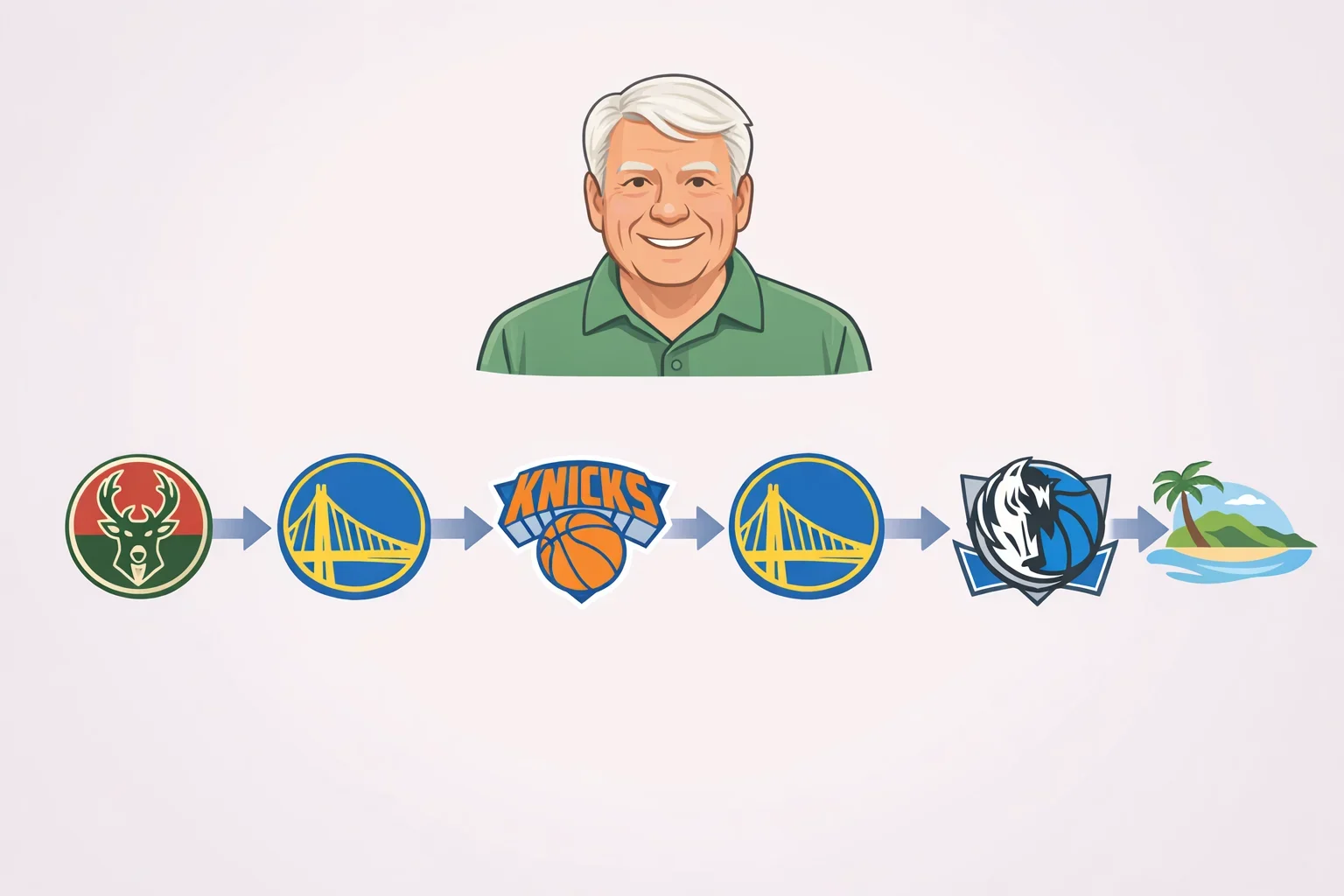
Nelson coached four franchises, the Milwaukee Bucks, Golden State Warriors (in two separate stints), Dallas Mavericks and New York Knicks, across 34 years between 1976 and 2010 (Sports Illustrated). He's one of only two coaches in league history to record at least 250 wins with three different franchises: Milwaukee, Golden State and Dallas (AP).
His 1,335 wins stood as the NBA record for 12 years until Gregg Popovich passed him in 2022. Nelson ranks second all-time in both wins and games coached, with 2,398 (NBCA, last year).
He barely ended up coaching at all. Nelson retired as a player in 1976 with roughly $10,000 in the bank and briefly weighed NBA refereeing before signing on as Milwaukee's lone assistant under Larry Costello that fall (NBA.com). Costello resigned under pressure after the Bucks lost 15 of their first 18 games, and general manager Wayne Embry offered Nelson the job on a permanent basis. Nelson turned it down three times over two days before accepting (NBA.com; Milwaukee Journal Sentinel).
Nelson took over the 3-15 Bucks on Nov. 22, 1976. After Milwaukee finished 30-52 that season, he led the team to 64 wins in his first full year (Milwaukee Journal Sentinel).
Before any of that, Nelson had already won five championships as a Celtics player between 1966 and 1976, and the franchise retired his No. 19 jersey. The Naismith Memorial Basketball Hall of Fame inducted him as a coach in 2012 (NBA.com).
Don Nelson's death and the Nellie Ball basketball strategy

In Milwaukee, Nelson introduced the "point forward," a concept he first tested with 6-foot-7 Marques Johnson before building it around 6-foot-5 Paul Pressey, using a forward as the primary ball handler while surrounding him with shooters (Milwaukee Journal Sentinel). Pressey's assists jumped from 3.1 to 6.8 per game in his third NBA season under Nelson, then rose to a career-high 7.8 the following year, in 1985-86 (Sports Illustrated).
"Nellie knew the type of players that would fit his system," Bucks star Sidney Moncrief once said. "It was like a machine. The right players, right system and right coach" (Milwaukee Journal Sentinel).
Nelson explained the logic behind what became known as "Nellie Ball" in blunt terms. "You only play Nellie Ball when you don't have a very good team, or when you have a bunch of good small players and not many good big players," he said in 2012, adding, "When you have bad teams, you've got to be creative to win games you're not supposed to win" (Sports Illustrated).
How Nellie Ball played out in Milwaukee, Golden State and Dallas

Over 10 full seasons as Bucks head coach, Nelson's teams missed the playoffs only twice and reached the Eastern Conference finals three times, though never further. His 11-year run in Milwaukee also produced seven straight 50-win seasons and six straight division titles (Milwaukee Journal Sentinel).
He repeated the turnaround pattern in Golden State, taking a 20-62 team to a 43-39 record and a Western Conference semifinal berth in a single season (Milwaukee Journal Sentinel). With the Warriors' "Run TMC" trio of Tim Hardaway, Mitch Richmond and Chris Mullin, he used undersized lineups to create mismatches that produced a pair of playoff upsets in the early 1990s (Sports Illustrated).
In Dallas, Nelson inherited a team that had gone 20-62 in 1997-98 and 19-31 in the lockout-shortened 1998-99 season. The Mavericks won 40 games in 1999, then reeled off five straight 50-win seasons built around Dirk Nowitzki playing center out near the three-point line alongside Steve Nash and Michael Finley, a spacing setup that pulled defenses far outside the paint (Sports Illustrated; Milwaukee Journal Sentinel). That group came within two wins of the 2003 NBA Finals, falling to San Antonio in the Western Conference finals after a 60-22 regular season (NBA.com).
Nelson carried the same approach into his second Golden State stint, starting Stephen Jackson and Al Harrington at center in a small lineup that helped the eighth-seeded 2007 "We Believe" Warriors upset a 67-win Dallas team in the first round (Sports Illustrated; Milwaukee Journal Sentinel).
The Bucks credited Nelson with "pioneering the concept of the point forward" in a statement following his death, while the Warriors called him "one of the most innovative and influential coaches in the history of the NBA" and tied him to both the Run TMC and "We Believe" eras (Milwaukee Journal Sentinel).
Stephen Curry, who joined Golden State in the 2009 draft, said in a team statement that Nelson was "one of the big reasons I was drafted by the Warriors" and that he "challenged me and gave me an opportunity to be my best self on the court," calling his impact on the sport "immeasurable" (Sports Illustrated).
Don Nelson's legacy and memorial arrangements

A celebration of life is planned for Aug. 13 in Dallas, with an ashes ceremony in Maui for family and friends, according to arrangements announced by the Nelson family (Milwaukee Journal Sentinel).
The National Basketball Coaches Association gave Nelson its Chuck Daly Lifetime Achievement Award last year, and it said the small-ball approach he built in Milwaukee and refined in Dallas and Golden State remains in use by professional, college and international teams (NBCA, last year).
Longtime NBA coach Del Harris described Nelson's career as unfolding in phases: a defensive-minded run in Milwaukee that produced three Coach of the Year awards in the 1980s, followed by an offense-first small-ball era in Golden State and, in his words, "a heck of a run" in Dallas (Milwaukee Journal Sentinel).
Nelson never won a championship as a head coach, the one accomplishment his playing career delivered five times over. The NBCA's statement makes clear the gap didn't erase his influence: small, skilled lineups built around shooting and spacing rather than size, the framework he kept testing on losing teams for three decades, still shape how professional, college and international rosters get built (NBCA, last year).