
Social media posts sometimes claim that completing a few standing movements proves a person over 60 is fitter than someone decades younger. That comparison is not supported by the public health guidance discussed here.
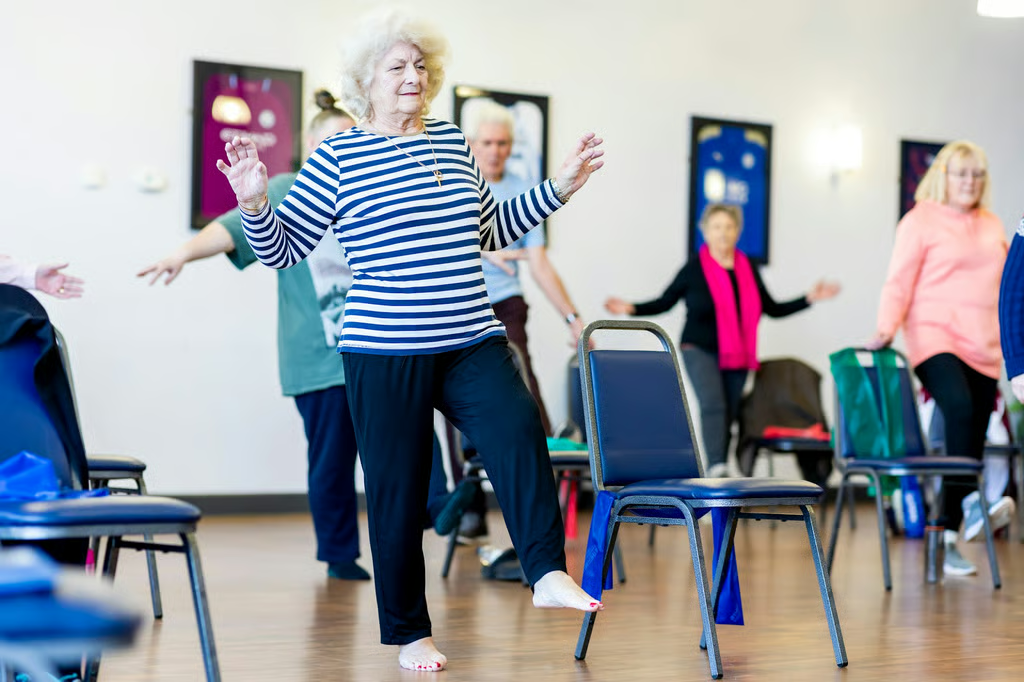
These four supported exercises instead offer a practical way to work on balance, coordination, and lower-body control. They target movements used in daily life, including walking, turning, and rising from a chair, without requiring gym equipment.
CDC guidance for older adults recommends combining balance activities with aerobic exercise and muscle strengthening. It specifically identifies standing on one leg and walking backward as balance activities. This routine is an informal practice sequence, not a diagnostic test, fall-risk score, or standard every adult over 60 should be able to pass.
Regular exercise can improve balance and help prevent falls, but the benefits come from repeated training rather than a one-time test. A systematic review published in October 2025 analyzed 37 randomized controlled trials involving adults over 60 without diagnosed diseases. Participants assigned to exercise programs showed improvements in balance and fall-related outcomes compared with control groups.
That does not mean one session, or this exact routine, reduces an individual’s fall risk by a fixed amount. Use a sturdy support surface, begin with the easiest variation, and stop if a movement causes pain, dizziness, or a feeling that you may fall.
What these exercises can show
The routine challenges static balance, balance while moving, and lower-body strength. It cannot diagnose a balance disorder, calculate fall risk, or measure overall fitness.
Instead of assigning yourself a score, notice whether you need hand support, step out of position, or rush to finish. A decline from your usual ability is more useful than comparing your performance with someone else’s.
Ask a healthcare professional or physical therapist for guidance before attempting the routine alone if you have fallen recently, frequently feel unsteady, use furniture to stay upright, or experience dizziness or faintness.
The US Preventive Services Task Force recommends exercise interventions for community-dwelling adults 65 and older who have an increased risk of falling. Effective programs often combine gait, balance, functional, and strength training. This routine is not a substitute for an individualized assessment or supervised fall-prevention program.
Set up the area first
Practice beside a fixed countertop or sturdy, non-rolling chair that cannot slide or swivel. Remove rugs, cords, pets, and other obstacles. Wear stable, supportive shoes.
Anyone with a recent fall, substantial unsteadiness, or a strong fear of falling should have another adult nearby or ask whether supervised exercise would be safer.
Rest as needed and keep both hands within reach of the support surface. Begin with full hand support and reduce it only when you can complete the movement without grabbing, hopping, or stepping suddenly to recover.
Stop immediately if you feel pain, dizziness, faintness, unusual shortness of breath, sudden weakness, or as though you may fall.
4 standing exercises for adults over 60
1. Supported single-leg stand
Setup: Stand facing a fixed countertop with both hands resting on it. Keep your feet about hip-width apart.
Movement: Shift your weight onto one leg and lift the other foot slightly from the floor. Hold for a few controlled seconds, lower the foot, and repeat on the other side. Look at a fixed point ahead.
Make it easier: Keep both hands on the counter and lift the foot only an inch.
Make it harder: Progress from two hands to one hand, then to fingertip support. Do not remove support unless you can remain steady without gripping, hopping, or leaning sharply.
2. Heel-to-toe walk
Setup: Stand beside a long countertop or secure handrail with a clear path ahead.
Movement: Place one foot in front of the other so the heel nearly touches the toes of the back foot. Take several slow steps while keeping one hand close to the support surface.
Make it easier: Leave a small gap between the heel and toes or begin with three to five steps. A wider position is appropriate when a full heel-to-toe stance feels unsafe.
Make it harder: Narrow the gap gradually while maintaining a slow pace. Do not sacrifice control to make the feet touch.
3. Sit-to-stand
Setup: Sit near the front of a sturdy, non-rolling chair with your feet flat on the floor. Use the armrests if needed.
Movement: Lean slightly forward, press through your feet, and stand upright. Pause, then move your hips back and lower yourself slowly. Begin with as many controlled repetitions as feel comfortable, even if that is fewer than eight.
Make it easier: Use the armrests, perform fewer repetitions, or use a taller chair.
Make it harder: Use less arm assistance before adding repetitions. Stop when the movement becomes rushed or you begin dropping onto the seat.
4. Supported backward walk
Setup: Use a short, clear route beside a fixed countertop or secure handrail. Inspect the entire path before beginning. Skip this exercise if you have fallen recently, cannot walk steadily forward without support, or feel unsafe moving backward.
Movement: Keep one hand on or immediately above the support surface. Take three to five short steps backward, moving one foot at a time.
Make it easier: Practice slow side-to-side weight shifts while holding the counter.
Make it harder: Add one or two steps only after the shorter variation feels controlled. Never move beyond the available support surface.
Using planned hand support is appropriate. Needing to reach unexpectedly for support is a sign that the exercise should be made easier.
How to adjust the routine
The single-leg stand, heel-to-toe walk, and backward walk primarily challenge balance. Sit-to-stand develops the lower-body strength used to rise from chairs, beds, and other seated positions.
Practice the routine two or three times per week if you can complete it comfortably and recover without lingering pain or unusual fatigue. This exact sequence has not been clinically tested as a complete program, so it should not be your only form of activity or fall prevention.
Increase one variable at a time: use less hand support, add a few seconds or repetitions, or take one or two more steps. Avoid reducing support and increasing duration during the same session.
After an illness or long break, return to an easier variation rather than restarting at your previous level. Balance training should create a manageable challenge, not force you to repeatedly catch yourself.
When to stop and seek help
Stop if you develop new pain, dizziness, faintness, unusual shortness of breath, sudden weakness, or changes in vision. Seek prompt medical advice for sudden or severe symptoms rather than trying to exercise through them.
Contact a healthcare professional if your balance has recently worsened, you have fallen, or you regularly need furniture or another person to remain steady. A physical therapist can assess your movement and adapt the exercises to your current ability.
The goal is not to complete all four movements without support. It is to build the balance, strength, and control needed to move through daily activities more confidently and safely.