
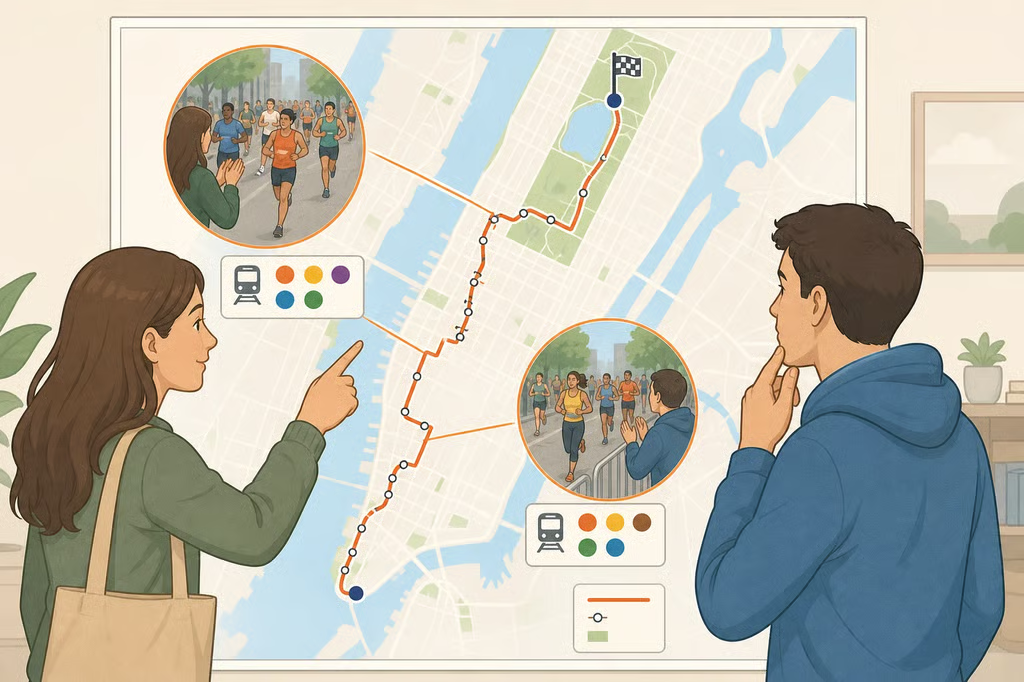
Watching the New York City Marathon takes more planning than finding a place along the sidewalk. On Sunday, November 1, 2026, runners will race through all five boroughs before finishing in Central Park. If you're hoping to cheer on a friend or family member, knowing when they'll pass and how to reach your viewing spot is essential.
The 26.2-mile course begins on Staten Island, crosses into Brooklyn and Queens, heads through Manhattan and the Bronx, and returns to Manhattan for the finish near West 67th Street. Most of the route is free to watch, but bridges and the starting area are off-limits. Finish-line viewing also comes with additional restrictions.
Check your runner's start time and pace
Before choosing a viewing location, ask your runner for their bib number, assigned wave, and expected pace. The marathon uses staggered starts, meaning runners can pass the same mile marker more than an hour apart.
According to New York Road Runners' official 2026 start schedule, the men's professional wheelchair division begins at 8 a.m. ET, followed by other professional and adaptive divisions. General-entry runners start in five waves:
| Start wave | Scheduled start (ET) |
|---|---|
| Wave 1 | 9:10 a.m. |
| Wave 2 | 9:45 a.m. |
| Wave 3 | 10:20 a.m. |
| Wave 4 | 10:55 a.m. |
| Wave 5 | 11:30 a.m. |
These times are subject to change, and runners may cross the starting line after their scheduled wave begins.
To estimate when someone will reach a viewing spot, multiply the distance by their expected pace. For example, a runner averaging 10 minutes per mile would reach mile 8 about 80 minutes after crossing the starting line, assuming a steady pace.
Treat that calculation as an estimate. Crowding, hills, and fatigue can change a runner's pace throughout the race.
Best places to watch the NYC Marathon
Brooklyn's neighborhood streets, Manhattan's First Avenue, and the final stretch toward Central Park offer different ways to experience the race. The official NYRR spectator guide identifies recommended viewing locations along the course.
| Viewing location | Approximate mile | Best for |
|---|---|---|
| Fourth Avenue, Brooklyn | 2–4 | Early cheering |
| Fourth Avenue and Flatbush Avenue | 8 | Brooklyn crowds |
| Williamsburg and Greenpoint | 10–13 | Neighborhood atmosphere |
| Queens near the Pulaski Bridge | 13 | Halfway-point support |
| First Avenue, Manhattan | 16–18 | Large cheering crowds |
| Fifth Avenue, East 90th–105th streets | 23–24 | Late-race encouragement |
| Columbus Circle | Final mile | Watching the finish approach |
Brooklyn offers several opportunities to catch runners early. Williamsburg and Greenpoint provide a lively neighborhood atmosphere, while First Avenue is among the marathon's busiest cheering corridors.
Fifth Avenue is particularly useful for encouraging runners through the difficult final miles. Columbus Circle offers a view of the final approach, although access becomes more restricted closer to the finish.
Spectators cannot enter the Staten Island starting area or watch from bridges along the course. The Queens side of the Pulaski Bridge provides a nearby street-level alternative around the halfway mark.
The Bronx route changes for 2026
The marathon's Bronx section has been adjusted for the first time in 15 years, making older route maps unreliable for spectators planning to watch there.
The updated course takes runners through a revised section of the South Bronx after they cross the Willis Avenue Bridge, before they return toward Manhattan via the Madison Avenue Bridge.
Spectators heading to the Bronx should consult the official 2026 course map to identify streets along the updated route and designated pedestrian crossings.
Best two-stop routes for watching your runner
Seeing a runner twice is possible, but your travel time must fit their pace. These three combinations offer starting points for spectators willing to move between locations.
Brooklyn to Manhattan: Mile 8 to miles 16–18
Watch near Fourth Avenue and Flatbush Avenue, then take the subway toward First Avenue in Manhattan. Both locations offer energetic crowds, although faster runners may leave little time for the transfer.
Williamsburg to Fifth Avenue: Miles 10–13 to miles 23–24
Start in Williamsburg or Greenpoint before heading toward Fifth Avenue between East 90th and East 105th streets. The greater distance between stops provides a longer travel window, depending on your runner's pace.
First Avenue to Columbus Circle: Miles 16–18 to the final mile
Cheer on First Avenue, then head toward Columbus Circle. This is an ambitious pairing, especially for faster runners or anyone hoping to enter a restricted finish viewing area.
For any two-stop plan, check MTA service alerts and use the MTA trip planner to identify stations and transfers. Allow extra time for crowds, walking, and permitted pedestrian crossings. If the timing looks tight, choose one location rather than risk missing your runner at both.
Central Park finish-line access and restrictions
The marathon finishes on West Drive near West 67th Street in Central Park. Unlike most street-side viewing locations, the final approach has controlled entrances and capacity restrictions.
Grandstand seating requires a ticket, with entry at West 62nd Street and Broadway. Free standing-room viewing is available inside Central Park from Columbus Circle toward the south end of the grandstands, approximately 500 feet before the finish.
According to NYRR's spectator instructions, non-ticketed spectators can enter at Broadway and West 61st Street or from the east side using the Central Park path near Heckscher Fields. All entrances require security screening, and officials may restrict entry when the area reaches capacity.
Chairs are not permitted in the standing spectator area, and spectators cannot access the restricted section north of the grandstands. Arrive early and follow posted instructions rather than assuming you can cross between viewing areas.
How to track your runner during the marathon
The Official New York Road Runners App provides live runner tracking, allowing spectators to follow friends and family along the course. It also includes leaderboards, marathon maps, and race-day information.
Download the app before race day and find the runner you want to follow. Use tracking updates alongside their expected pace to estimate when they'll reach your location. Updates may not appear instantly, so avoid relying on a single predicted arrival time.
NYRR's October 26 broadcast announcement confirms national coverage on ESPN2 and ESPN Unlimited from 8 to 11:30 a.m. ET. ABC7/WABC-TV will provide local coverage, while ABC7NY.com will stream a dedicated finish-line camera from 10:30 a.m. to 6 p.m. ET.
Race-day checklist: Tracking, transit, and meeting up
Before leaving, confirm your runner's wave, bib number, and expected pace. Charge your phone, bring a portable charger, dress in layers, and agree on a meeting location.
According to NYRR's official 2026 finish information, the Family Reunion area will operate along West 69th through West 71st streets from 11 a.m. to 6 p.m. ET. Meeting sections are organized alphabetically by last name, with bag inspection and security screening at the Columbus Avenue entrances.
NYRR recommends arriving about 20–30 minutes after your runner's anticipated finish, allowing time for them to leave the course. Avoid bringing large bags, strollers, or bulky items to Family Reunion.
Heavy crowds can disrupt cellular service near the finish. Agreeing on a meeting point outside the runners-only area is more dependable than trying to coordinate entirely by phone afterward.
Choose a viewing spot you can reach comfortably, arrive before your runner is expected, and leave enough time to enjoy the race. A well-timed cheer from one location can mean more than spending the morning rushing between several.