
- Best Dry-Land Training for Swimmers: 2025 Review Findings
- Why combined aquatic and dry-land training ranked highest
- Core and power training: narrower, sprint-specific signals
- What a training-volume study found, and its limits
- A separate question: warming up before a race
- Where this leaves swimmers and coaches
Best Dry-Land Training for Swimmers: 2025 Review Findings
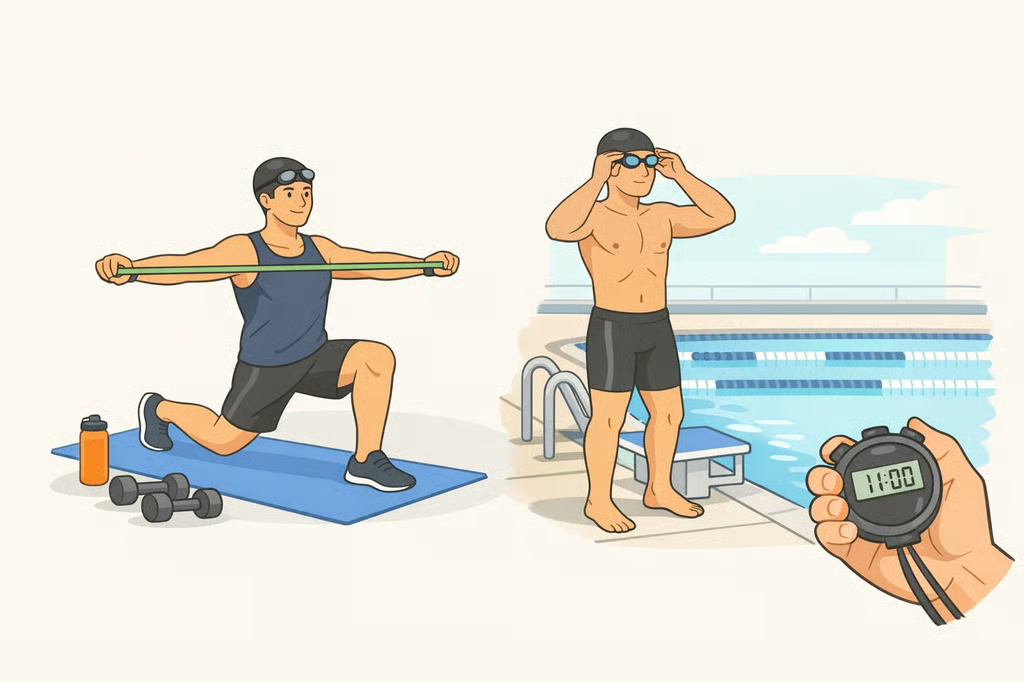
A two-tier network meta-analysis published last year in Frontiers in Physiology pooled 36 randomized controlled trials and 844 competitive swimmers to compare training environments, aquatic-only, dry-land-only, and combined, rather than rank individual exercises. Against a control condition, combined aquatic and dry-land training produced a significant 2.01-second improvement in 100-meter time, according to the study. For coaches and swimmers shaping dry-land training for swimmers, that's the headline number, though the review leaves real questions open about who it applies to and how.
Researchers ran the comparison in two stages. A first tier looked at broad training environments; a second tier then broke combined and dry-land programs into specific modalities like resistance training, core work, and power training, according to the full results. That layered design is what sets this review apart. An earlier 2022 review of 27 studies had already found that a combined swimming-and-strength-training approach seemed to outperform swim-only training, but it couldn't settle which strength method worked best, reporting resistance, core, and plyometric training all produced similar gains of 2% to 2.5%. The newer analysis compares environments and methods within the same network.
Why combined aquatic and dry-land training ranked highest

Across the first-tier comparison, combined training showed the highest efficacy of any environment across multiple outcomes, not just 100-meter time. Against control, it also produced significant gains in swim velocity, stroke rate, and stroke length, data show.
The second tier narrowed that further. Water training paired with dry-land resistance training, shortened to W + DRT, ranked highest for 50-meter, 100-meter, swim velocity, and stroke-length outcomes. In its own 100-meter network, drawn from 11 studies and 250 swimmers, W + DRT significantly outperformed a HIIT comparison and control, producing an estimated 2.35-second advantage over control, per the reported figures. That 2.35-second figure comes from a smaller, modality-specific network than the 2.01-second result from the broader first tier, so the two numbers describe related but separate comparisons, not the same finding stated twice.
Researchers concluded that combined training, particularly W + DRT, was the most effective category overall, while core and power training functioned more as targeted adjuncts for narrower outcomes, per the study's conclusion. The review doesn't specify session frequency, exercise selection, or program length within each modality. It identifies which category of training helped most, not a weekly plan.
Core and power training: narrower, sprint-specific signals
Not every distance responded the same way, and the evidence thins out as the events get shorter. For 25-meter performance, a network of 7 studies and 161 swimmers found core training had the highest probability of ranking as the top method, with a SUCRA score of 77.1%, ahead of W + DRT at 70.6%, the breakdown shows.
SUCRA, short for surface under the cumulative ranking curve, estimates how likely a treatment is to be the best option among those compared. A high SUCRA score is a probability ranking, not proof of a significant edge. In this 25-meter network, the significant improvement over control belonged to W + DRT, not to core training on its own.
For 50-meter performance, across a larger network of 21 studies and 481 swimmers, power training ranked first with a SUCRA of 96.0%, with W + DRT second at 80.7%. There, W + DRT significantly outperformed HIIT, resistance training alone, and control head-to-head, the analysis found.
A separate look at take-off velocity, built from just 5 studies and 120 swimmers, found core training ranked highest by SUCRA at 78.1%, yet showed no statistically significant differences between any of the interventions tested. That's the clearest example in the review of a favorable ranking that never translated into a proven advantage.
An earlier front-crawl-specific biomechanics review found a similar pattern in 2021: strength, resistance, and core training helped sprint performance, resistance training specifically improved stroke rate, and plyometric training helped starts without measurably improving overall swim times. That review, built on 15 studies, called for more research on strokes beyond front crawl.
None of this makes core or power work a substitute for W + DRT. The sprint-distance findings point to a possible targeted benefit for swimmers focused on starts and short races, built on smaller networks than the headline result, which is reason enough to raise it as a specific conversation with a coach rather than add it by default.
What a training-volume study found, and its limits
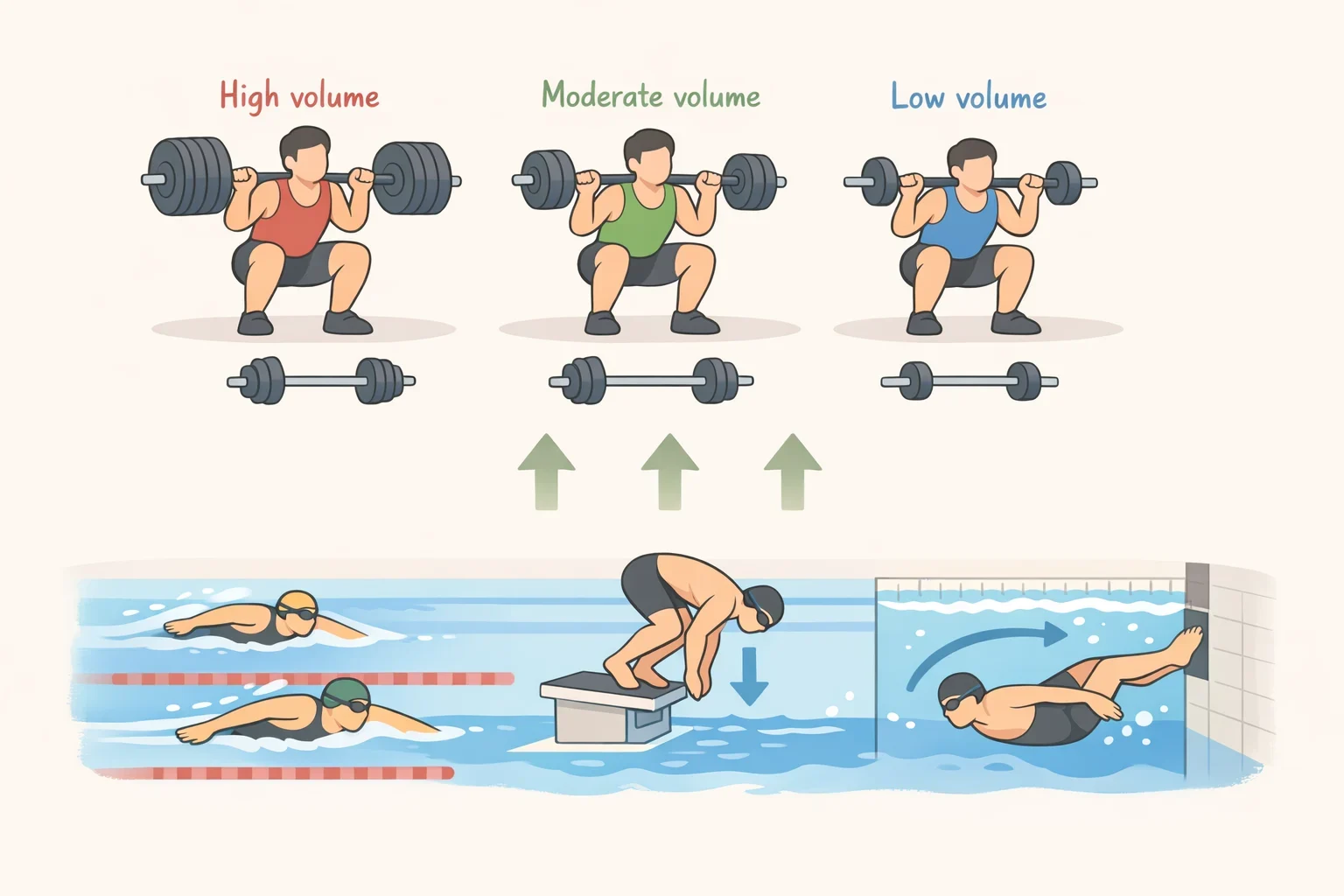
A 2021 randomized trial tested a related question: how much strength training volume swimmers actually need. Researchers split 33 male competitive swimmers, averaging around 16 years old, into high-, moderate-, and low-volume-load maximum-strength groups during a mid-season block from January to March.
All three groups improved 1RM bench press and leg extension strength, along with 25-meter and 50-meter front-crawl times, start speed, and turn performance, with no significant differences between the volume groups. Researchers concluded that low training loads produced results comparable to higher loads in strength training for competitive swimmers, meaning this particular group didn't need large lifting volumes to see a benefit.
That conclusion comes from one study of adolescent male swimmers training mid-season, so it speaks to that group and window specifically. It hasn't been tested in female swimmers, adults, or across a full competitive season, and the 2025 network meta-analysis doesn't fill that gap either. Its second-tier categories compare types of training, not doses.
A separate question: warming up before a race
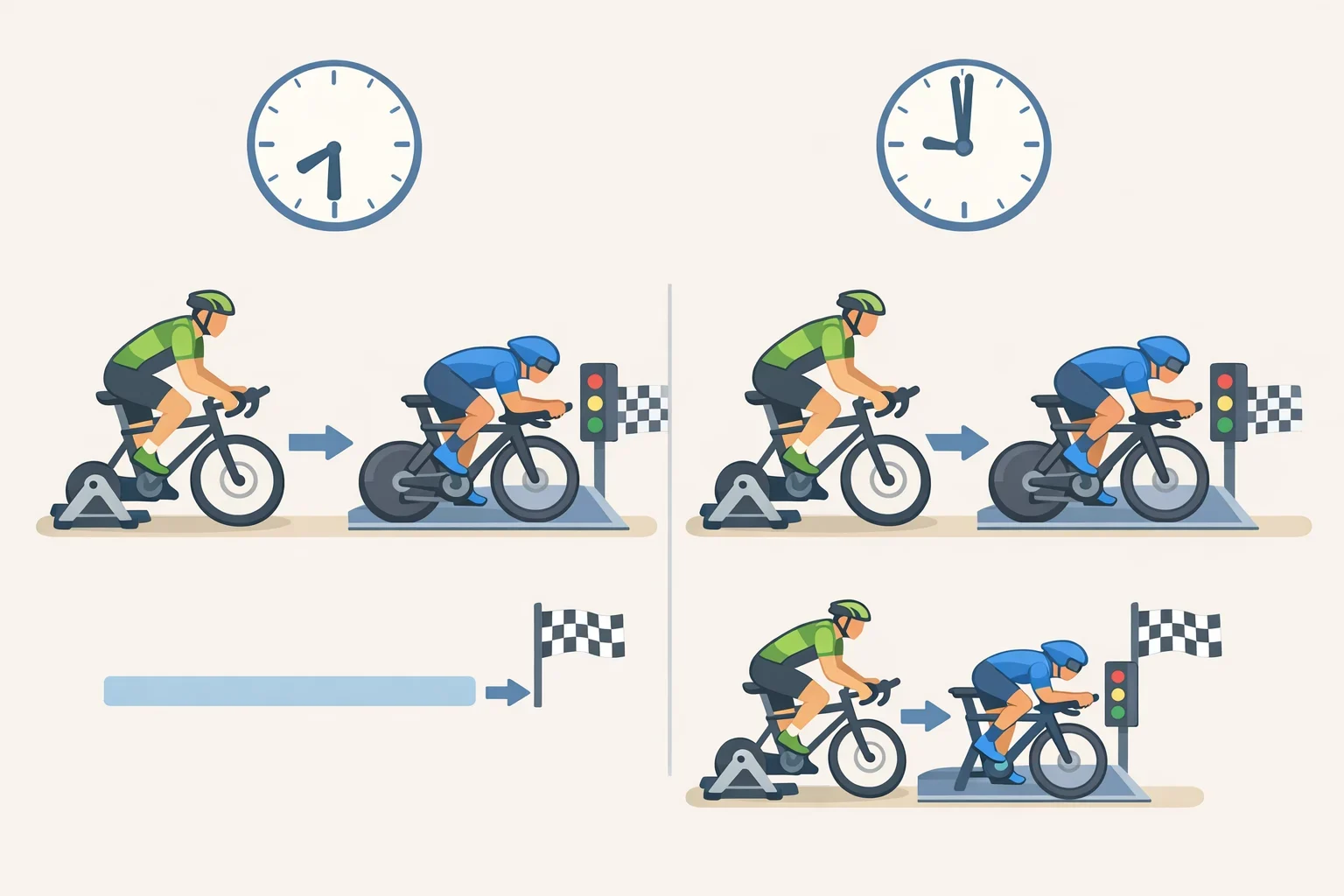
Season-long strength training is a different topic from what a swimmer does in the minutes before a race. A 2022 systematic review of 25 studies found that cutting the gap between a pool warm-up and race start by at least half consistently produced faster time trials, by 1.1% to 1.5% across every included study, while active land-based warm-ups added gains of 0.7% to 0.9%. That's a race-day adjustment, not a substitute for the resistance training discussed above.
Where this leaves swimmers and coaches
The strongest support in this body of research is for layering dry-land resistance training onto existing pool practice rather than replacing swim volume with land work. Combined training is the only category with a significant, well-supported edge over control across multiple outcomes. The review doesn't specify how many sessions per week, which exercises, or what loads to use, so those specifics are decisions to make with a swimmer's age, experience, and current training load in mind, not answers this research settles.
Core or power-focused sessions carry narrower support, tied to specific distances and smaller study networks, so they fit better as an added conversation with a coach once a base resistance routine is established than as a universal add-on. For dryland training for swimmers built around sprint events, that means discussing the option before adding it automatically. Training volume itself doesn't appear to need to be large to produce a benefit, based on the one study that tested this directly in adolescent male swimmers, though that finding hasn't been confirmed in other populations.
Because swim training already places significant repetitive load on the shoulders, new resistance work is generally introduced gradually rather than all at once. Sharp pain, pain that worsens with training, or shoulder discomfort that doesn't settle with rest is a reason to pause and check in with a physical therapist, athletic trainer, or sports medicine provider before continuing.