
- Texas UIL WBGT Heat Rules for High School Sports Explained
- What the UIL rule actually requires
- UIL wet bulb globe temperature requirements and why WBGT isn't the heat index
- Texas high school sports WBGT thresholds and required breaks
- What happens when the reading changes mid-practice
- How often the rule will actually kick in
- Where the rule doesn't reach: contests
- What this means for fall practice
Texas UIL WBGT Heat Rules for High School Sports Explained
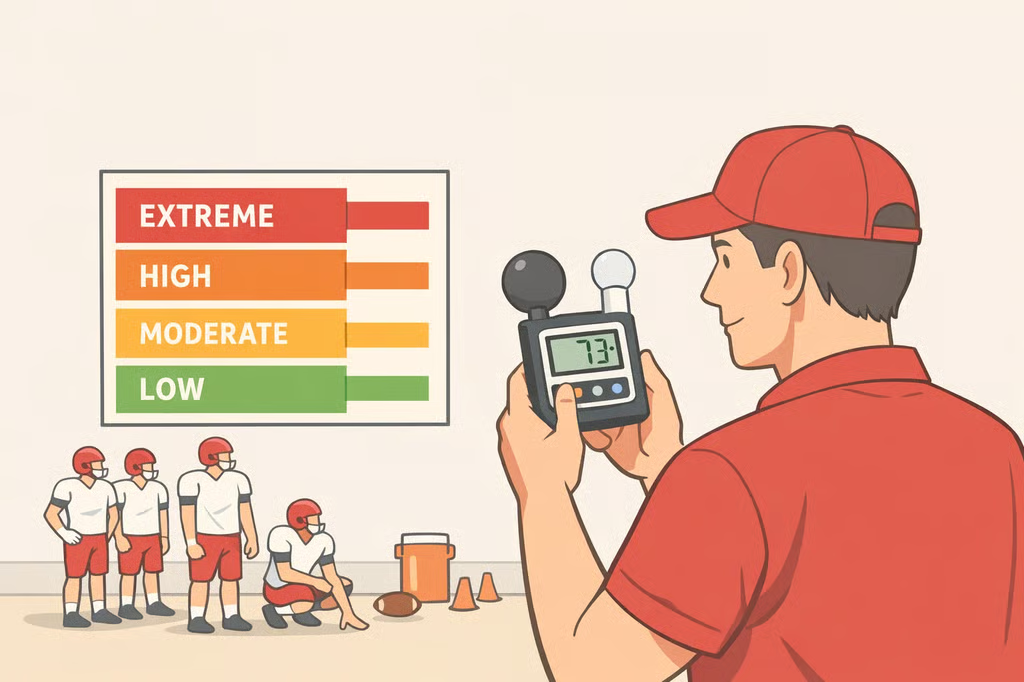
Texas high school teams can no longer eyeball the heat and decide whether to practice outside. As of August 1, 2026, UIL member schools must take a wet bulb globe temperature (WBGT) reading before every outdoor practice, according to the UIL's heat stress FAQ. That reading determines whether UIL-mandated breaks, time limits, equipment restrictions, or cancellation apply.
The Texas UIL WBGT heat rules for high school sports replace three years of voluntary guidance with a hard requirement. Depending on what the device shows, a team could run a full three-hour practice or lose the day entirely, TPR reported.
Readings have to be taken within 15 minutes before outdoor activity starts and every 30 minutes throughout practice or workouts, per the UIL FAQ. Texas now joins at least 17 other states that require WBGT to guide outdoor practice decisions, TPR reported.
The change follows three years of the UIL Medical Advisory Committee recommending, rather than requiring, WBGT protocols. Based on ongoing medical research and accepted national best practices, the committee recommended making those protocols required standards, and the UIL Legislative Council approved the change effective for the 2026-2027 school year (UIL FAQ).
What the UIL rule actually requires
The requirement covers every outdoor athletic practice and marching band activity across UIL member schools, not just football, according to the UIL's official heat stress page. Schools have to use a scientifically approved WBGT instrument, or another scientifically proven method such as internet-based weather station software or an app, to take readings (UIL).
That covers practices and workouts specifically. Contests, including football games and track meets, fall under a separate set of expectations addressed later in this article.
UIL wet bulb globe temperature requirements and why WBGT isn't the heat index
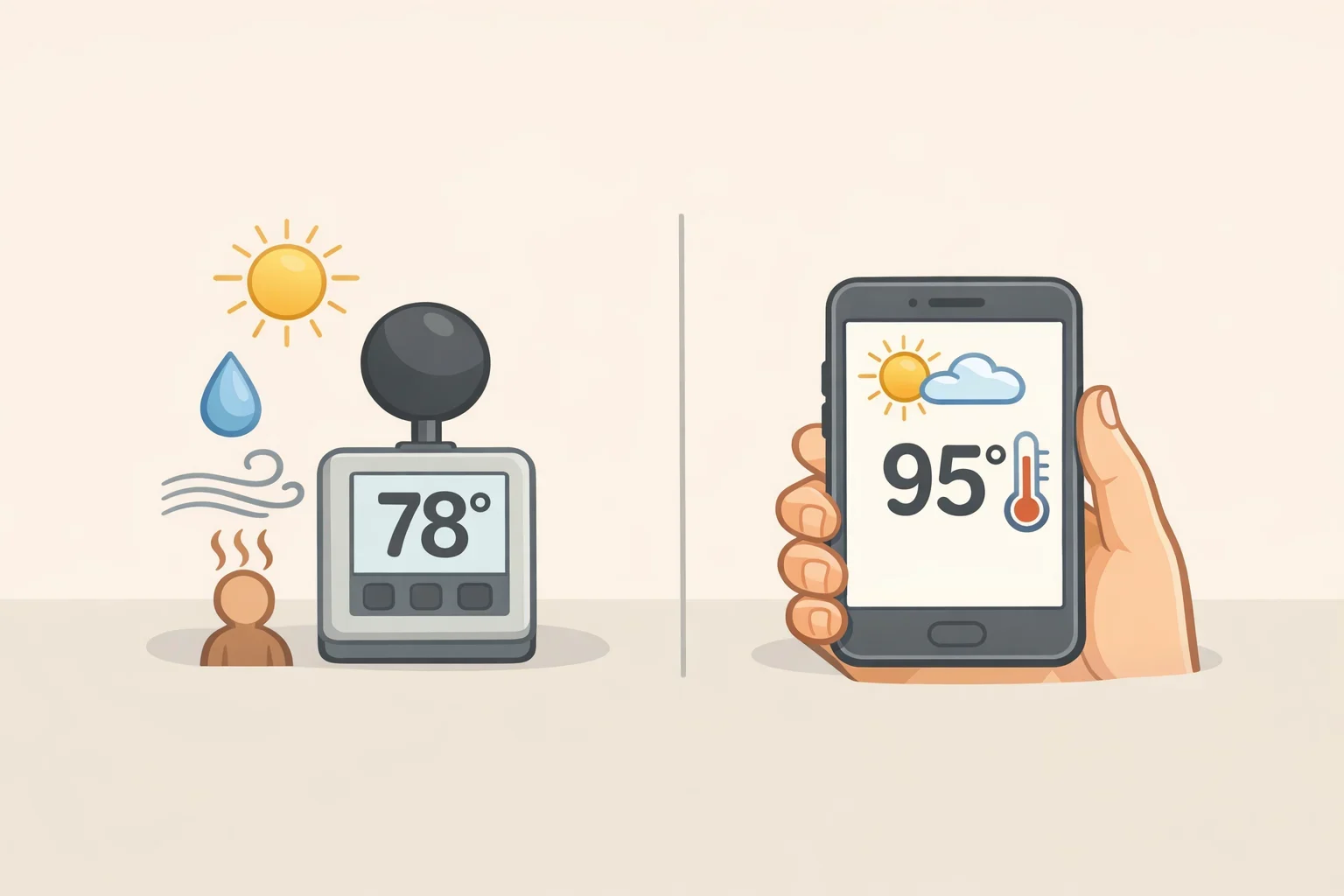
WBGT is not the number on a weather app. It factors in air temperature, humidity, wind speed, and cloud cover to produce a broader measure of heat stress than air temperature alone, according to TPR and the NFHS.
It's expressed in degrees, but the scale doesn't translate directly to Fahrenheit. A WBGT reading of 86 is not the same thing as an 86-degree day on a phone forecast, and the measure is considered more informative than heat index for calculating how much time is safe to spend outdoors (TPR).
This standardization push isn't unique to Texas. The NFHS Foundation has provided WBGT devices to more than 5,000 high schools nationally, part of a broader effort to get programs measuring heat stress consistently instead of relying on how the air feels (NFHS).
Texas high school sports WBGT thresholds and required breaks
The rule works on a sliding scale. As the WBGT reading climbs, practice time shrinks and equipment restrictions tighten. In most parts of the state, a reading under 82 allows a full three-hour outdoor session with no required modifications, according to TPR's reporting on the new UIL chart:
WBGT reading What changes for outdoor practice Below 82 Full three-hour practice allowed in most parts of the state; no modifications required Higher than 82 At least three 4-minute breaks per hour; on-site rapid cooling zone required Above 87 Practice capped at two hours; at least four breaks per hour; football players wear shorts instead of pads Above 90 Practice capped at one hour; no pads or helmets; conditioning drills prohibited 92.1 or higher Practice moves indoors or is canceled
The rapid cooling zone requirement runs on its own separate threshold. UIL rules call for a cooling zone whenever outdoor athletic or marching band activity happens at a WBGT of 79.7 or higher for Class 2 schools, or 82.0 or higher for Class 3 schools (UIL FAQ). The UIL's heat guidance doesn't spell out what defines a Class 2 or Class 3 school; coaches, parents, and athletic directors who aren't sure which applies should confirm with the athletic department rather than guess.
Wherever the threshold falls, the cooling zone itself has one job: full-body ice-water immersion for anyone showing signs of heat illness or distress (UIL FAQ).
The urgency behind that setup comes down to timing. Heat stroke, the most severe form of heat-related illness, leaves only about a 30-minute window for life-saving cooling once it's identified, according to NFHS. Not every heat complaint during practice reaches that level of severity, but the cooling zone has to be ready either way.
What happens when the reading changes mid-practice
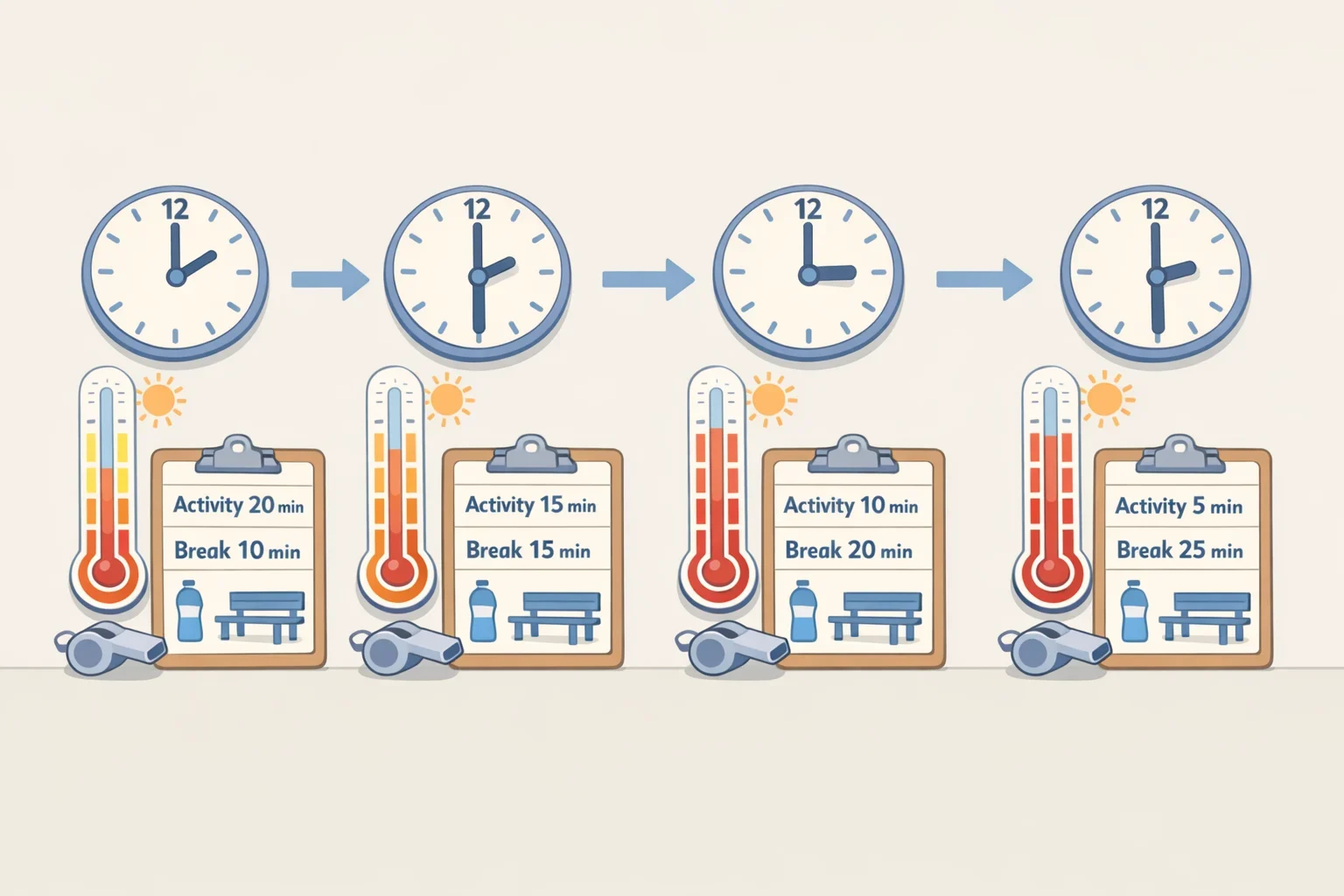
The UIL requires a new WBGT reading every 30 minutes during practice, but its published FAQ doesn't spell out whether a fresh reading changes the applicable tier the moment it's taken, or whether a session already underway finishes at its current tier before anything adjusts (UIL FAQ). Coaches building practice schedules should plan to reassess after every reading rather than assume the plan drawn up that morning still holds two hours later.
How often the rule will actually kick in
The thresholds aren't a rare emergency measure in much of Texas. Perry Weather tracked WBGT readings across the eight regions of the Texas High School Athletic Directors Association last year, and the Houston region hit the no-outdoor-workout benchmark on eight days, the one-hour cap on 13 days, and the two-hour range on 23 days, TPR reported. Most of those concerning readings clustered between 11 a.m. and 5 p.m.
Morning practice isn't automatically exempt, either. One early-morning practice in Katy earlier this month still registered a WBGT of 86.2, high enough on its own to trigger shortened practice time and the shorts-only rule for football, according to TPR. That single reading doesn't mean every early practice lands in that range, but it shows that air temperature alone won't tell a coach what's actually happening.
Where the rule doesn't reach: contests
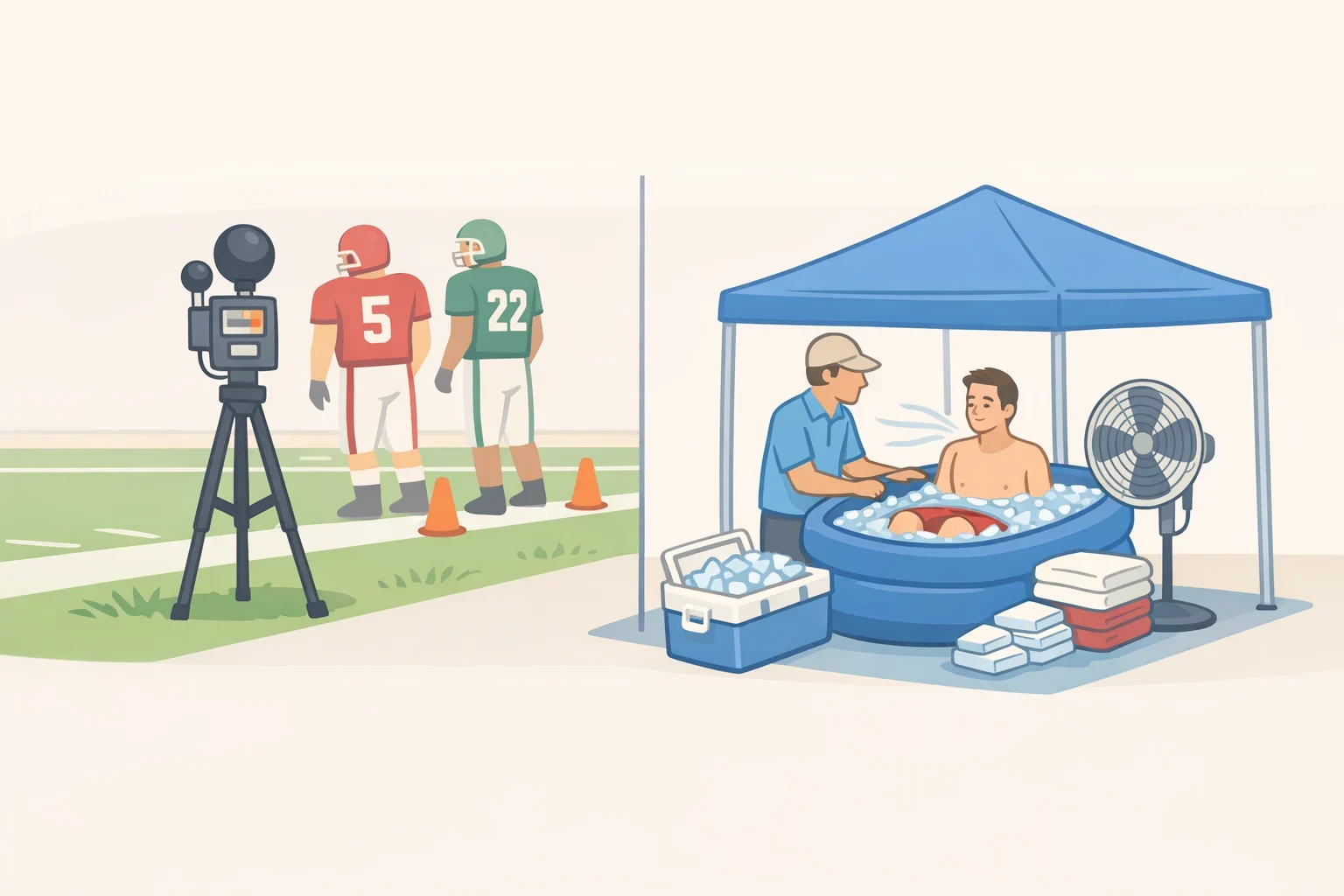
The duration and equipment limits above apply to practices and workouts. A football game or track meet isn't bound by the same two-hour caps or shorts-only rules that govern practice, per TPR and the UIL FAQ.
That doesn't mean contests go unmonitored. Schools still have to track WBGT during games, maintain the same rapid cooling zone requirement, and make what the UIL calls "responsible modifications" for player safety (UIL FAQ). Separate recommended best practices exist for modifying games played in high temperatures, Harrison told TPR.
What this means for fall practice
The rule applies to UIL member schools running outdoor practices, workouts, and marching band sessions this fall. The biggest exception sits with contests: games and meets carry monitoring and cooling-zone obligations, but not the duration and equipment caps that now govern practice.
Coaches and athletic directors should confirm their school has an approved WBGT instrument or app running, and that a rapid cooling zone capable of full-body ice-water immersion is set up before outdoor sessions start. Parents and athletes can ask a coach or athletic trainer how WBGT readings are being tracked and shared during practice.
Whatever the device reads at any given moment, an athlete showing signs of heat illness or distress needs to reach the rapid cooling zone right away. UIL guidance calls for emergency action plans that identify how to recognize heat illness, when to activate EMS, and how to deliver rapid cooling through cold-water immersion or an equivalent method (UIL FAQ). The chart governs what a team has to do before that point. The emergency plan is what matters once a player needs care immediately.