
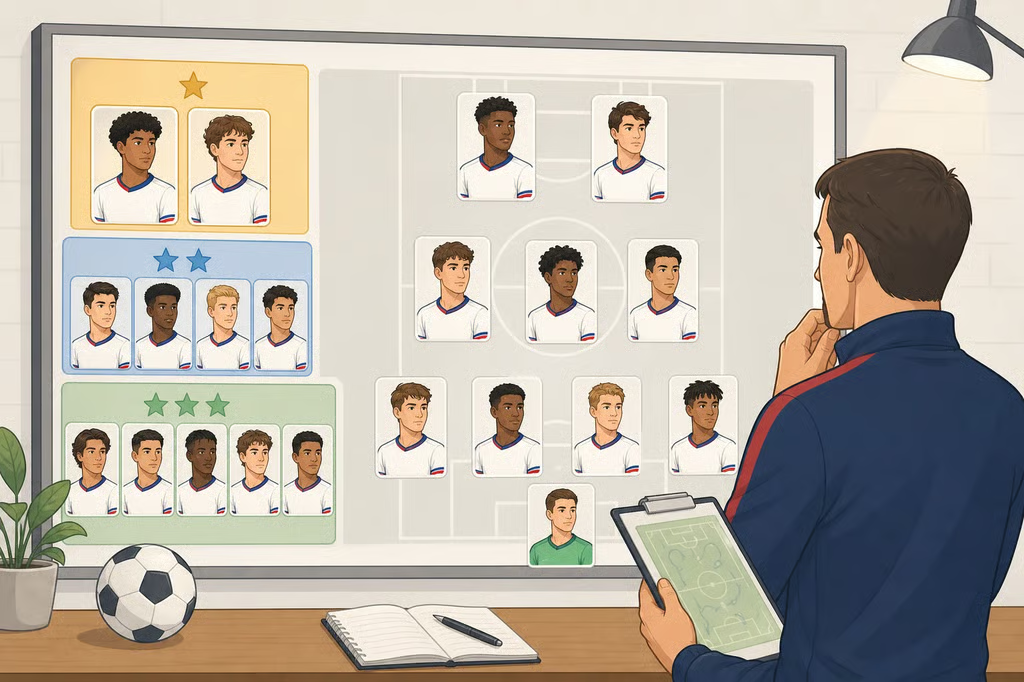
USMNT young core for 2026 World Cup: tiers and proof
The United States men’s national team entered the 2026 World Cup with a group that was young, talented, and difficult to evaluate as one unit. Malik Tillman and Yunus Musah had already accumulated senior experience. Diego Luna had a credible case for a larger role. Cade Cowell, Paxten Aaronson, and Kevin Paredes remained less settled at the highest level.
That distinction mattered more than the team’s personality. The “swag” framing that surrounded the United States during the 2025 Concacaf Gold Cup captured confidence and style, but it could not answer the practical question facing Mauricio Pochettino: which young players had become dependable senior contributors?
Pochettino became USMNT head coach in September 2024, according to U.S. Soccer. The United States co-hosted the 2026 World Cup with Canada and Mexico, and the host nations received automatic qualification under the tournament arrangement, according to FIFA.
That qualification path shaped the evaluation. This group did not have to navigate a conventional qualifying campaign together before reaching the tournament. The Gold Cup and other senior-team matches supplied useful evidence, but neither could fully replicate a World Cup environment.
The supplied source material does not include verified 2026 lineups, player minutes, opponents, goals, assists, or match-by-match roles. A post-tournament verdict therefore cannot responsibly be assigned to individual players here. What can be assessed is the hierarchy established before the World Cup: which players had already built a case, which were close, and which still needed senior-team proof.
Three tiers make the comparison clearer
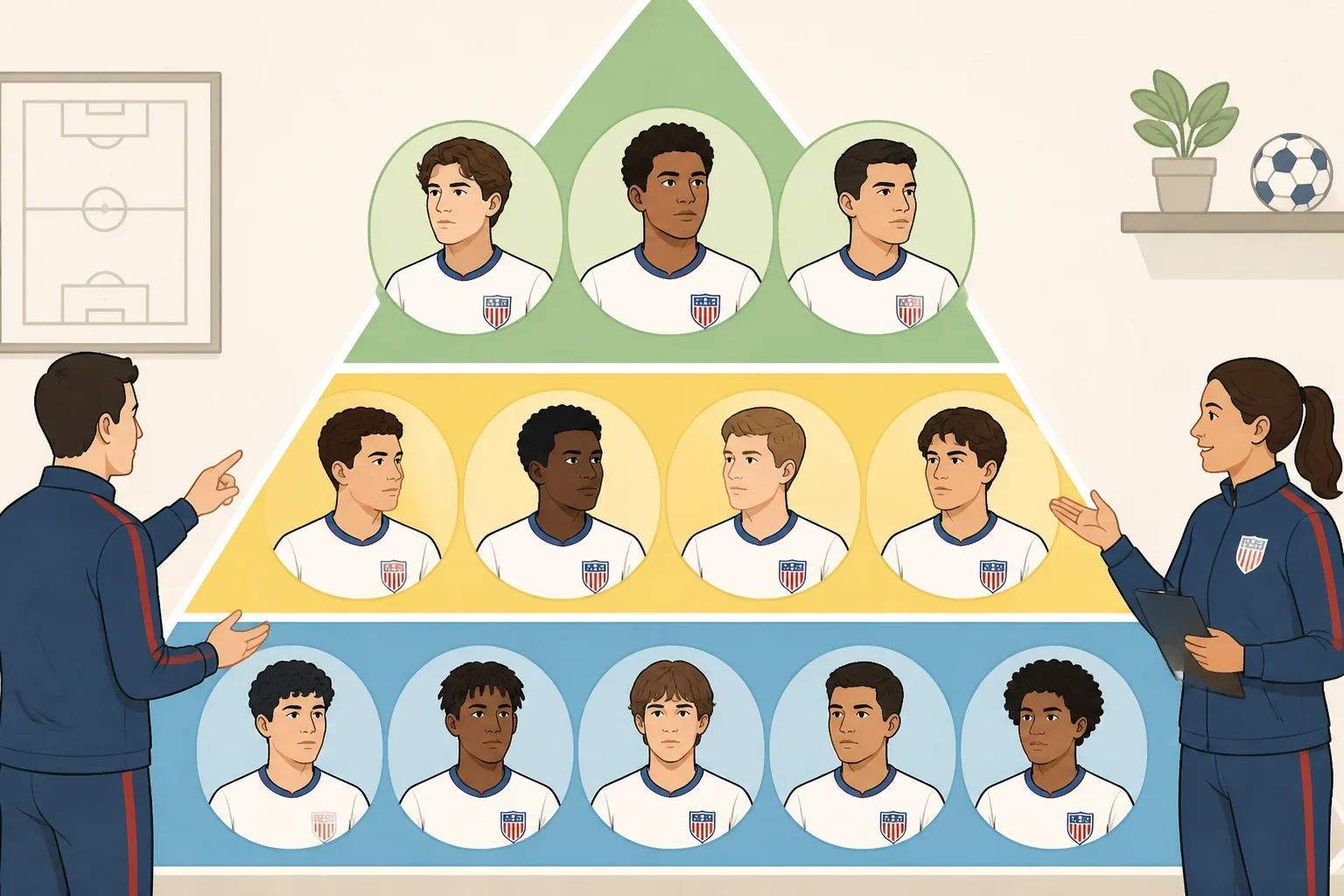
“Young core” is a convenient label, but it hides different levels of readiness. A player with regular first-team club responsibility and double-digit international caps is not in the same position as a prospect with a few appearances and inconsistent senior minutes.
A workable pre-World Cup framework uses three evidence categories:
- Established contributors: regular senior club or international roles, with meaningful experience already accumulated.
- Credible roster contenders: evidence of first-team responsibility or tournament contribution, but not yet a settled place in the national-team hierarchy.
- Longer-term prospects: senior-team potential and some international exposure, but limited or inconsistent top-level club responsibility.
The categories are not talent rankings. They describe the amount and quality of evidence available before the tournament. Club transfers, caps, and tournament appearances should not be treated as interchangeable measures.
Tier 1: Established contributors
Malik Tillman and Yunus Musah belonged in the first tier based on the supplied pre-tournament information. Tillman was described as a regular first-team player for PSV Eindhoven in the Dutch Eredivisie, while Musah held a rotation role at a top-division European club. Both were also described as having double-digit international caps, with support attributed to PSV and U.S. Soccer.
Those descriptions point to different levels of club responsibility. A regular first-team role suggests repeated involvement, while a rotation role indicates a player moving in and out of the lineup. That difference matters when assessing whether a player can be trusted in a major tournament, especially when the national team has several options in similar positions.
Tillman’s case was the more straightforward of the two. His PSV role supplied a clear weekly platform, and the combination of club minutes and international experience gave him a stronger pre-tournament foundation than a player known primarily for potential.
Musah’s inclusion in this tier depended more heavily on accumulated senior-team experience than on a claim that he was an automatic club starter every week. That did not make his case weak. It meant the evidence came from a different balance of club role and national-team trust.
Tier 2: Credible roster contenders

Diego Luna and Caleb Wiley fit the second tier. Luna was described as a regular starter for Real Salt Lake, according to MLS. Wiley moved from Atlanta United to Ligue 1 side Strasbourg, according to RC Strasbourg Alsace.
Luna had the clearest route upward. Regular MLS starting responsibility gave him a consistent club platform, and his Gold Cup contribution added senior international evidence. That combination made him more than a developmental name, even if it did not automatically establish him as a World Cup starter.
Wiley’s case required more caution. A move to Strasbourg indicated a higher-level opportunity, but a transfer itself was not proof of first-team performance. The relevant question was whether the move produced regular senior minutes and whether those minutes translated to national-team trust.
That distinction is easy to lose in young-player discussions. A promising transfer can strengthen a player’s trajectory, but it does not equal a starting role. The player still has to convert the opportunity into appearances, minutes, and responsibility.
Tier 3: Longer-term prospects
Cade Cowell, Paxten Aaronson, and Kevin Paredes were identified as players with senior-team caps but less consistent first-team club minutes at the top level, according to U.S. Soccer.
This tier should not be read as a dismissal. It describes incomplete evidence. A player may possess the technical qualities required for a major role while still lacking the repeated senior minutes that allow a national team to rely on him in different match situations.
The three players also should not be treated as identical. Their club situations, positions, and pathways differed. The common point was that their pre-tournament evidence did not place them alongside Tillman or Musah as established contributors.
That is the value of the three-tier system. It prevents a broad “the young players are ready” narrative from turning every prospect into the same kind of success story. Tier 1 represented accumulated proof. Tier 2 represented a case gaining strength. Tier 3 represented potential that still needed confirmation.
What the 2025 Gold Cup actually showed
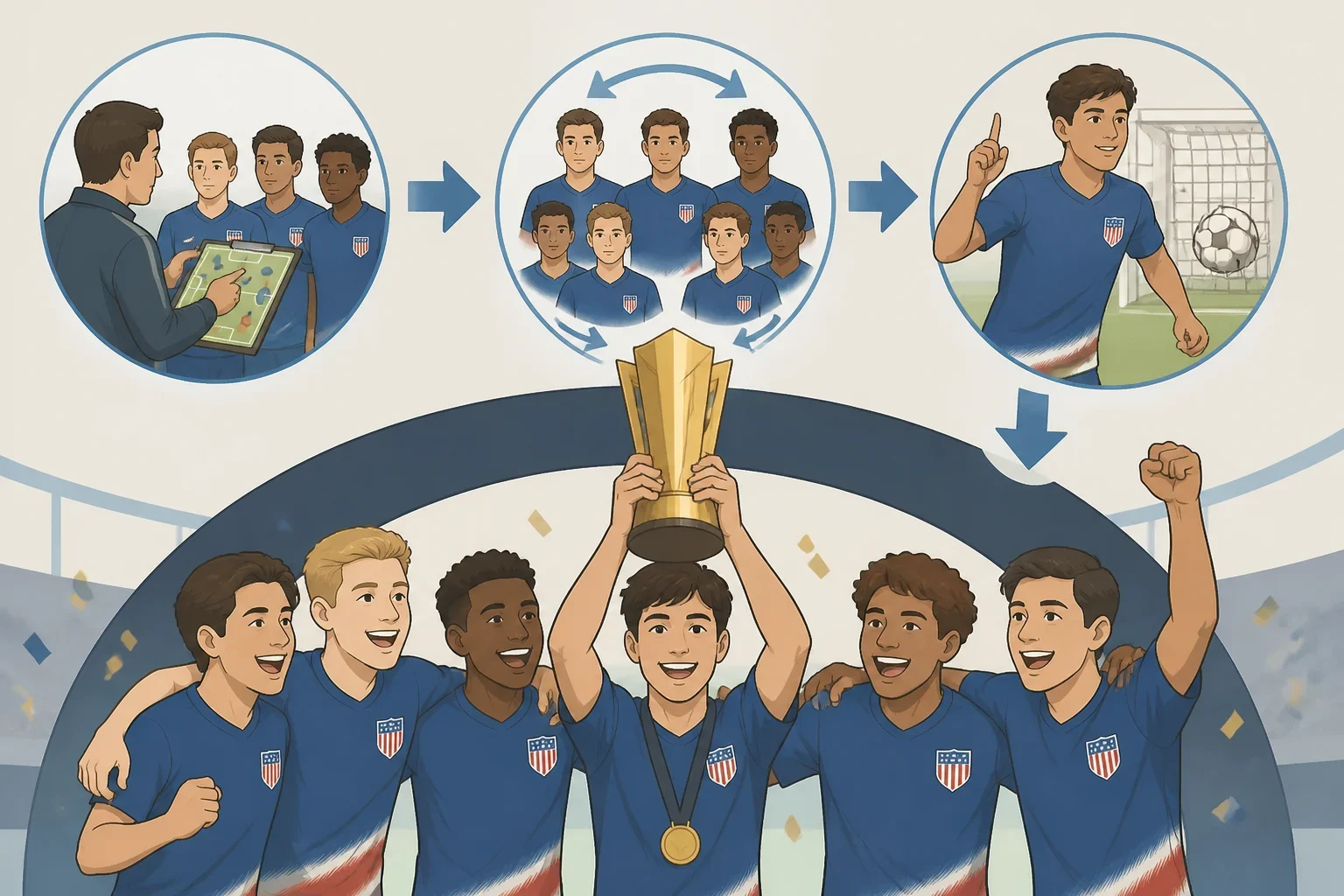
The 2025 Concacaf Gold Cup was the strongest pre-World Cup evidence that the United States had useful depth beyond its most familiar regulars. Pochettino rested a number of established players, and the younger squad reached the final before losing to Mexico, according to Concacaf. Diego Luna was among the U.S. scorers, according to Concacaf.
For Luna, that was a meaningful step. He was not merely being discussed as a future option. He contributed in a senior international tournament and helped a younger group reach the title match. That strengthened the argument for giving him a larger role.
The run also showed that the United States could remain competitive with a less familiar lineup. This mattered for a tournament roster. A team needs more than its preferred starting group, and the Gold Cup supplied evidence that several younger players could handle international responsibility when called upon.
The evidence had limits, though. A regional tournament was not the same test as a World Cup. The opposition, tactical variety, and margin for error differed. Reaching the final therefore demonstrated depth and composure, not automatic World Cup readiness.
That distinction was particularly important for Luna. His Gold Cup performance supported promotion from the prospect conversation into the credible-contender tier. It did not settle whether he could start against the strongest opponents or maintain that level across a full World Cup schedule.
The same reasoning applied to the other young players. Tournament appearances mattered, but the quality of the opposition and the player’s specific role mattered just as much. A substitute appearance, a start, and a full-match contribution were different forms of evidence.
The 2022 generation set a higher comparison point
The previous USMNT generation offered a demanding benchmark. Christian Pulisic, Weston McKennie, Tyler Adams, and Gio Reyna were part of the United States team at the 2022 World Cup, according to The Athletic.
They did not all carry the same responsibility. Pulisic, McKennie, and Adams were treated as regular starters, while Reyna had a more limited role and did not start against the Netherlands, according to The Athletic. Any comparison that describes all four as equally established would blur the difference between being selected and being trusted from the opening whistle.
Pulisic and McKennie also entered that tournament with major European club experience at Chelsea and Juventus, respectively, according to The Athletic. Their club affiliations did not, by themselves, prove identical weekly roles, but they established a demanding standard for the newer group.
The comparison should therefore focus on responsibility rather than reputation. The question is not whether the current young players had attractive club résumés. It is whether they had reached the same level of repeated first-team exposure and senior international trust at a comparable stage.
Tillman was the strongest counterpoint. His regular Eredivisie role at PSV, attributed to PSV, suggested a senior club platform that could compare favorably with parts of the earlier generation’s development path. That did not establish that the two groups developed at the same speed. It did show why the current group should not be dismissed as behind simply because it had not produced another Pulisic or McKennie.
The earlier group also had a completed World Cup knockout appearance before the next cycle began. The United States faced the Netherlands in the Round of 16 at the 2022 tournament, giving its leading players a form of evidence the newer group could earn only in 2026. Pre-tournament club form could suggest readiness. It could not replace responsibility under World Cup conditions.
What would have changed each player’s standing

The most useful post-tournament assessment would compare players using the same evidence rather than relying on reputation. Four checks matter:
- Starting role: A World Cup start would demonstrate a higher level of trust than roster inclusion alone.
- Meaningful minutes: Repeated minutes against strong opposition would carry more weight than a brief appearance in a favorable match state.
- Production: A goal or assist would add evidence of contribution, though one attacking action would not establish a permanent role.
- Tournament involvement: A player who remained unused or marginal would not qualify as a proven contributor, even if his club potential remained obvious.
The squad-size rules also created competition among players across the three tiers, according to FIFA. Making the roster would show that Pochettino valued a player’s profile for that tournament. It would not automatically show that the player had become part of the team’s central group.
The same caution applies to a player who missed the roster. Exclusion would not settle that player’s long-term ceiling. It would establish only that he did not contribute to that particular World Cup squad.
Because verified tournament records are not included in the supplied material, the final comparison has to stop short of declaring who proved the case. The proper next step is to check the official match and lineup records, then apply the same standard to every player.
The defensible judgment
Before the 2026 tournament, the United States had an encouraging young core, but it did not have one finished young core.
Tillman and Musah entered with the strongest cases because they already had established senior experience. Luna had the best argument for moving upward after the Gold Cup, where his contribution showed that he could handle meaningful international responsibility. Wiley had a credible path into the conversation through his move to Strasbourg, but the transfer itself could not establish his national-team role.
Cowell, Paxten Aaronson, and Paredes remained more difficult to classify. Their caps and potential mattered, but limited top-level club responsibility left the central question open: could they be trusted repeatedly at the highest level?
The Gold Cup answered part of that question. It showed depth and gave Luna a stronger case. It did not provide an equivalent answer to the World Cup test.
The “swag” framing was useful as a description of confidence and personality. It was never a ranking system. The meaningful hierarchy depended on starts, minutes, opponents, and production, with each player assessed against the same standard.
The pre-tournament evidence pointed to a group with a strong foundation rather than a completed verdict. Tier 1 players had already accumulated senior evidence. Tier 2 players were pushing into larger roles. Tier 3 players still needed more consistent club and international responsibility.
Readers evaluating the group after the tournament should check official FIFA and U.S. Soccer match records for which players actually started, logged meaningful minutes, and contributed against the strongest opponents. That comparison, rather than the pre-tournament narrative, is the real test of whether this young core held up.