
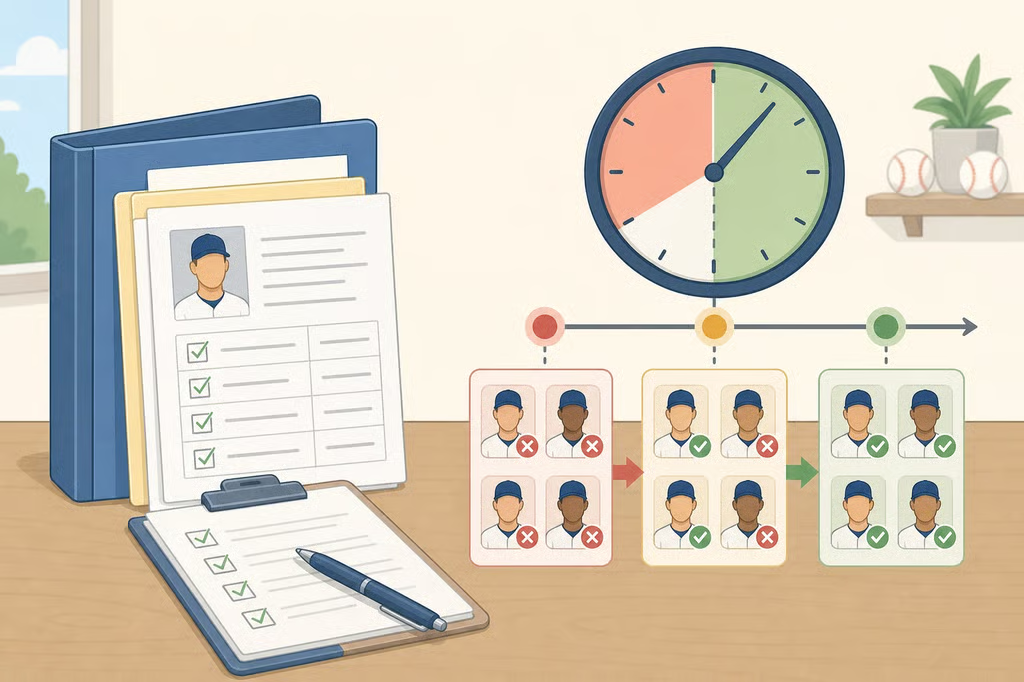
By September, MLB contenders are no longer deciding which late additions can preserve a path to October. That deadline has passed. For 2026, players who were on a club’s 40-man roster before Sept. 1, or on its 60-day injured list entering September, are automatically eligible for the postseason. Players outside those groups can still qualify in limited circumstances if they were already in the organization by Aug. 31.
Those rules determine who can be considered for October, but eligibility does not guarantee playing time. Clubs submit a separate 26-player roster before each postseason series and can make changes between rounds, according to MLB’s postseason roster rules.
That distinction matters for September call-ups, injured players, Minor League prospects and late-season acquisitions. A player can meet MLB’s postseason eligibility requirements and still be left off a particular series roster.
Who qualified for the 2026 MLB postseason
A player did not need to be on the active 26-player roster by Aug. 31 to qualify automatically for postseason play. Instead, automatic eligibility covers players who were on the 40-man roster before Sept. 1 and those who entered September on the 60-day injured list.
That means a player can spend much of the season in the Minor Leagues and remain eligible for October if he is on the 40-man roster. He does not need to have appeared in a Major League game during the regular season.
There is also an exception for players outside the 40-man roster. A club can petition the Commissioner’s Office to add one of those players as an injury replacement if he was already in the organization by Aug. 31. The injured player being replaced must have served the minimum required time on the injured list before the substitution can be approved.
Players who were on the restricted list as of Sept. 1 can also be eligible, provided they were not suspended for performance-enhancing drugs during the season. A player who served a PED suspension during the year cannot participate in that season’s postseason.
The cutoff is firm for players who arrive later. Anyone who joins an organization after Aug. 31, including a player signed or claimed off waivers in September, cannot appear on that club’s postseason roster.
How late roster moves affect postseason eligibility
The Aug. 31 postseason cutoff is separate from the MLB Trade Deadline.
In 2026, the MLB Trade Deadline fell on Aug. 3 at 6 p.m. ET. That was the final point in the season when players signed to Major League contracts could be traded from one club to another. MLB eliminated its former system of post-deadline waiver trades before the 2019 season.
Player movement does not stop completely after the Trade Deadline. Clubs can still place players on outright waivers, and Minor League players who are not on 40-man rosters can still be traded. The Aug. 31 postseason cutoff creates a separate question: whether a player who changes organizations late in the season can still be used in October.
For example, outright waivers remain available after the Trade Deadline. Under MLB’s outright-waiver rules, teams with worse winning percentages receive priority when multiple clubs claim the same player. A successful claim also transfers responsibility for the money remaining on the player’s contract, and the player joins the claiming club’s 40-man roster.
Timing still determines his postseason options. A player who joins a new organization by Aug. 31 can retain a path to October under MLB’s eligibility rules. A player who joins that organization in September cannot appear on its postseason roster.
How teams choose their 26-player postseason roster
Postseason eligibility only makes a player available for selection. A club must still decide which 26 players it wants for each series.
Teams file a new postseason roster before every round, so the group can change as the playoffs progress. A player left off the Wild Card Series roster, for example, could still be selected for the Division Series, League Championship Series or World Series.
The current MLB postseason format has 12 teams, with six from each league. Each league sends its three division winners and three Wild Card teams to the playoffs. The top two seeds receive first-round byes, while the remaining clubs compete in best-of-three Wild Card Series.
For 2026, the postseason begins Sept. 29. By then, teams will have had several weeks since the eligibility cutoff to evaluate injuries, recent performance and potential matchups before setting their opening playoff rosters.
Those choices can vary by opponent. One series could call for another relief pitcher, while another might favor a faster bench player or someone returning from injury. An eligible player can therefore move on or off the roster between rounds depending on what the club needs.
What happens after a postseason injury
An injury during a playoff series can also lead to a roster change.
A club can seek permission from the Commissioner’s Office to replace an injured player before the series ends. Pitcher replacements must also be pitchers, while position-player replacements must be position players.
There is a cost to making that move. Once replaced, the injured player cannot return for the rest of the current series or for the following postseason round if his team advances.
That restriction prevents injury substitutions from becoming a routine way to cycle players on and off the roster during a series. Teams have a way to replace someone who cannot continue, but the decision can affect their options in the next round as well.
How to check whether a player is postseason-eligible
For a player whose October status is unclear, start with his roster status entering September.
First, check whether he was on the club’s 40-man roster before Sept. 1. If so, he is automatically eligible. A player who was on the 60-day injured list entering September also qualifies.
If neither applies, check whether he was already in the organization by Aug. 31. He may still be approved as an injury replacement if the player he would replace has satisfied the applicable injured-list requirement.
Next, check when he joined his current organization. A player acquired, signed or claimed after Aug. 31 cannot play for that club in the postseason.
Finally, check the 26-player roster filed for the series in question. Being postseason-eligible only makes a player available for selection; it does not guarantee a place on every playoff roster.
For fans following September call-ups and late roster moves, that is the key distinction: Aug. 31 determines which players can still have a route to October, while each series roster determines who actually gets to play.