
- NCAA Transfer Portal August 10 Deadline: What the Rules Say
- What the NCAA has documented about transfer timing
- Transfer windows and eligibility periods are separate systems
- NCAA transfer portal eligibility requirements for newly eligible athletes
- How the NCAA five-year eligibility period is calculated
- Before entering the portal: what to verify
NCAA Transfer Portal August 10 Deadline: What the Rules Say
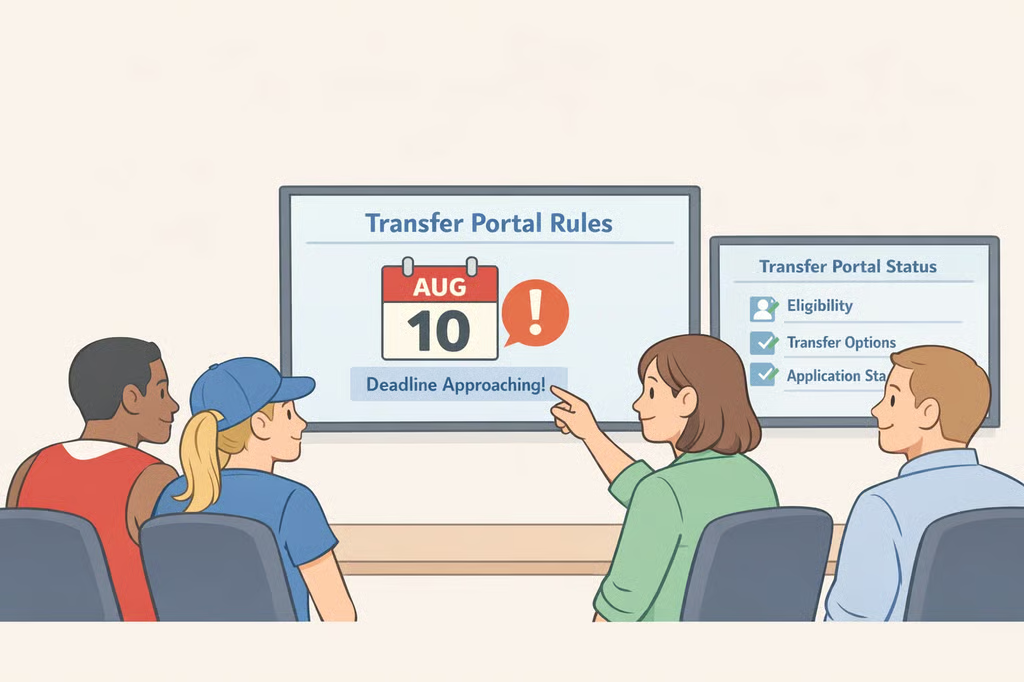
No NCAA rule or governing-body page reviewed for this story sets a nationwide transfer portal deadline of August 10, 2026. That's the direct answer to a question circulating among college athletes and families this week: does an NCAA transfer portal August 10 deadline actually exist, and if so, who does it apply to?
The two NCAA pages most likely to contain a universal cutoff, the NCAA's transfer rules and eligibility page and its Division I and II age-based eligibility rules page, don't mention one. That doesn't prove no sport or conference has adopted its own August date; this article's sourcing doesn't cover every sport and division's transfer calendar, and readers should confirm their own sport's rule directly with a compliance office rather than assume either way.
Part of the confusion likely traces back to a separate NCAA update. The Eligibility Center said in guidance issued last month that it planned to add age-based eligibility information to student accounts in early August (NCAA, last month). Whether that update had gone live by August 10 couldn't be confirmed from the source material reviewed here, and the NCAA described it as a planned system update, not a deadline for athletes to act.
This matters to two different groups, and each is governed by a different set of rules. Current Division I and II athletes deciding when to enter the portal need to know their sport's transfer window. Incoming 2026-27 enrollees trying to figure out how many seasons they have left need the new age-based eligibility rule instead. Here's what's actually confirmed about both.
What the NCAA has documented about transfer timing
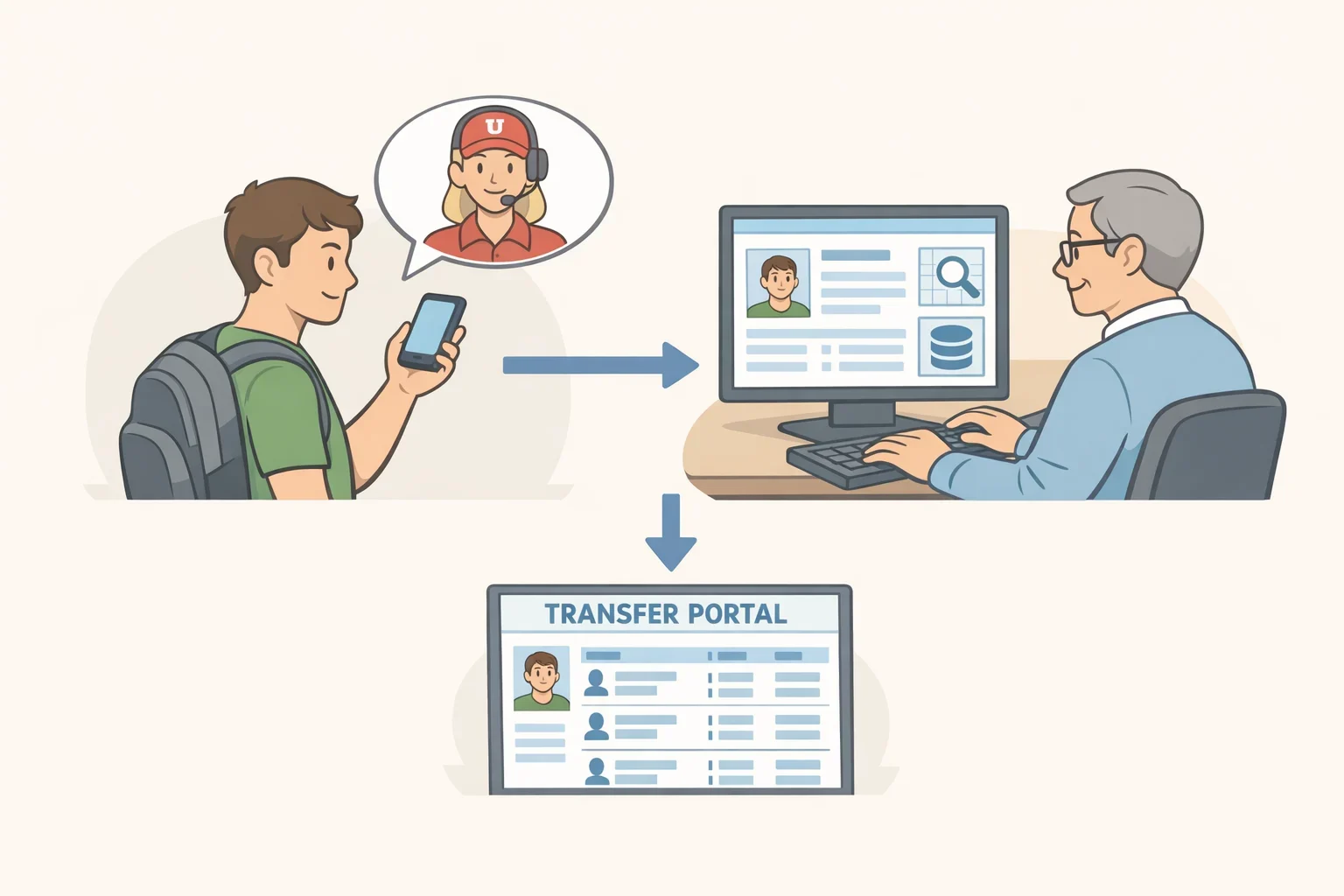
Portal mechanics are straightforward. An athlete notifies their current school of intent to transfer, and the school, not the athlete, enters the name into the Transfer Portal database (NCAA, two months ago).
Real transfer windows exist, but they're set sport by sport and division by division. The clearest example in current guidance is Division II football, which requires athletes to start the notification process during a Jan. 2-16 window, a rule that took effect June 1 this year (NCAA, this spring). Once that window closes, a Division II football player has to wait for the separate Division I football transfer window before initiating a transfer.
That's the only sport-specific window documented in the material reviewed for this article. Other sports and divisions may run on entirely different calendars. Check with your compliance office before assuming any single date applies to your sport.
Transfer windows and eligibility periods are separate systems
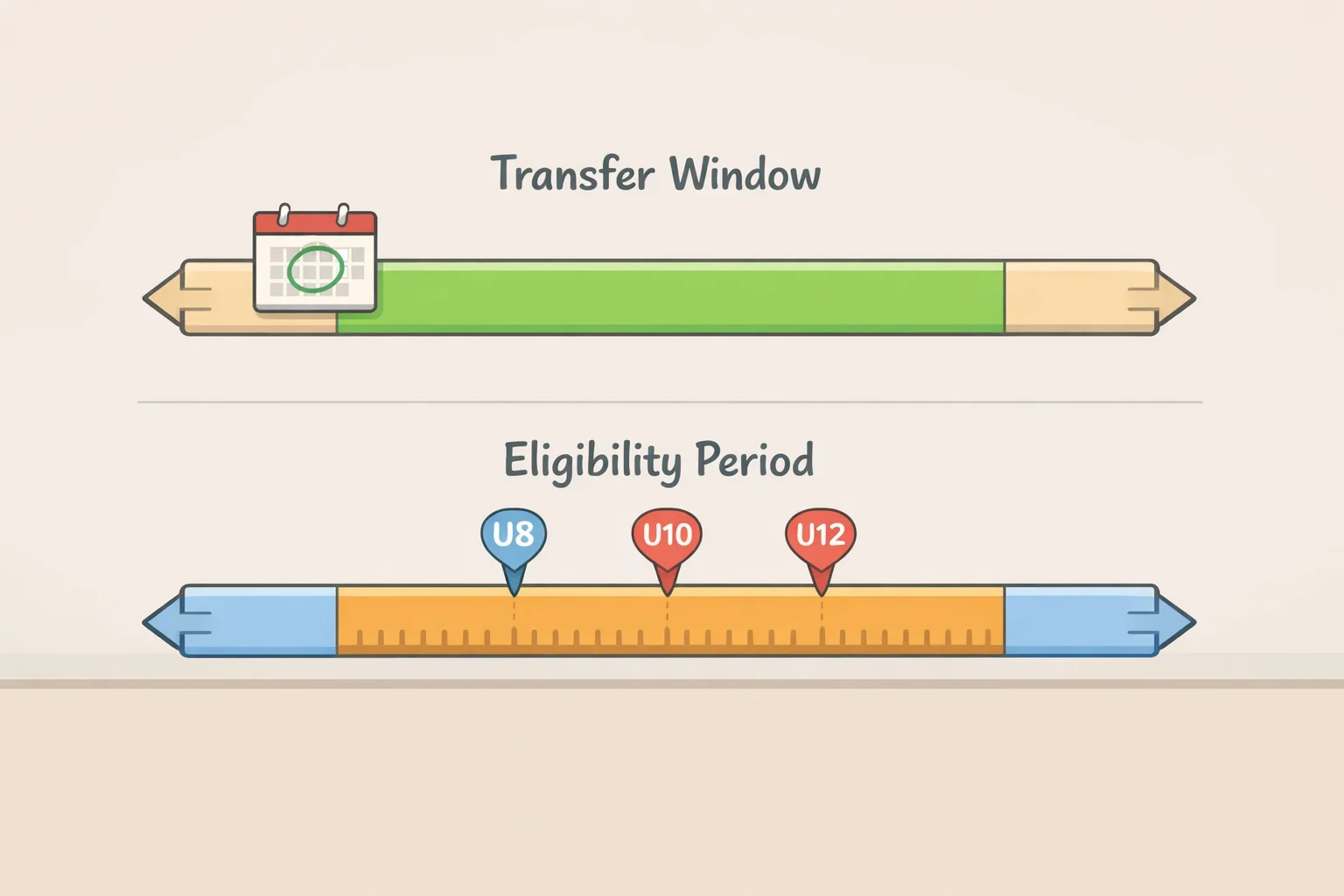
It's worth separating these clearly, because they get conflated often. Transfer windows control when an athlete may start the transfer process. The age-based eligibility rule controls how much competitive eligibility a Division I or II athlete has left, based on age and enrollment history, not on when they transfer (NCAA, last month). An athlete can be fully inside a legal transfer window and still have questions about how many seasons remain, or vice versa.
NCAA transfer portal eligibility requirements for newly eligible athletes
The new rule replaces the old season-count-and-waiver system with one consistent eligibility period, and the NCAA has been explicit that it isn't a blanket "five years for everyone" policy, despite some shorthand calling it that (NCAA, last month). Which version applies depends on which of four transition categories an athlete falls into:
- Athletes who used their final season of competition under the old rules during 2025-26 get no additional eligibility under the new system.
- Current athletes with eligibility remaining after 2025-26 get whichever outcome is better, the old rules or the new age-based rule, with the school responsible for evaluating that comparison.
- Prospects initially enrolling full time in 2026-27 get the same treatment: whichever system benefits them more.
- Prospects initially enrolling in fall 2027 or later fall under the new age-based rule only, with no fallback to the old system.
One consequence worth flagging before making a transfer decision: athletes who continue under the old rules lose access to several waiver categories the new rule eliminates, including medical hardship, extension-of-eligibility, season-of-competition, athletics-activity and delayed-enrollment waivers (NCAA, last month). Once those waivers are gone, there's no case-by-case appeal to recover lost time.
How the NCAA five-year eligibility period is calculated

This section applies only if an athlete falls under the new age-based rule, meaning 2026-27 enrollees where it produces the better outcome, or fall 2027-and-later enrollees. The five-year clock starts on the earlier of two triggers (NCAA, last month):
- Initial full-time enrollment, meaning the term an athlete first enrolls full time and attends class at any college, domestic, international or two-year.
- The age-based trigger: for an athlete who turns 19 before Sept. 1 of a given year, the clock begins that same fall. As an illustration, an athlete who turns 19 in July 2026 would have a clock starting fall 2026 even if enrollment is delayed, since delaying doesn't buy extra time.
For an athlete who turns 19 on or after Sept. 1, the clock instead begins the following academic year, unless full-time enrollment happens sooner. Under that rule, someone turning 19 in October 2026 would see a clock start in fall 2027 unless they enroll full time before that.
Once it starts, the clock runs continuously. It doesn't pause for sitting out, transferring, switching teams or time away from the sport, which the NCAA says means athletic departments no longer need to track redshirt status the way they once did (NCAA, last month).
Two narrow exceptions can still adjust the clock. Time spent in active-duty military service, on an official religious mission or in a similar service commitment can be excluded, but only if the athlete doesn't compete during that period; competing voids the exception. A documented pregnancy, supported by medical documentation, can pause the clock for the period the athlete cannot compete (NCAA, last month).
Roles are split here. For current athletes, schools decide whether the old rules or the new rule produce the better outcome. For students initially enrolling in fall 2026 and beyond, the NCAA Eligibility Center certifies the eligibility period itself, on top of its standard academic and athletics certifications (NCAA, last month). That certification is the number that ultimately governs eligibility, not a personal calculation.
Before entering the portal: what to verify
- Confirm your sport and division's transfer window with your compliance office. Only Division II football has a documented Jan. 2-16 window in current guidance; other sports and divisions may run different timelines (NCAA, this spring).
- Identify which of the four transition categories applies. That determines whether the age-based clock above even applies to a given athlete.
- If the age-based rule applies, estimate the clock start using birthdate and enrollment history. Treat this as a starting point for a conversation with the compliance office, not a final answer.
- Division I transfers should check academic standing before assuming eligibility carries over. Four-year transfers must have been academically eligible at their prior school to be immediately eligible for competition and athletic aid at the new one. All Division I transfers must also meet progress-toward-degree benchmarks: 40% of required credit before year three, 60% before year four, 80% before year five (NCAA, roughly three months ago). These specific benchmarks apply to Division I; Division II athletes should confirm their own academic standards with compliance rather than assume the same figures apply.
- Understand what portal entry does and doesn't do. Entry opens the door to coach contact once a school submits an athlete's name, but it doesn't by itself confirm eligibility, transfer-window compliance or academic standing under NCAA requirements (NCAA, two months ago). For Division I specifically, schools that sign, roster or let a transfer participate before portal entry face an automatic head-coach suspension for half a season and a fine equal to 20% of the sport's budget, a rule that applies to transfers on or after Feb. 25, 2026 (NCAA, earlier this year).
What an athlete can reasonably estimate on their own: the applicable sport and division window, a rough clock start from birthdate and enrollment history, and academic credit progress. What only a compliance office and the Eligibility Center can actually confirm: whether the old rules or new rule produce the better outcome for a current athlete, the certified eligibility period for a fall 2026-or-later enrollee, whether a transfer window applies, and immediate-competition status at a new school.
The next step is simple: contact the current or prospective school's athletics compliance office to verify the sport-specific transfer window and which eligibility category applies before entering the portal. For athletes covered by the new age-based rule, treat any self-calculated clock start as a talking point for that conversation, not a substitute for the Eligibility Center's official certification.