
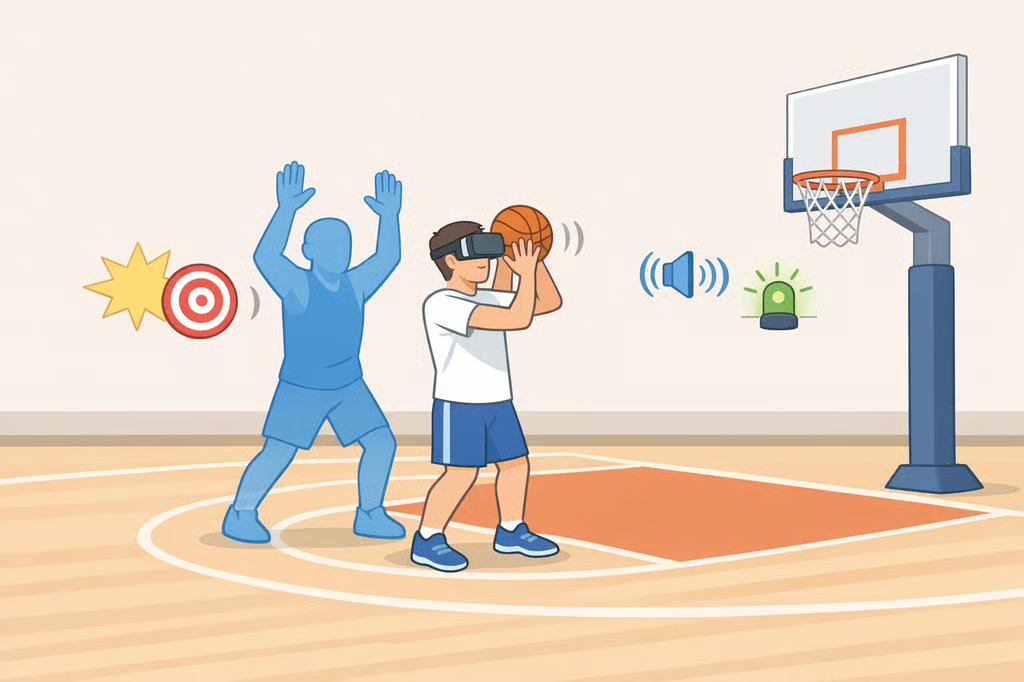
Virtual reality can recreate defenders, repeat visual cues and let players rehearse without a full court. What it cannot yet do is reproduce the feel of a basketball, the force of contact or the unpredictability of a live game.
Research suggests VR may help with a narrow range of basketball skills, particularly managing visual distractions and practicing selected shooting drills. The evidence remains preliminary, however. The studies are small, use mostly inexperienced participants and do not show that improvements carry over to competitive play.
For athletes and coaches, VR is best viewed as an additional practice tool—not a replacement for court time, live defenders or instruction from a qualified coach.
What the defender-distraction study tested
A September 2025 study published in Frontiers in Virtual Reality examined whether VR could help players become less distracted by an approaching defender during a basketball throwing task.
Researchers assigned 54 adults with little basketball or VR experience to three groups. One practiced against a live defender, another trained in VR against a virtual defender and a third practiced without a defender. The participants were ages 18 to 35, and none had professional basketball experience.
Each group completed three 20-minute sessions. During the task, participants threw from a fixed position while a defender approached from the side and raised an arm.
Researchers awarded zero points for a miss or backboard-only contact, one point for hitting the rim and two points for a made basket. This was a controlled throwing score rather than a standard test of shooting percentage, mechanics, agility or game performance.
Before training, the defender reduced scores among the participants included in the main comparison. After training, neither the VR group nor the live-defender group showed a statistically significant difference between attempts with and without the defender. The researchers interpreted that result as adaptation to the visual distraction.
Similar results do not prove equal training value
The VR and live-defender groups did not differ significantly in how their results changed over time. That suggests they adapted similarly during this specific exercise, but it does not prove that virtual and live practice are equally effective.
A study designed to establish equivalence would need to define how closely the two methods must perform before data are collected. This experiment did not do that.
The principal comparison also excluded the no-defender group. Most participants in that group were not initially affected when a defender appeared during testing, leaving too few affected participants for the researchers’ planned analysis.
Without a usable ordinary-practice comparison, the study could not determine whether training with a virtual or live defender was more effective than simply repeating the throwing task.
The two exercises also differed mechanically. Participants in the live condition threw a physical basketball. Those in VR used a handheld controller and pressed a button to control the virtual throw. The virtual defender was also taller than the live defender. These differences limit how directly the methods can be compared.
A youth study found one clearer advantage
A July 2025 study in BMC Sports Science, Medicine and Rehabilitation tested VR-assisted basketball training in adolescents ages 14 to 16 who had no previous formal basketball training.
Seventeen students completed the eight-week experiment. Eight received 45 minutes of court instruction twice a week. Nine completed the same program and added 15 minutes of VR basketball twice a week using an Oculus Quest 2 headset and the Gym Class Basketball VR application.
The VR group improved from its own baseline in straight-line dribbling, slalom dribbling and a stop-shot test. When researchers compared the amount of change between groups, however, only the stop-shot result significantly favored the VR group. Free-throw performance did not show a clear benefit.
The study could not isolate VR as the cause because the VR group received more total practice. Its sample was also smaller than the researchers had calculated they needed. In addition, the controller-based drills could not reproduce realistic ball handling, shooting form or release mechanics.
The results therefore offer limited evidence for novice teenagers and should not be generalized to experienced high school, college or professional players.
Where VR may fit in basketball practice
VR appears most suitable for repeatable perceptual and tactical exercises. It can expose a player to the same visual distraction several times, change a defender’s position and reduce the physical load required for additional repetitions.
That may help inexperienced players whose accuracy declines when a defender enters their peripheral vision. It may also give injured or workload-limited athletes a way to rehearse visual recognition and positioning without completing a full-contact session.
Newer research is exploring team tactics rather than isolated shots. A January 2026 mixed-reality study tested a large-scale system designed to guide coordinated basketball plays. Such systems may eventually help players rehearse spacing and movement patterns, but early experimental platforms are not proof of better performance in games.
VR remains less convincing for skills that depend heavily on physical feedback, including shooting touch, rebounding, ball protection, contact balance and sharp changes of direction. A controller cannot fully recreate ball weight, fingertip pressure, floor reaction forces or an opponent’s physical resistance.
What the evidence still cannot show
Neither of the main training studies measured performance during an organized game or scrimmage. The defender-distraction study ended immediately after three sessions, so it did not establish whether the adaptation lasted beyond the posttest.
Participants in its VR group also reported increased disorientation on the Simulator Sickness Questionnaire. Nausea and eye-related symptom scores did not change significantly, but the small sample and wide variation in responses prevent firm safety conclusions.
A systematic review of VR sports training found promising uses in visual perception, motor learning, anticipation and decision-making. It also called for stronger real-world comparisons and better evidence that virtual gains transfer to actual sports performance.
Researchers have not established an ideal session length, frequency or intensity for VR basketball training. Headset type, software quality, tracking accuracy and the realism of virtual interactions may also affect results.
Can VR replace basketball practice?
No. The available evidence supports VR as a supplement.
Virtual drills may help some inexperienced players manage visual distractions or add controlled repetitions. They may also become useful for tactical walkthroughs as mixed-reality systems improve. None of the current studies shows that VR can replace coached shooting sessions, ball-handling work, agility training, conditioning or practice against live defenders.
Coaches should choose a specific skill to target, keep VR sessions short and test any improvement on court with a physical ball. Players should end a session if they develop dizziness, nausea, eye strain or disorientation.
The most useful question is not whether VR works in the abstract. It is whether a particular virtual drill produces an improvement that still appears when the headset comes off.