
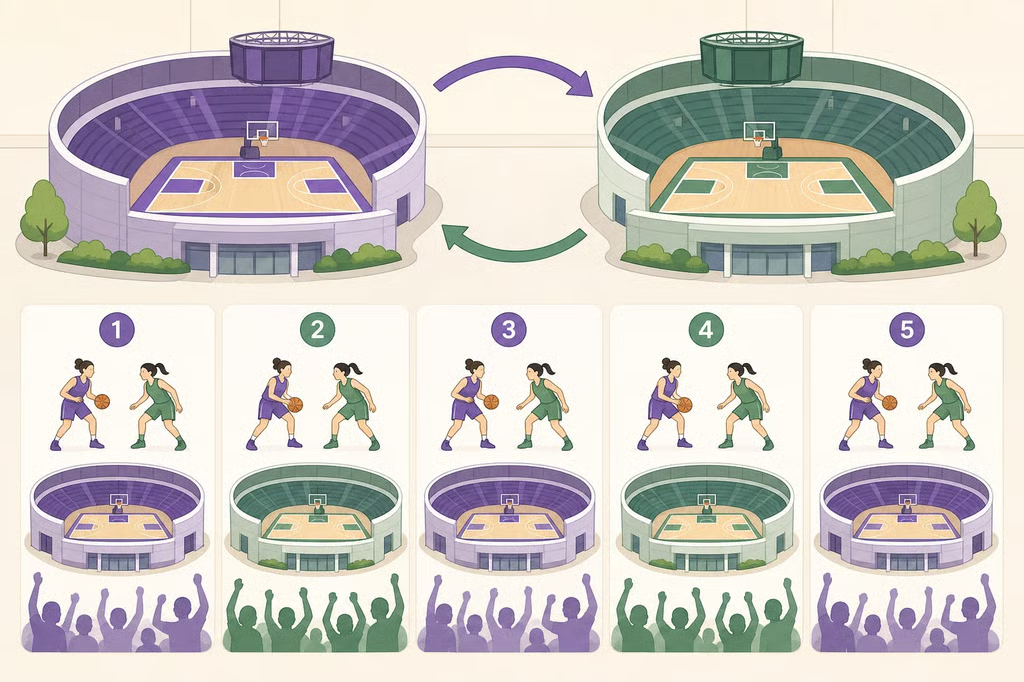
The WNBA uses a 1-1-1 format for its best-of-three first round: the higher seed hosts Games 1 and 3, if necessary, while the lower seed hosts Game 2. The setup guarantees both teams at least one home playoff game while reserving a potential series decider for the higher seed.
The league introduced the format for the 2025 playoffs as part of a broader postseason overhaul. At the same time, the WNBA Finals expanded from best-of-five to best-of-seven for the first time in league history. The WNBA announced both changes in October 2024 while keeping the opening round at a maximum of three games.
How the WNBA 1-1-1 format works
The sequence is straightforward. Game 1 is played at the higher seed's arena, Game 2 moves to the lower seed's court, and Game 3, if necessary, returns to the higher seed.
In a No. 3-vs.-No. 6 matchup, for example, the No. 3 seed hosts Game 1, the No. 6 seed hosts Game 2, and the series returns to the No. 3 seed for Game 3 if the teams split the first two.
“1-1-1” describes where the games are played, not how many games are guaranteed. The first round remains best-of-three: the first team to win twice advances, and a 2-0 sweep ends the series after Game 2.
The format applies only to the opening round. According to the WNBA's 2025 playoff format and results page, the semifinals use a best-of-five 2-2-1 format, while the Finals use a best-of-seven 2-2-1-1-1 sequence.
The top eight teams qualify regardless of conference and are seeded by regular-season record. If teams finish tied, league tiebreakers determine their order rather than treating identical records as equal.
1-1-1 vs. 2-1 format: what changed and why
From 2022 through 2024, the first round used a 2-1 setup: the higher seed hosted Games 1 and 2, while the lower seed hosted Game 3 if necessary.
The WNBA adopted that structure for the 2022 season when it moved all eight playoff teams into best-of-three first-round series. No teams received byes under that system.
The 2-1 arrangement created an unusual trade-off. The lower seed was not guaranteed a home playoff game because the series could end after two games on the higher seed's court. If the matchup did reach Game 3, however, the deciding game shifted to the lower seed's arena.
The 1-1-1 format reversed that dynamic. The lower seed gained a guaranteed Game 2 at home, while the higher seed regained the advantage of hosting a deciding Game 3.
The 2022 setup had itself replaced a much different postseason structure. From 2016 through 2021, the top two seeds received byes directly to the semifinals, Nos. 3 and 4 received first-round byes, and seeds 5 through 8 opened in single-elimination games. The WNBA's 2016 playoff rules called for another single-elimination round before the semifinals.
Seen against that history, the switch to 1-1-1 was not a complete redesign of the postseason. It changed how home-court advantage worked within a first round that had already become best-of-three.
How 1-1-1 played out in 2025
The first season under the new format produced three deciding Game 3s.
No. 1 Minnesota swept No. 8 Golden State 2-0. The other three first-round matchups all went the distance: Phoenix defeated New York 2-1, Las Vegas beat Seattle 2-1, and sixth-seeded Indiana eliminated third-seeded Atlanta 2-1.
That meant three lower-seeded teams hosted Game 2 before their series returned to the higher seed for a deciding third game.
Attendance offered another useful look at what guaranteed home dates could mean for playoff markets. Sports Illustrated reported that the smallest Game 2 crowd in the 2025 first round was 12,500, compared with roughly 11,000 for the largest Game 2 crowd in 2024.
Golden State drew 18,543 for its Game 2 against Minnesota even after the matchup moved from San Francisco to San José because of a scheduling conflict with the Laver Cup. Arena capacities and local circumstances vary, so those figures do not prove the format itself caused attendance to rise. They do show that lower-seeded teams could draw substantial crowds once a home playoff game was guaranteed.
The longer series require similar caution. Three of four matchups reaching Game 3 does not establish that alternating venues made the first round more competitive. Matchups, injuries, roster quality, and individual performances all influence whether a series lasts two games or three.
What the results clearly demonstrated was the format's practical effect: every playoff team hosted at least once, and three of the four series returned to the higher seed's arena for a winner-take-all Game 3.
Why best-of-three still draws debate
Changing the home-court sequence did not change the first round's length. Two victories still decide the series, leaving less room for recovery than in the best-of-five semifinals or best-of-seven Finals.
That contrast became sharper in 2025 because the Finals expanded to seven games while the opening round remained capped at three.
Las Vegas Aces coach Becky Hammon was among those who questioned whether three games were enough. During the 2025 postseason, Hammon said she would prefer a five-game first round if the league did not return to its previous home-court setup, according to a Sports Business Journal review of the new format.
The question of series length is separate from the 1-1-1 format itself. Expanding the first round to best-of-five would change how many victories are required to advance. A 1-1-1 structure determines only where the games in the existing best-of-three series are played.
The 1-1-1 format in one sentence
In a WNBA 1-1-1 first-round series, the higher seed hosts Games 1 and 3, while the lower seed hosts Game 2. The first team to win two games advances, so Game 3 is played only if the teams split the first two.
The format also continued beyond its 2025 debut. The WNBA's Golden State Valkyries confirmed that the 2026 playoffs again use a best-of-three, 1-1-1 first round, followed by best-of-five semifinals and a best-of-seven Finals.
The result is a simple balance: every playoff team gets at least one home game, while the higher seed keeps the right to host the game that decides the series if it reaches Game 3.