

- Blood Neurofilament Light Biomarker for Progressive Multiple Sclerosis
- What "progression independent of relapse activity" means
- Two proteins, two biological signals
- Plasma neurofilament light and MS progression: the 2022 trial data
- A separate analysis splits the signal by subtype
- Could these markers help monitor treatment response?
- What the evidence doesn't yet support
- What a neurofilament light blood test for multiple sclerosis can and cannot show
Blood Neurofilament Light Biomarker for Progressive Multiple Sclerosis
An international research collaboration called BioMS-eu measured two blood proteins, neurofilament light (NfL) and glial fibrillary acidic protein (GFAP), in 1,058 people with progressive multiple sclerosis (MS). NfL, a blood biomarker for progressive MS disease progression that researchers have studied for years, predicted future disability worsening mainly in people with primary progressive MS (PPMS), while the GFAP signal was driven mainly by secondary progressive MS (SPMS), the BioMS-eu investigators reported, drawing on data from network centers and collaborating cohorts across multiple sites (BioMS-eu analysis).
That split complicates an earlier picture. A 2022 post hoc analysis of two large phase 3 trials found that high blood NfL predicted disability progression in both progressive MS subtypes, not one, according to the EXPAND and INFORMS post hoc analysis.
For people with progressive MS, their neurologists, and researchers designing the next round of trials, the disagreement matters. It shapes whether a blood test could eventually flag disability that builds quietly, apart from relapses, or whether subtype, age, and assay differences still make the picture too tangled to read at the individual level. Every finding below is a group-level statistical association, not a diagnostic result.
What "progression independent of relapse activity" means
Researchers use a specific term for disability that worsens between relapses: progression independent of relapse activity, or PIRA. A 741-patient study drawing on the Brigham MS Center Research Database evaluated whether serum GFAP could predict PIRA, along with future need for a gait aid and conversion to SPMS, according to the Brigham GFAP study.
PIRA isn't the same as having no MRI activity at all. A person can still show some lesion activity on a scan and be classified with PIRA, which is one reason the studies discussed here define "hidden" decline slightly differently from each other.
Two proteins, two biological signals
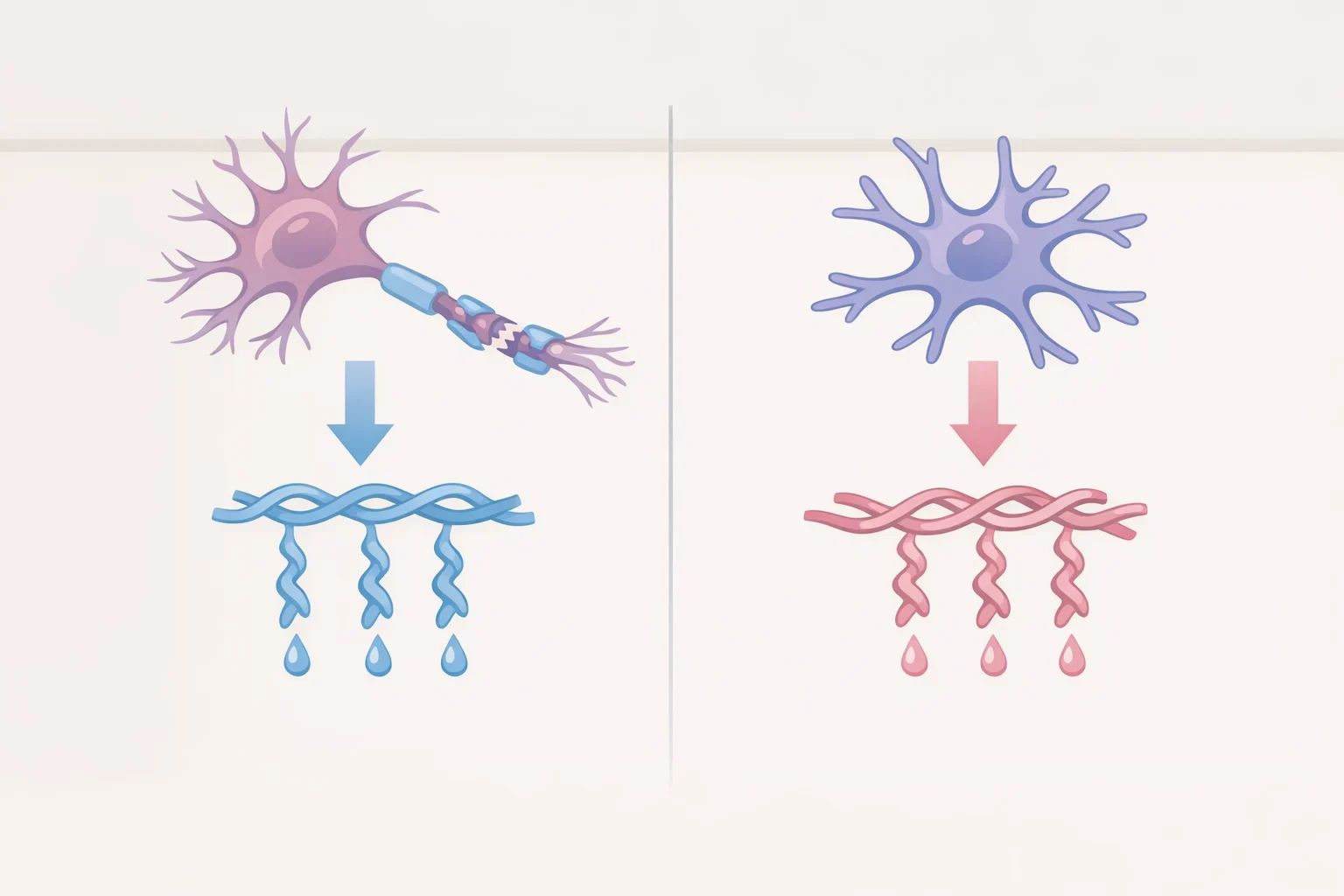
NfL rises when axons, the nerve fibers that carry signals through the brain and spinal cord, are damaged. That process is closely tied to acute inflammatory activity, such as a relapse or a new MRI lesion, according to a review of MS blood and spinal fluid biomarkers.
GFAP may reflect a different biological process: astrocyte activation, which is elevated in progressive forms of MS. The same review describes GFAP as an emerging marker of progression that continues independent of relapses.
A 257-patient study from the thorough Longitudinal Investigation of MS at Brigham and Women's Hospital (CLIMB) found serum GFAP wasn't elevated by recent disease activity the way serum NfL was, a finding that supports the idea the two proteins track different biology, according to the CLIMB study.
The biomarker review also names other candidates under study, including CHI3L1, which has been linked to PIRA and to certain MRI lesion types such as paramagnetic rim lesions. NfL and GFAP are among the most prominent markers discussed in the studies reviewed here, though they aren't the only ones researchers are testing.
Plasma neurofilament light and MS progression: the 2022 trial data
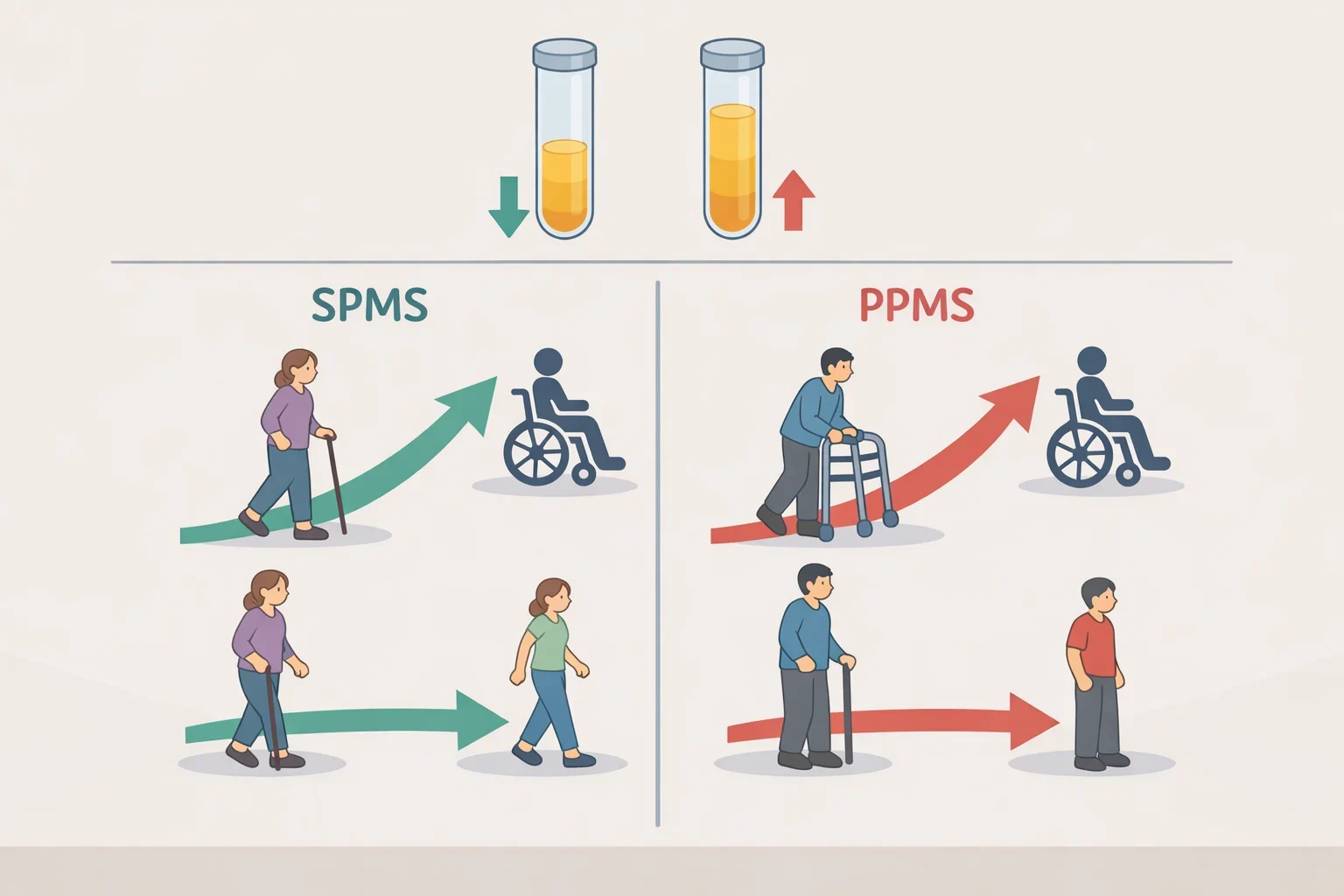
The 2022 analysis pooled data from two placebo-controlled phase 3 trials, EXPAND (siponimod, in SPMS) and INFORMS (fingolimod, in PPMS), covering 4,185 blood samples from 1,452 people with SPMS and 1,172 samples from 378 people with PPMS. The study's authors split participants by a baseline plasma NfL cutoff of 30 picograms per milliliter, according to the EXPAND and INFORMS post hoc analysis.
High NfL predicted a significantly greater risk of confirmed disability progression at both three and six months in both subtypes. It also predicted earlier wheelchair dependence in PPMS, where the risk was nearly triple that of people with low NfL (hazard ratio 2.97, 95% CI 1.44-6.10). The same wheelchair link did not reach statistical significance in SPMS (hazard ratio 1.50, 95% CI 0.96-2.34).
High NfL was also tied to faster brain atrophy and, in SPMS, cognitive decline. The association with future disability and brain atrophy persisted in participants both with and without acute disease activity, meaning active MRI lesions or a recent relapse, at baseline. NfL levels also dropped in people treated with siponimod or fingolimod compared with placebo, a change the study's authors suggested could make it a useful outcome measure in future progressive MS trials.
A separate analysis splits the signal by subtype

The BioMS-eu collaboration took a different approach. Instead of a fixed pg/mL cutoff, it used age- and sex-adjusted Z-scores, a statistical measure of how far a value sits from the average for someone of the same age and sex, for serum NfL and GFAP across 1,058 participants and 7,530 clinic encounters. Follow-up lasted a median of 4.6 years, during which researchers recorded 723 confirmed disability worsening events, meaning disability that held up on repeat exams rather than a single visit, according to the BioMS-eu analysis.
After adjusting for age, sex, disease duration, baseline disability score (EDSS, the standard scale neurologists use to rate MS-related disability), and treatment, each one-unit rise in GFAP's Z-score was linked to about a 10% higher risk of confirmed worsening (adjusted hazard ratio 1.107, 95% CI 1.001-1.225, p=0.049). That result is statistically significant but borderline, and it was driven mainly by the SPMS group (adjusted hazard ratio 1.242). NfL, meanwhile, predicted worsening only among people with PPMS, not across the full progressive MS group, the BioMS-eu investigators reported.
That pattern differs from the 2022 trial data, where NfL flagged risk in both subtypes. Several factors could explain the gap. The 2022 cohort came from randomized trials testing specific drugs, siponimod and fingolimod, against placebo, while BioMS-eu pooled data from network centers and collaborating cohorts across multiple sites. One measured plasma NfL against a fixed threshold; the other measured serum NfL and GFAP against a statistically adjusted score that already accounts for age and sex. Those are related measurements, not interchangeable ones.
The CLIMB cohort adds another layer. It found serum NfL tracked recent and upcoming inflammatory activity (adjusted β=1.21, p=0.016 for the prior two years; β=1.17, p=0.042 for the following two years) but wasn't independently linked to disability progression confirmed six months later once that activity was accounted for. GFAP, which wasn't elevated by recent activity, was tied to that six-month progression instead (adjusted hazard ratio 1.71, 95% CI 1.19-2.45, p=0.004), and the association grew stronger in patients with low NfL and no recent inflammatory activity. The different adjustment strategies across these studies may help explain why one marker looks predictive in one dataset and not another, according to the CLIMB study.
Could these markers help monitor treatment response?
A separate 177-patient study spanning several MS treatments found serum NfL was higher in people who didn't respond to therapy than in those who did (10.6 pg/mL vs. 8.4 pg/mL, p=0.007). NfL and GFAP also declined on different timelines after people started ocrelizumab: NfL dropped to healthy-control levels within a year, while GFAP took closer to two years, according to the study of NfL and GFAP in treatment response.
That study combined multiple MS types and treatments into one analysis, and neither marker reliably separated responders from non-responders within the ocrelizumab subgroup specifically. The finding is exploratory and doesn't support using either marker to make an individual treatment decision today.
What the evidence doesn't yet support

Every hazard ratio and percentage described above reflects risk across a group of patients, not a validated way to tell one person their personal odds of progressing.
The 741-patient Brigham study found serum GFAP predicted PIRA, future need for a gait aid, and conversion to SPMS in initial models that didn't adjust for other factors. Once researchers adjusted for factors such as age, the association held only for patients younger than 50, a subgroup finding rather than proof that GFAP only works below that age. GFAP also showed no link to future fatigue or cognitive change in this cohort.
One author on that study disclosed consulting fees and research support from Octave, a company that manufactures a commercial multi-biomarker test that includes GFAP. That's a relevant conflict-of-interest disclosure, but it doesn't speak to the test's regulatory status or how well it performs for the specific prediction questions covered here, since the research data reviewed doesn't address that.
The biomarker review notes that combining multiple markers can add predictive accuracy in specific clinical scenarios. The studies summarized here, though, do not report a combined NfL-GFAP prediction model for progressive MS specifically, so that potential remains theoretical rather than demonstrated. The review frames fluid biomarkers overall as "quickly emerging" tools for tracking MS course and treatment response, language that points to active investigation rather than settled clinical use.
What a neurofilament light blood test for multiple sclerosis can and cannot show
None of this means a person with progressive MS can order an NfL or GFAP test and read a personal progression risk from the number. Plasma and serum samples are handled differently, assays vary by lab, and reference ranges differ between a fixed pg/mL cutoff and an age- and sex-adjusted Z-score. A result also needs to be read alongside MS subtype, age, recent MRI activity, and current treatment, since each of those changes what a given number likely means.
Comparing a personal lab value directly to the 30 pg/mL threshold from the 2022 trial, or to a Z-score from the BioMS-eu study, isn't a reliable way to interpret an individual result without knowing which assay and sample type produced it. Anyone who receives an NfL or GFAP result should ask the treating MS clinician whether it changes the current monitoring or treatment plan, rather than compare it against numbers pulled from published research.
The subtype split between NfL and GFAP shows up most consistently in the larger, adjusted BioMS-eu dataset, though the 2022 trial, drawn from thousands of participants in two randomized trials, found NfL relevant in both subtypes. Both sets of findings are prognostic associations measured across groups of patients, not evidence that a blood test can diagnose or confirm progression in an individual.
Anyone noticing new, persistent, or worsening symptoms, such as changes in balance, mobility, vision, or thinking, should report them to the MS care team promptly, and seek urgent medical attention for any sudden or severe neurological symptom regardless of a biomarker result. Ask the MS care team whether NfL, GFAP, or both are part of the clinic's monitoring approach, and treat any result as one piece of information to discuss, not a self-administered progression test.