
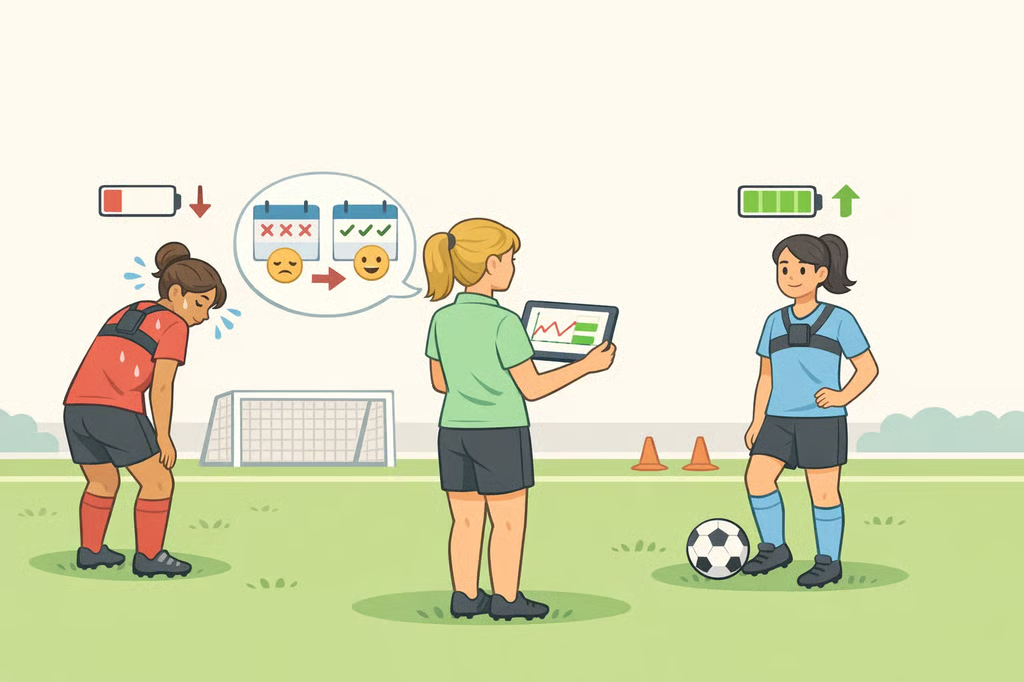
A July 2026 study using four seasons of data from FC Barcelona’s women’s team found that accumulated workload and other fatigue-related measures helped estimate the risk of noncontact musculoskeletal injuries. The findings support evaluating a player’s workload across several weeks rather than relying on her most recent match, training session, or fitness test.
The research does not establish a universal fatigue limit, prove that workload alone causes injuries, or allow an algorithm to determine whether a player is safe to compete. Injury risk depends on several interacting factors, and workload data should support — not replace — medical assessment, player feedback, and coaching judgment.
Earlier research on international women’s tournaments adds an important distinction. Players recorded less total, high-speed, and very-high-speed running as tournaments progressed, particularly after heavy minutes and recovery periods of three days or fewer. That study measured running performance, not injuries, so it cannot show that congestion directly caused hamstring strains, ACL tears, or other injuries.
How accumulated workload enters injury predictions
Published July 8, 2026, in npj Digital Medicine, the FC Barcelona injury-prediction study combined survival analysis, machine learning, probability calibration, and decision theory. The dataset covered the 2019–2023 seasons and included 34 players, nearly 14,000 daily observations, and 83 noncontact musculoskeletal injuries.
The researchers found that distance accumulated during the previous 21 days was the model’s most influential injury predictor. High-speed running, accelerations, and decelerations recorded on the same day were also influential.
Those measurements are more accurately described as workload variables or fatigue indicators than direct measurements of fatigue. They show how much physical demand a player has experienced, but they do not reveal her complete physiological condition or prove that workload caused a later injury.
The framework also accounted for risk accumulating over time and distinguished between injuries of different severity. It allowed medical and performance staff to adjust decision thresholds according to the importance of a match and how certain they wanted to be that resting a player would provide a benefit.
When the researchers tested the system on a season that had not been used to train it, correctly identified injuries accounted for more total missed time than the days associated with false warnings. That result suggests the model could help staff make more informed availability decisions, but it does not demonstrate that following its recommendations prevents injuries.
The limitations are substantial. The model was developed from one elite club and has not been independently validated across leagues, age groups, playing levels, or recreational settings. It also was not evaluated in a prospective trial in which teams acted on its recommendations and compared subsequent injury rates.
Nature identifies the published manuscript as an early, unedited version that may still receive corrections. The study therefore offers promising evidence and a new decision-support framework — not a finished screening standard for women’s soccer.
What tournament congestion changes
A 2024 tournament study followed 28 players from one women’s national team across four international tournaments. Researchers compared match exposure, consecutive match number, recovery days, and minutes played with GPS-based running measures.
More minutes played and recovery periods of three days or fewer were associated with lower running output as tournaments progressed. Recovery time, prior match exposure, and consecutive match number were also associated with changes in total distance, high-speed running, accelerations, and decelerations.
Greater prior match exposure and longer recovery periods were linked to a smaller decline in running output between the first and second halves. That does not mean playing more matches improves performance. It indicates that match exposure, conditioning, and recovery may interact rather than affecting every player in the same way.
The study did not examine whether players whose running output fell the most were more likely to become injured. Reduced output could reflect fatigue, pacing, tactics, opponent quality, the score, or other match conditions. Coaches should not treat a decline in GPS numbers as an injury diagnosis.
Why one metric is not enough
A separate preseason study followed 120 regional and national soccer players through a season in which 29 sustained a hamstring strain. Researchers assessed psychological, physiological, kinematic, fatigability, performance, and health-related variables.
No individual measure predicted hamstring injuries well enough on its own. The researchers’ preliminary model instead combined eight variables: age, sex, previous hamstring injury, knee-flexor fatigability, best sprint time, maximal theoretical velocity, perceived vulnerability to injury, and beliefs about playing through pain.
Together, the variables produced an area under the curve of 0.82 and identified 79% of the players who later sustained a hamstring strain in that sample. Those figures do not represent universal accuracy. The model was based on a relatively small number of injuries, and its population was not limited to elite women’s players.
Across the Barcelona and preseason studies, injury risk emerges from several interacting factors. Accumulated workload, injury history, sprint performance, muscular fatigability, symptoms, and individual health information may all contribute, but no single measurement can determine whether an injury will occur.
What teams should monitor during congested schedules
The studies do not establish one cutoff that tells a coach when a player must rest. Teams can instead monitor several signals together:
- Minutes played across club and international duty
- Recovery time between matches
- Distance accumulated over several weeks
- High-speed running and repeated accelerations or decelerations
- Previous hamstring or other musculoskeletal injuries
- Changes in pain, strength, sprint performance, or normal movement
These measures are more useful when compared with the player’s own history than with one roster-wide limit. A workload increase that is manageable for one player may represent a significant change for another.
Youth and recreational teams should not copy professional GPS thresholds. Age, growth, training history, playing level, medical history, and access to recovery support all affect how workload should be interpreted.
Sudden pain, weakness, bruising, restricted movement, or an unexplained decline in sprint performance warrants assessment by an athletic trainer, physical therapist, or sports medicine clinician. Wearable data and risk scores should not be used to clear an injured player for full training.
Research is also expanding beyond GPS measurements. On April 22, 2026, the National Women’s Soccer League and its players association joined Project ACL, an initiative that began in England’s Women’s Super League. The project is examining the multifactorial causes of ACL injuries, including workload, travel, recovery conditions, and the wider training environment.
What coaches and players can take from the research
Congested schedules can reduce running output, while newer women-specific evidence indicates that accumulated workload can improve injury-risk estimates. Neither finding establishes a fixed number of minutes, miles, or recovery days beyond which an injury becomes inevitable.
The most defensible approach is to examine patterns over several weeks, combine workload measurements with symptoms and injury history, and involve qualified medical staff when pain or unexplained performance changes appear.
Teams without advanced tracking systems can still follow the same principle: avoid abrupt increases in training, provide appropriate recovery, take symptoms seriously, and base return-to-play decisions on clinical assessment rather than a schedule or fitness-tracker score.