
- Can You Exercise Too Much for Your Joints? The Evidence
- What the knee osteoarthritis risk data shows
- Can you exercise too much for your joints? What federal guidelines say
- Resistance training for knee osteoarthritis symptoms
- Exercise for joint longevity: what the research supports for different readers
- Building a joint-friendly training plan across three starting points
- What to do next
Can You Exercise Too Much for Your Joints? The Evidence
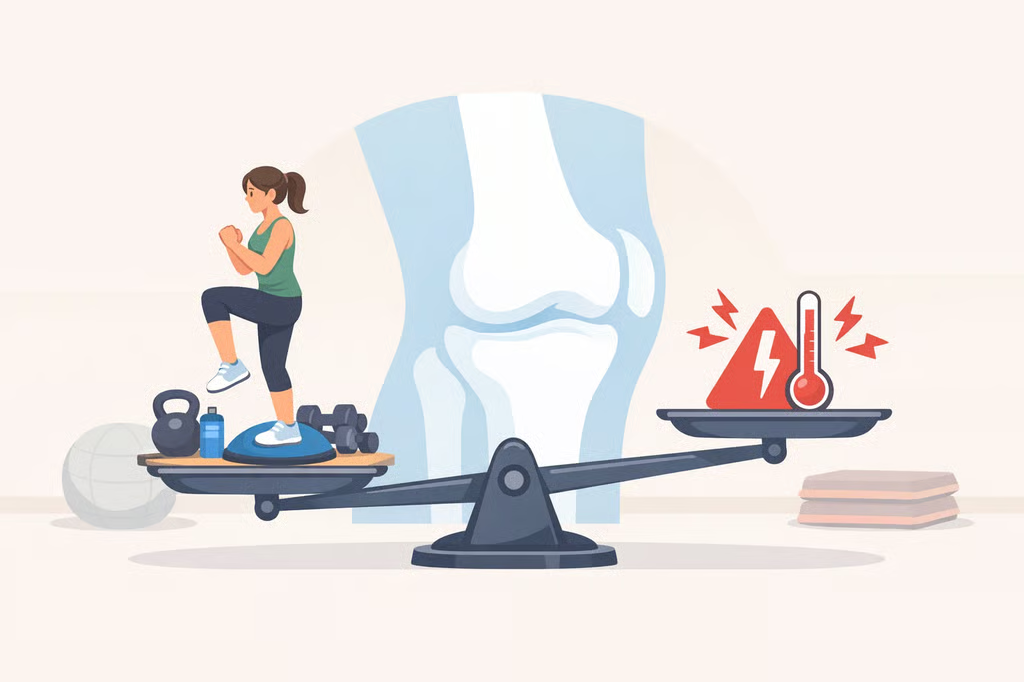
A pooled analysis of 14 observational studies covering more than 507,000 people, including 27,412 incident cases of knee osteoarthritis, found that high overall physical activity carried a 26% higher relative risk of developing the condition than moderate activity, according to a systematic review. It's the kind of number that puts a figure on a question a lot of active people quietly wonder about: can you exercise too much for your joints?
That statistic describes future risk in people who didn't yet have knee osteoarthritis when the studies began. Whether exercise helps or hurts once osteoarthritis is already diagnosed is a separate question, one a 2024 systematic review and meta-analysis addressed by pooling 12 trials and 4,920 participants with knee or hip OA and finding that aerobic training, resistance exercise, and multimodal programs improved pain, function, and quality of life.
Among adults 65 and older, fewer than 15% meet both federal aerobic and muscle-strengthening recommendations, according to the HHS Physical Activity Guidelines Midcourse Report. Falling short of the guideline range, not blowing past it, is the far more common problem in that age group.
This piece works through two separate questions raised by that research: whether high training volume raises osteoarthritis risk in people who don't have the disease, and how exercise should be used once someone already does. From there it looks at what a joint-friendly training plan looks like depending on where a reader is starting. None of this replaces an individualized evaluation from a physical therapist or physician.
What the knee osteoarthritis risk data shows
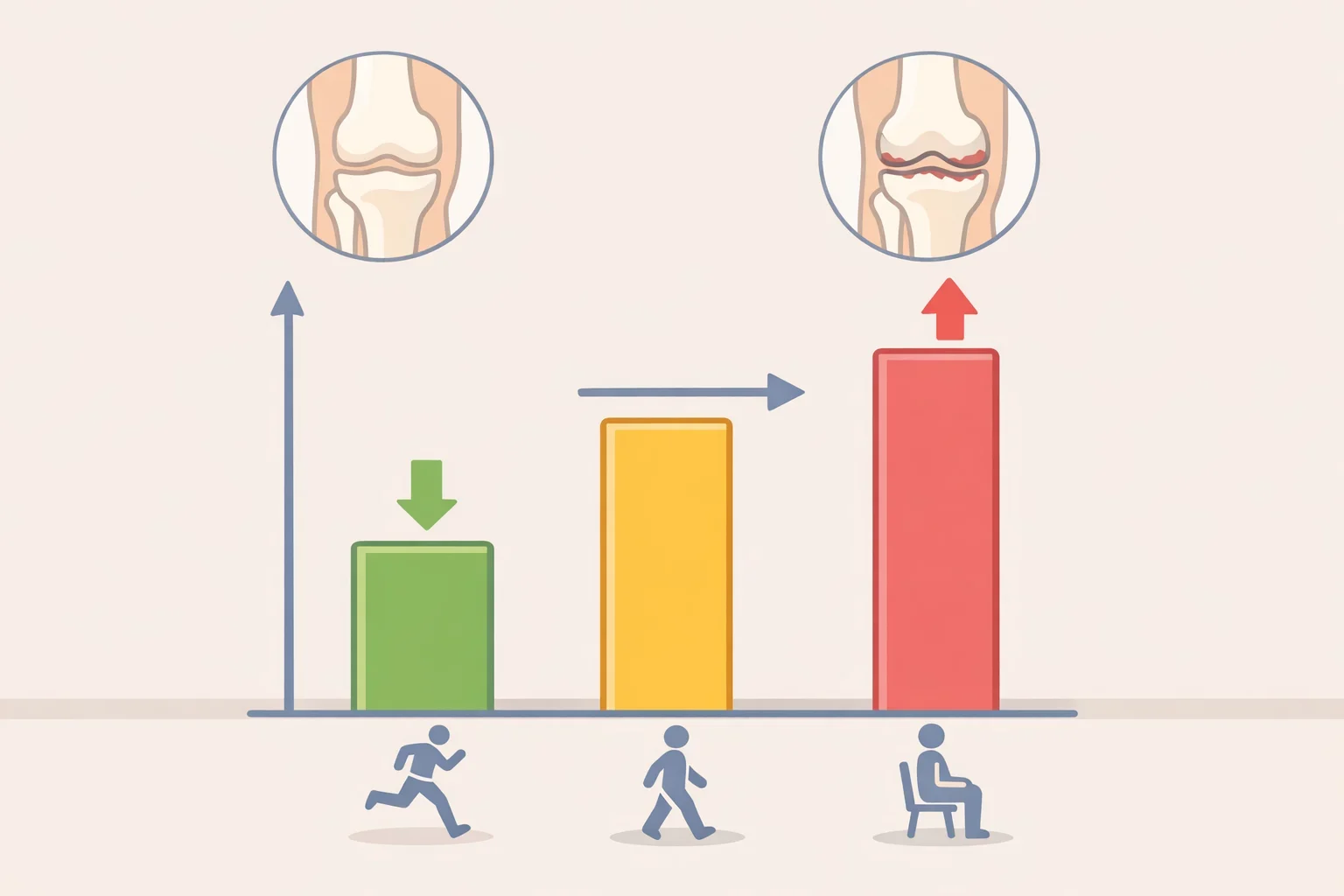
The review, which pooled 13 cohort studies and one case-control study, found the risk signal only shows up when comparing high activity against moderate activity. Against low activity as the reference point, neither high activity (RR 1.02, 95% CI 0.84-1.23) nor moderate activity (RR 0.94, 95% CI 0.84-1.05) showed a statistically significant change in knee OA risk, according to the review.
A weaker signal pointed the same direction. Exceeding international physical-activity guidelines may modestly increase OA risk (RR 1.18, 95% CI 1.02-1.35), though the researchers described the evidence behind that specific comparison as limited.
These are observational studies, not controlled experiments, so they can't prove high-volume exercise causes osteoarthritis. The study authors wrote that further research is needed to define which activity types, doses, and durations actually affect risk. The review also doesn't spell out exactly what counted as low, moderate, or high activity in the underlying studies, so it doesn't translate into a mileage figure or an hours-per-week number to avoid.
Because neither high nor moderate activity differed significantly from low activity in the review, while high activity was associated with greater risk than moderate activity, the evidence does not support pursuing maximum training volume for its own sake. That's not a reason to be wary of normal aerobic or strength training for most people, though the review doesn't establish that every joint or every individual responds to loading the same way.
Can you exercise too much for your joints? What federal guidelines say
The research above doesn't hand anyone a joint-specific safety ceiling. The activity ranges that follow come from general physical-activity recommendations, not a threshold tested for protecting joints specifically.
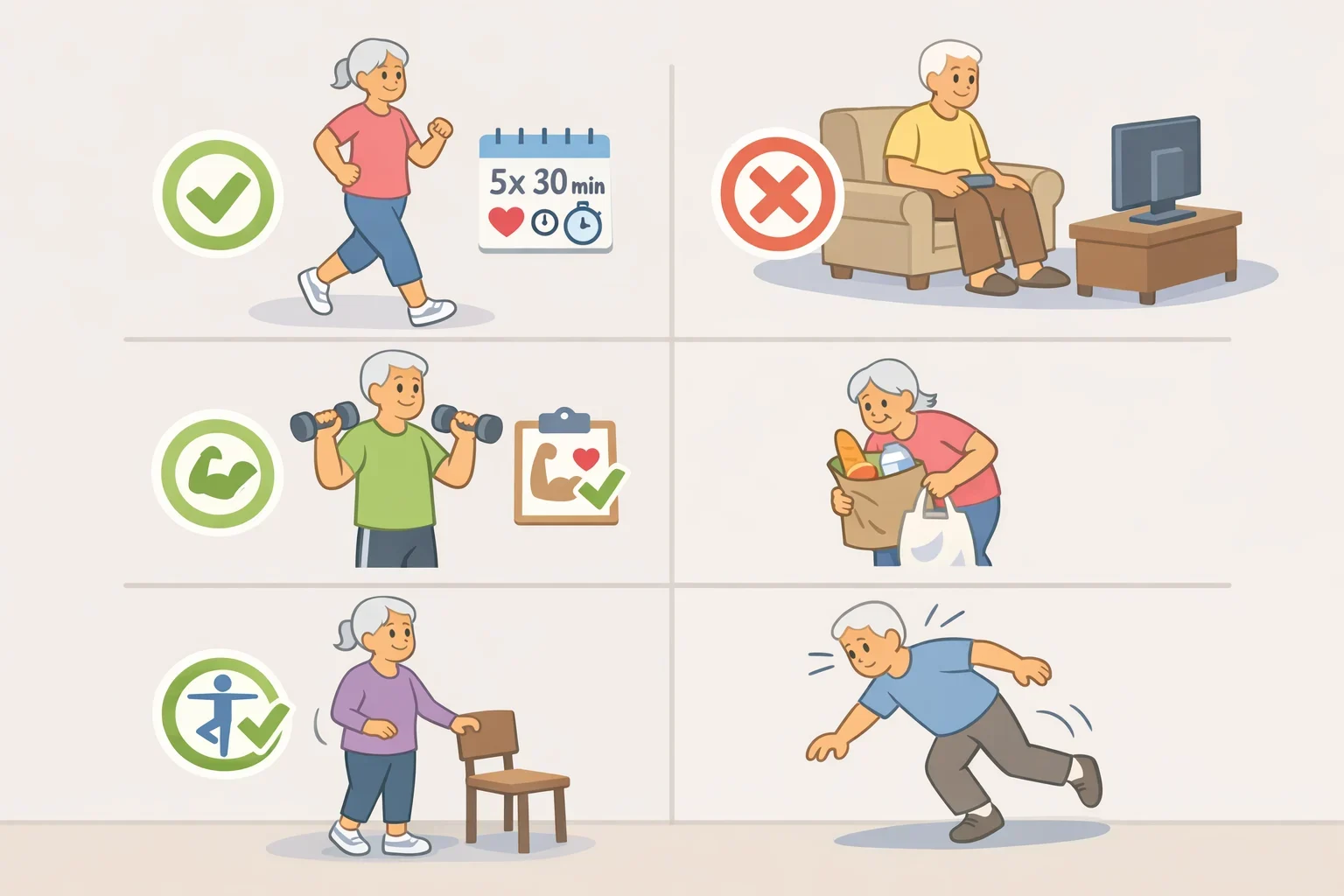
Adults are advised to get 150 to 300 minutes of moderate aerobic activity, or 75 to 150 minutes of vigorous activity, each week, plus muscle-strengthening work for all major muscle groups on two or more days, according to the HHS Physical Activity Guidelines Midcourse Report. For older adults, the guidelines add balance training as part of a multicomponent routine rather than aerobic and strength work alone.
Most older adults fall short of that range rather than exceed it. About 37% of adults 65 and older meet the aerobic target and just 19% meet the strength target, per the same report.
Resistance training for knee osteoarthritis symptoms
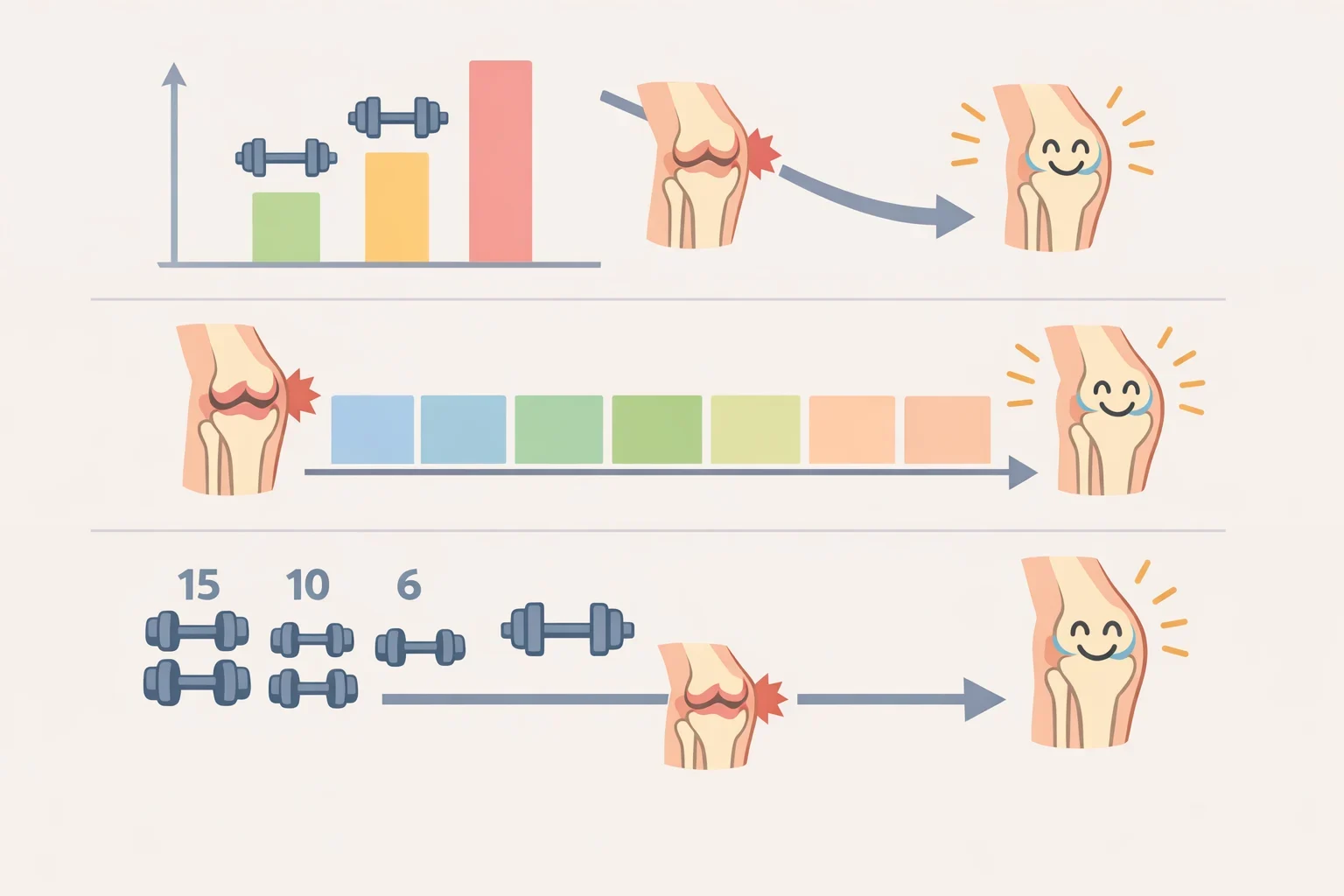
A separate line of research looked at dosing rather than risk. A network meta-analysis published last December pooled 46 randomized controlled trials and 3,463 people with knee OA, using a Bayesian model that reports results as standardized mean differences with 95% credible intervals rather than confidence intervals, a distinction that reflects the statistical method rather than a difference in what the numbers mean for readers. High-speed resistance training ranked as the most effective type overall, improving pain (SMD -1.35, 95% CrI -1.89 to -0.81) and function (SMD 1.70, 95% CrI 0.96 to 2.45) more than other resistance approaches tested.
The same analysis modeled dosing separately from training type. Moderate-intensity resistance training at an estimated 43-47% of one-repetition max, sustained for 35 to 37 weeks with 610-640 weekly repetitions, produced the strongest results for pain (SMD -0.76, 95% CrI -1.03 to -0.44) and function (SMD 1.29, 95% CrI 0.92 to 1.68). A shorter, higher-repetition block, 12 weeks at 1,200 weekly repetitions, worked better for stiffness (SMD -1.11, 95% CrI -1.58 to -0.64), according to the same analysis.
The analysis identified these as optimal doses within the included knee-OA evidence, not a universal template for people without OA or a program to self-administer without professional input. The trials behind those numbers ran under supervision, with participants already diagnosed.
Exercise for joint longevity: what the research supports for different readers
The 2024 review of exercise interventions for knee and hip osteoarthritis found the benefits varied with age and exercise type. Tai Chi and Baduanjin Qigong were reported to benefit older participants, while standard aerobic training worked better for younger participants, according to the review.
Combining exercise with dietary changes produced the highest effect size among the interventions tested (SMD 0.70, 95% CI 0.55-0.85). Separately, the review's authors noted that personalizing programs around individual characteristics matters for sustained improvement, though the data doesn't establish a direct link between that finding and the diet-and-exercise result specifically.
Building a joint-friendly training plan across three starting points
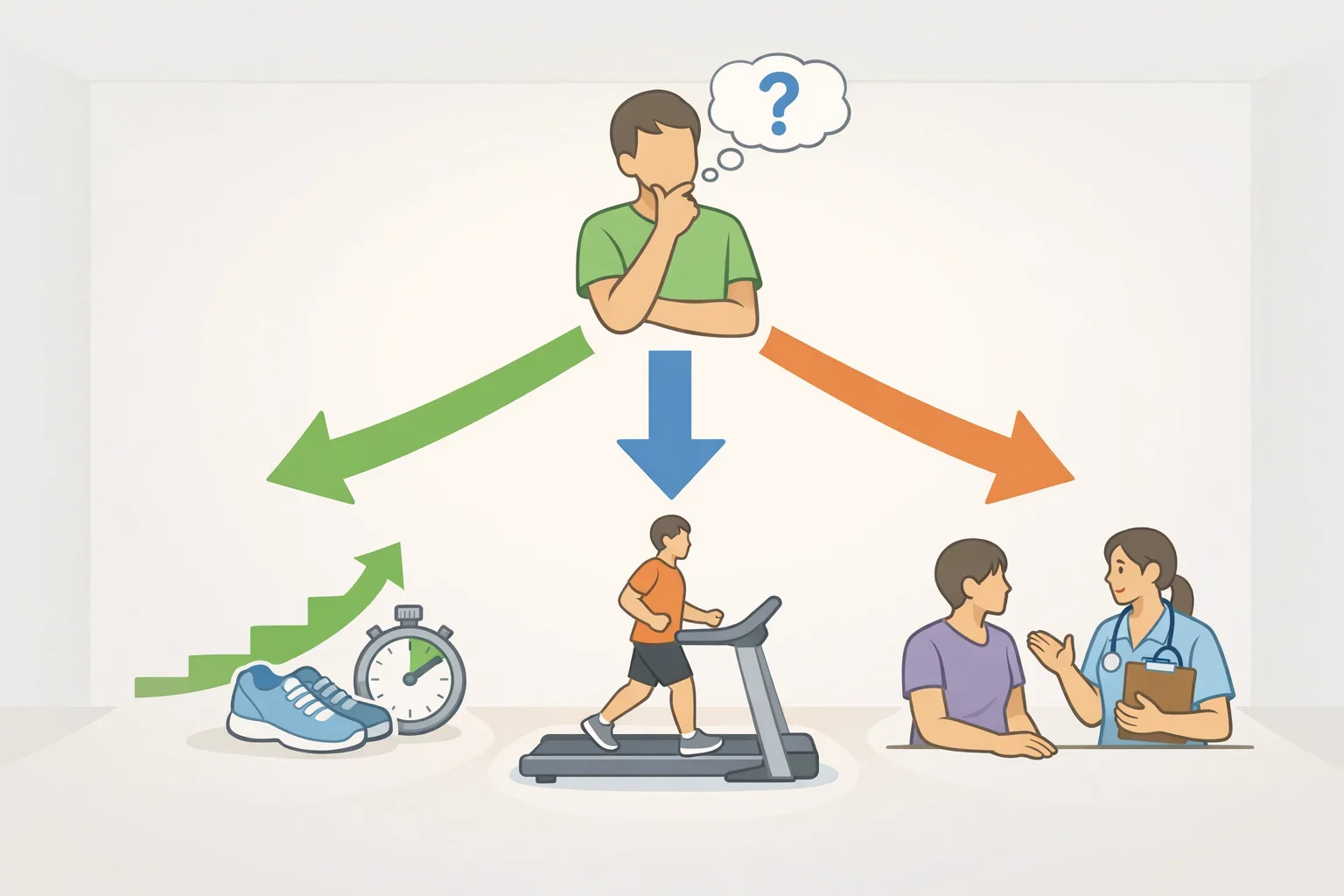
For readers starting from little or no activity, federal guidance for older adults suggests beginning with five or ten minutes of moderate aerobic activity and building up gradually. People with a chronic condition that prevents reaching 150 minutes a week are advised to stay as active as their condition allows rather than avoid activity altogether, according to HHS older-adult guidance.
For readers already meeting the federal guideline range, the risk data adds a caveat rather than a new target to chase. The evidence gives no support for pushing training volume toward a maximum for its own sake, since high activity showed no significant difference from low activity and only a modest increase compared with moderate activity, according to the same review. A steadier approach is to spread effort across aerobic work, resistance training, and mobility work instead of loading up on one type of training.
For readers with a diagnosed joint condition, the two symptom-focused studies cover different ground. The 2024 review, which included Tai Chi, Baduanjin Qigong, aerobic training, and combined diet-and-exercise programs, applies to people with knee or hip OA. The 2025 network meta-analysis on resistance-training type and dose applies specifically to knee OA, and its numbers describe trial outcomes rather than a self-prescribed program. Turning either set of findings into a personal routine, especially one involving higher-speed lifting, is worth doing alongside a physical therapist or certified trainer who knows the diagnosis and can adjust load week to week.
What to do next
None of the research reviewed here points to a specific mileage figure, hour count, or intensity ceiling that marks the line between healthy training and joint damage. What it does show is a modest, observational association between high and moderate activity levels in people without diagnosed OA, and solid evidence that structured exercise, including properly dosed resistance training, helps people who already have knee osteoarthritis manage pain and function.
Readers who aren't close to the federal activity targets should build toward them gradually, starting with short bouts and adding time or load over weeks. Readers already meeting those targets have no evidence-based reason to keep pushing volume higher on the assumption that more is automatically better for joint health. Readers with a knee or hip OA diagnosis have a legitimate case for structured resistance and aerobic training, but the specific dosing belongs in the hands of a physical therapist or physician rather than copied directly from a research protocol.
Persistent swelling, a joint that feels unstable, or pain that worsens during activity or doesn't settle with rest are general reasons to scale back a current plan and get evaluated by a physical therapist or physician, rather than push through the same routine and wait for it to resolve on its own.