
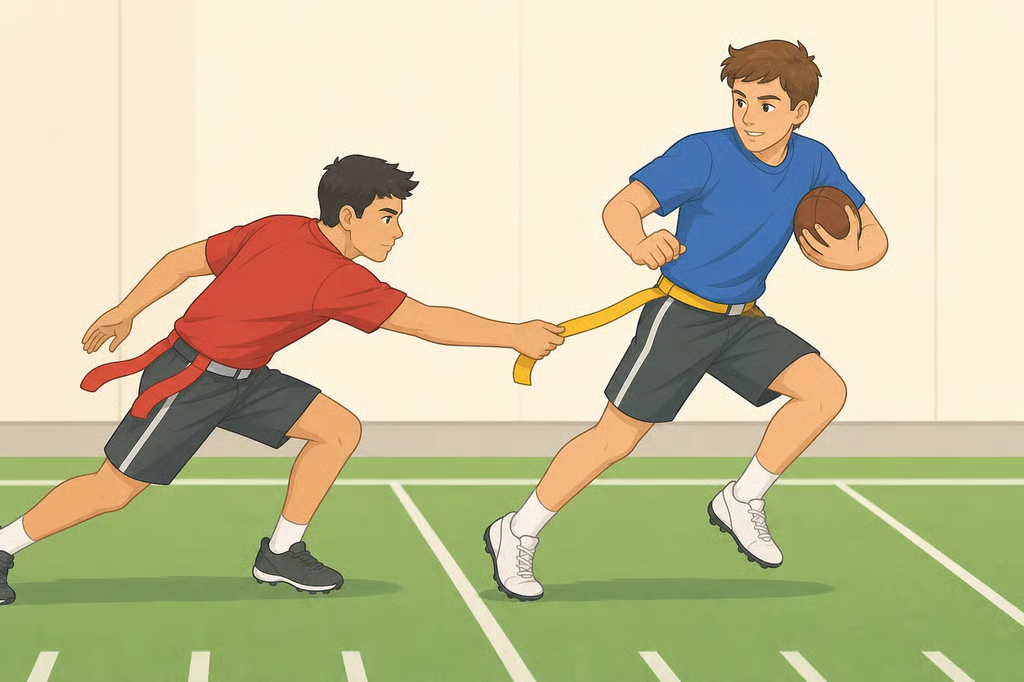
- Flag Football vs Tackle Football Rules: How Flag Pulls Work
- Flag football rules vs tackle football rules: how the flag pull works
- Rules that protect the flag-pull contest on both sides
- Is flag football non-contact? Contact formats and procedural rules
- Why flag football rules aren't one fixed rulebook
- What to check before you play
Flag Football vs Tackle Football Rules: How Flag Pulls Work
Flag football replaces the tackle with the legal removal of a flag from the ball carrier, and that swap is the starting point for understanding flag football vs tackle football rules. iFlag's rulebook frames the sport as "a finesse game" set against "the brute strength game of traditional tackle football" (iFlag Football Rules), and USA Flag's rulebook draws the same contrast in nearly identical language (USA Flag Football Rules). That shared framing sets up the real question: what actually replaces the tackle, and what rules keep that replacement fair for both sides of the ball?
This guide covers what three flag football rulebooks, iFlag, USA Flag, and the Professional Flag Football Association (PFFA), actually say, since none of the source material gathered for it includes an NFL, NCAA, or NFHS tackle rulebook. So the difference between flag football and tackle football described here comes from how flag-football organizations describe their own sport, not from a line-by-line comparison against a tackle rulebook. Players, parents, and coaches joining or running a league under any of these three organizations should walk away knowing how the flag pull works, what fouls look like on both sides, and why one format's rulebook doesn't automatically apply to another.
Flag football rules vs tackle football rules: how the flag pull works
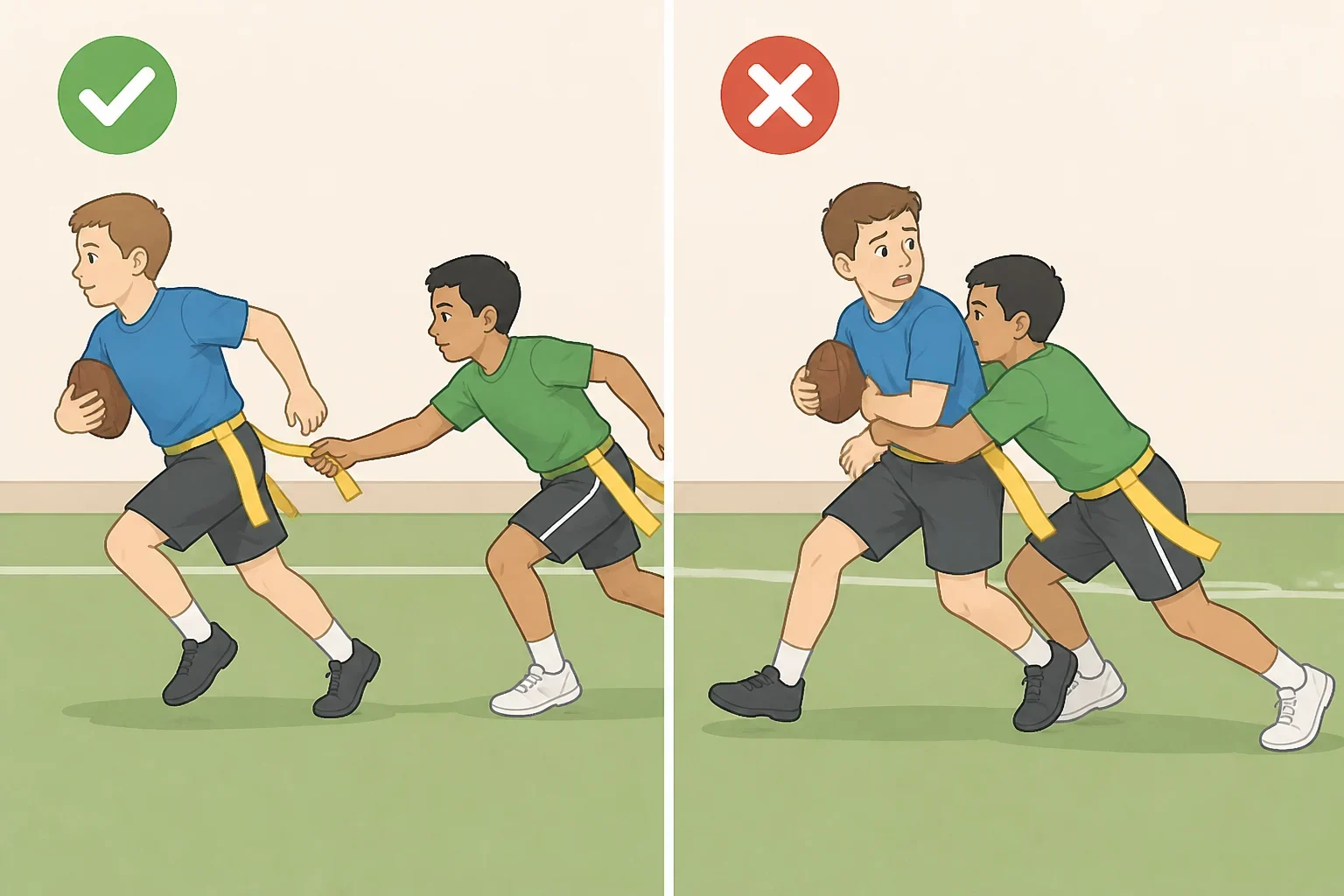
iFlag's rulebook defines the core mechanic directly: flag pulling is "the legal removal of a flag from an opponent in possession of the ball" (iFlag). That definition covers what's legal. The rule that actually makes flag pulling the required method, not just an available one, is the foul for doing anything else.
Under iFlag's rulebook, a defender who "physically contains, tackles, or attempts to tackle" a ball carrier without making a clear, legal attempt at the flag commits a foul. The rulebook lists bear hugs, holds, wrestling, obstructing, and pushing a runner out of bounds as examples of contact that crosses the line (iFlag).
Here's how that plays out on the field:
- Legal: a defender reaches in and removes the flag cleanly. The play ends there.
- Illegal: a defender bear-hugs, holds, wrestles, obstructs, or shoves the runner out of bounds instead of attempting the flag pull (iFlag).
- Standard penalty: the offense gets at least one line-zone-to-gain or fifteen yards, offended team's choice, from the spot of the foul, plus an automatic first down (iFlag).
- Rare outcome: if the foul happens inside the final line-zone-to-gain, or an official believes the illegal contact is the only thing that kept the runner from scoring, the play can result in a score being awarded under what iFlag calls the "last man" rule (iFlag).
For a split second, a clean flag pull and an illegal wrap-up can look similar from the sideline. Only one of them is legal under iFlag's rules.
Rules that protect the flag-pull contest on both sides
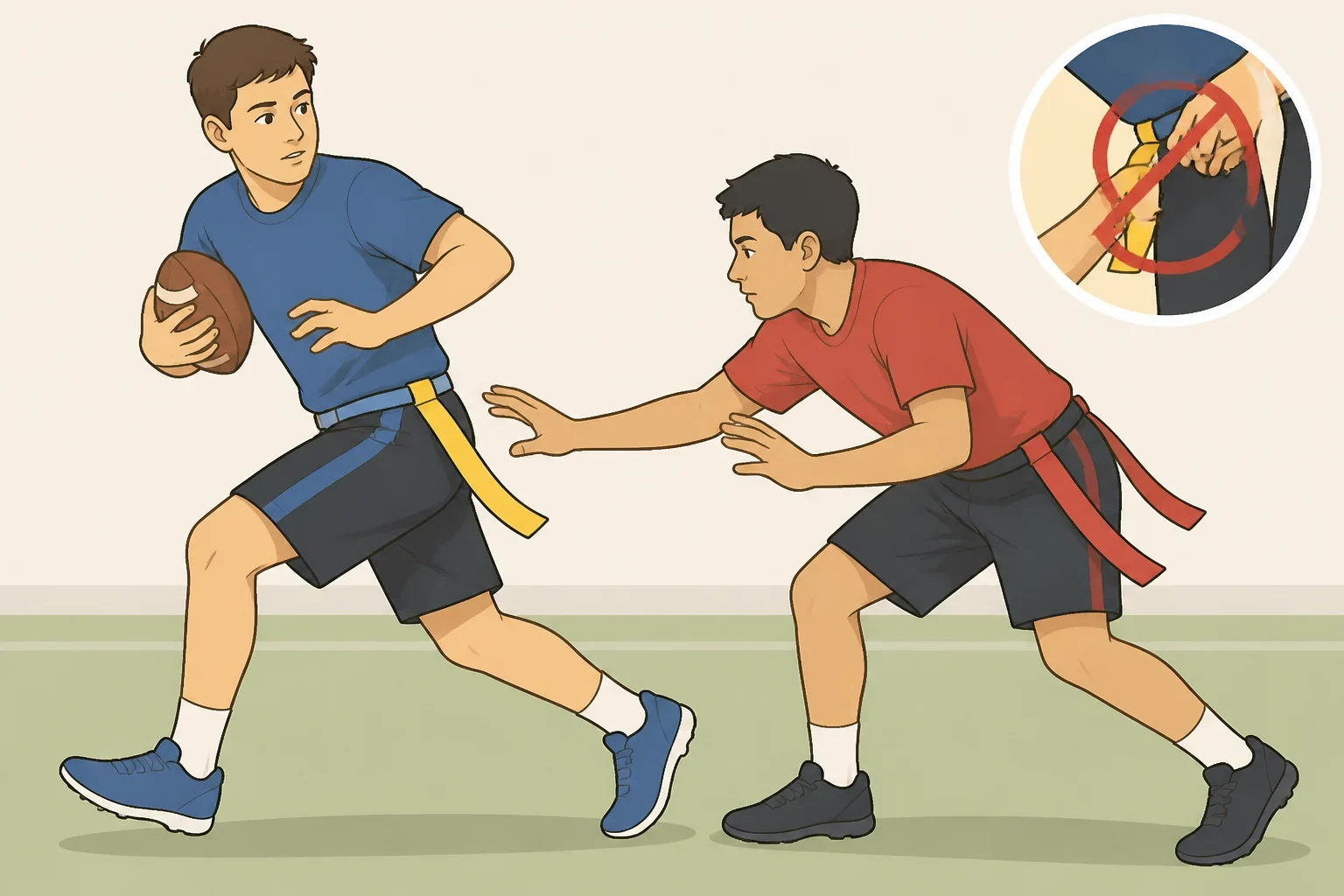
The flag pull isn't only a rule defenders have to follow. USA Flag's rulebook regulates the contest from the offense's side too, and three specific rules keep either team from working around it.
Stripping or attempting to strip the ball itself from a player's hands, including the quarterback, is illegal (USA Flag). Defenders don't get to go after the ball as a shortcut past the flag.
Flag guarding, defined as a ball carrier "denying a defender the opportunity to capture their flag in any physical way," is its own violation (USA Flag). USA Flag's rulebook doesn't spell out a specific gesture or example play, just that general standard.
Tampering with the flag itself to gain an advantage is also illegal (USA Flag), which closes off any attempt to make a flag physically harder to grab.
Taken together, these three rules keep either side from bypassing the actual contest at the center of the sport: defenders can't grab the ball instead of the flag, and runners can't block access to their flag or alter it to make a legal pull harder to complete.
Is flag football non-contact? Contact formats and procedural rules
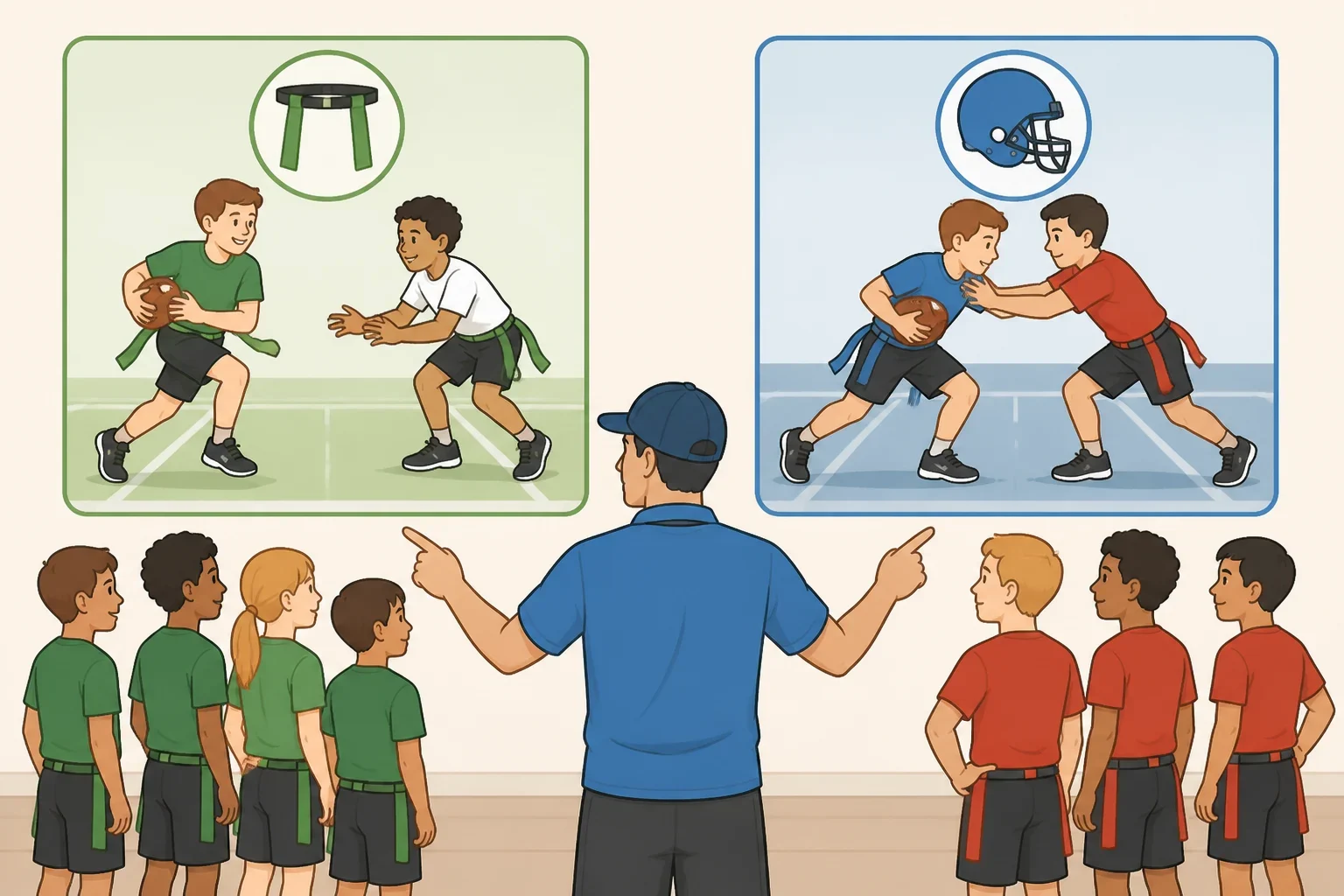
Flag football's reputation as a non-contact sport only holds for some formats, and it depends entirely on which one a league is running. PFFA lists 5v5 non-contact rules for men and women, a 5v5 non-contact coed version, a youth 5v5 non-contact version for boys and girls, and a separate 6v6 contact format for men and women, and each of those four rulesets is described as USA Flag approved (PFFA). Whether the 6v6 contact format still ends a run with a flag pull or allows tackling instead isn't specified in the source material reviewed here, so anyone considering that format should check PFFA's 6v6 rulebook directly rather than assume it works like the non-contact styles.
That contact-versus-non-contact question is about format, not procedure. USA Flag's own rulebook, separately, carries a few procedural rules worth knowing, and they apply within USA Flag's approved formats specifically:
- Quarterbacks cannot intentionally throw the ball out of bounds to stop the clock, an option available under NFL and NCAA rules (USA Flag).
- Entering the neutral zone before the snap is offside or encroachment, which blows the play dead immediately and costs the offending team five yards (USA Flag).
- There are no "free plays" for the offense (USA Flag), meaning a big gain doesn't stand just because a flag is on the ground.
Why flag football rules aren't one fixed rulebook
PFFA states that its formats share a set of general rules as a foundation, but each format also carries its own separate guidelines that need to be read on their own (PFFA). A general rule confirmed for one format doesn't automatically carry over to another, even inside the same organization.
The formats build on each other rather than standing completely apart. PFFA describes its coed rules as an extension of its 5v5 non-contact rules, and its 6v6 contact rules as an extension of its 5v5 contact rules (PFFA). Confirming a rule in one format still doesn't confirm it for another.
That layering also means a local league running something outside these three organizations needs its own point of reference. A league using two-hand touch instead of flag pulling to stop a play follows its own handbook; the sources reviewed for this guide don't classify two-hand touch as a different sport or a variation of flag pulling, only that the league's own rulebook decides what counts as a foul, a legal stop, or a penalty on that field.
What to check before you play

Flag football's core swap is straightforward: a legal flag pull replaces the tackle, and trying to tackle instead draws a real penalty under iFlag's rules. Beyond that, a few practical checks matter more than memorizing any single rule.
- Identify the organization running the league, since iFlag, USA Flag, and PFFA each publish their own rulebook.
- Identify the specific format, whether that's 5v5 non-contact, coed, youth, or 6v6 contact, rather than assuming one flag football rule applies across all of them (PFFA).
- Confirm the rulebook edition. The iFlag rulebook cited throughout this guide covers the 2023/2024 tournament season specifically (iFlag); check with the league directly for whether a newer edition is in use.
- Ask whether the format permits contact at all, since PFFA's own format list includes both non-contact and contact styles under the same organization (PFFA).
- If the league uses a different stopping method, such as two-hand touch, treat that league's own handbook as the governing document rather than assuming flag-pull rules apply.