
NFL playoff seeding and tiebreaker rules 2026 explained
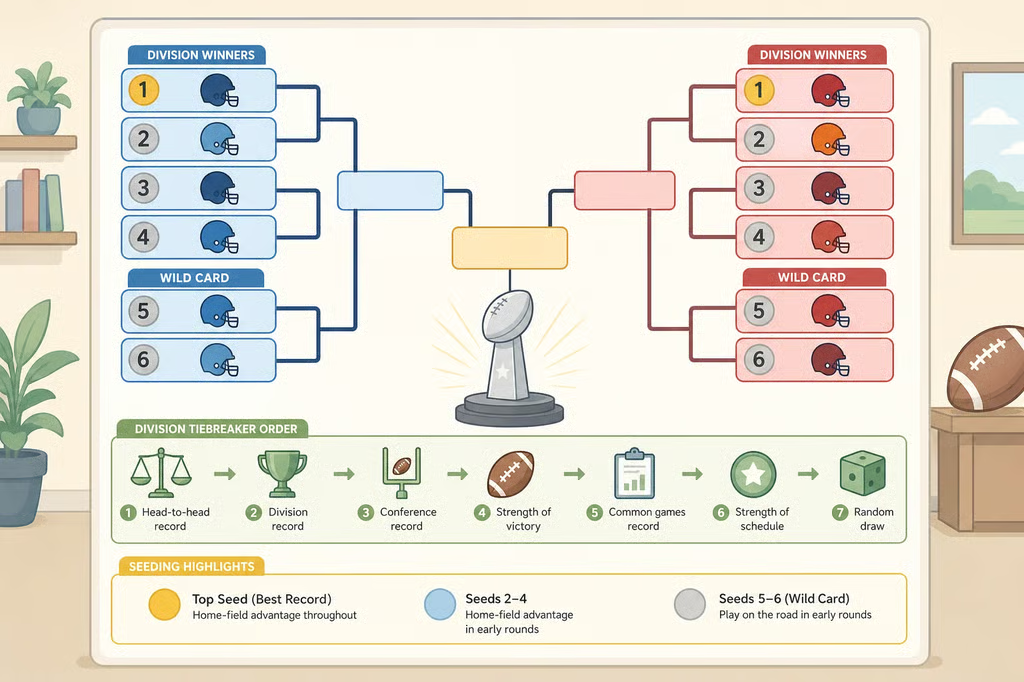
Winning a division, not owning the best record, is what puts an NFL team into the top four seeds in each conference. That detail decided who hosted playoff games last season: the Carolina Panthers reached the 2025-26 postseason and hosted a Wild Card game at 8-9, winning the NFC South through a three-way tiebreaker while teams with better records opened on the road (NBC Sports).
This guide covers the NFL playoff seeding and tiebreaker rules 2026 teams will play under this postseason, based on the format that produced the 2025-26 bracket. Fourteen teams qualify each year, seven per conference, split between four division champions and three wild cards, and seeding runs on regular-season record with tiebreakers stepping in whenever teams finish level (NBC Sports). That's the format that decided last season's bracket, and it remains the league's operative playoff seeding system heading into this season, with no confirmed rule change on record.
How teams qualify and get seeded
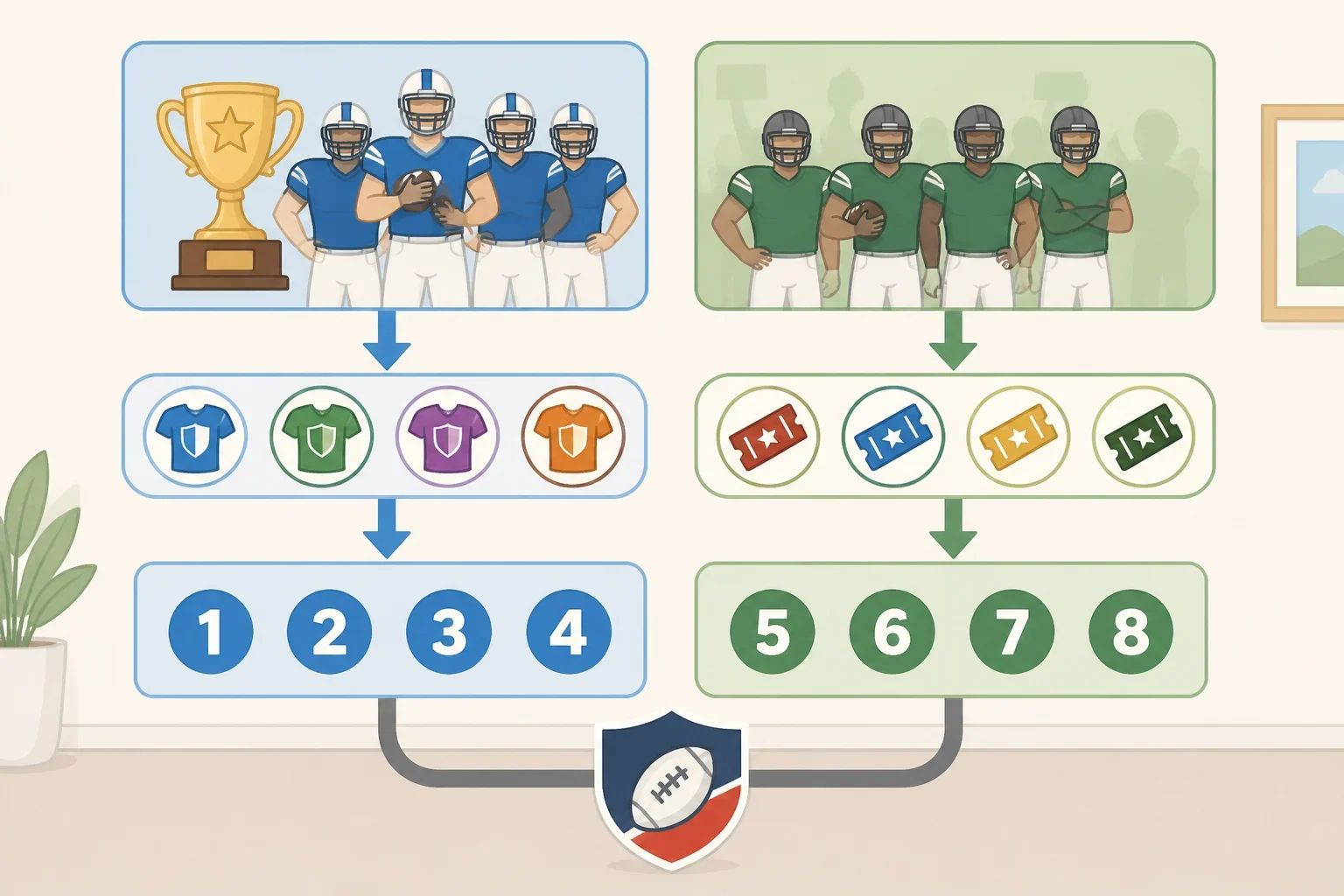
Qualification runs on two separate tracks in each conference. The four division winners get in by finishing first in their division, tiebreaker included when needed, while the three wild cards qualify by posting the next-best records among teams that didn't win a division (NBC Insider).
Once a team qualifies, its seed number is sorted within its own group, not against the full conference field. Division winners are seeded 1-4 by their own record, and wild cards are seeded 5-7 by theirs, so a division winner ranks ahead of every wild card even when a wild card's overall record is better (NBC Sports).
The seed number is what unlocks postseason advantages, not qualification itself. Only the No. 1 seed earns a first-round bye, and it keeps hosting through the conference championship as long as it keeps winning. Seeds 2 through 7 open in three Wild Card matchups per conference: 2-vs-7, 3-vs-6, and 4-vs-5 (NBC Sports; NBC Insider).
Sub-.500 division winners aren't rare. Carolina made the 2025-26 playoffs at 8-9 by winning the NFC South through a three-way tiebreaker, then hosted the Los Angeles Rams as the No. 4 seed in the Wild Card round (NBC Sports). The Washington Commanders qualified at 7-9 in 2020, and the Tampa Bay Buccaneers qualified at 8-9 in 2023, both by winning their division rather than compiling one of the conference's stronger records (NBC Sports).
Step Division winners Wild cards Qualification Finish first in the division, tiebreaker included Best remaining record among non-division winners Initial seeding Ranked 1-4 by own record Ranked 5-7 by own record Postseason advantage No. 1 seed gets a bye and keeps hosting while it wins; Seeds 2-4 host Wild Card games Seeds 5-7 all open on the road
Qualification and seeding are two distinct steps. A wild-card team with a better overall record than one of the four division winners can still land a lower seed and open on the road, because its seed is set only against the other two wild cards in its conference, not against the division champs ranked above it.
How the NFL playoff bracket reseeds after Wild Card weekend
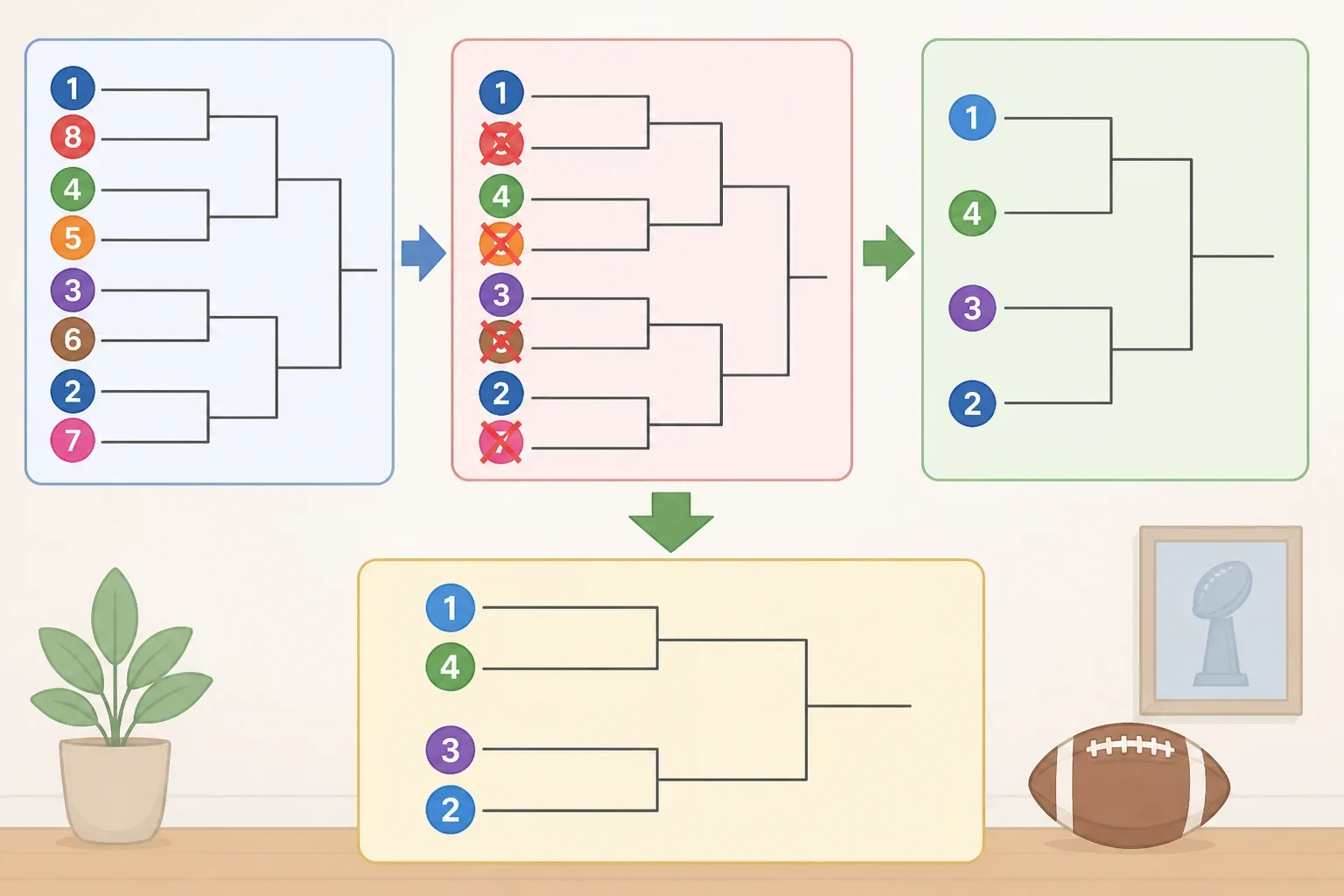
The bracket isn't locked in once Wild Card Weekend ends. In the Divisional Round, the No. 1 seed plays whichever surviving team has the lowest number, and the other two survivors play each other based on their remaining seeds, rather than following a printed bracket set before the postseason began (NBC Insider). Conference Championship Games are hosted by whichever team holds the higher remaining seed, setting up the two clubs that advance to the Super Bowl (NBC Sports).
Say a No. 7 seed knocks off a No. 2 seed on Wild Card Weekend. The No. 1 seed's Divisional Round opponent then shifts from the No. 2 to the No. 7, because the top seed always draws the lowest surviving number, not a pre-set matchup. One upset in the opening round changes who the No. 1 seed faces next, so tracking surviving seed numbers matters more than trusting a printed bracket to hold up.
NFL playoff tiebreaker rules: what settles a tie

Ties get broken using head-to-head results and conference and division records, according to NBC Sports's rundown of the 2025-26 format (NBC Sports). Those are the three factors most fans run into, and in a straightforward two-team tie, they're usually enough to settle it.
Carolina's 2025-26 division title is a good reminder that the specific factor deciding a tie is worth checking rather than assuming. The Panthers won the NFC South through a three-way tiebreaker, but the available reporting confirms only that a multi-team tiebreaker occurred, not which criterion actually decided it (NBC Sports). A three-club tie doesn't play out the same way a two-team tie does, which is exactly why guessing at the deciding factor from memory can lead to the wrong read on who's actually in.
Before applying any of these criteria to a real standings question, pull up head-to-head results and conference and division records directly from the current standings rather than assuming from a general rule of thumb. Whether a tie decides a division title or a wild-card berth, and whether more than two clubs are involved, changes which factor gets checked first, so treat head-to-head, conference record, and division record as the starting point rather than the whole story.
What to check before the 2026 postseason
- Confirm head-to-head results and conference and division records directly against the current standings before assuming which tiebreaker factor applies. A division race and a wild-card race can come down to different criteria.
- Once Wild Card Weekend produces an upset, track surviving seed numbers rather than a printed bracket. Divisional Round matchups depend on who's left standing, not on where teams started the postseason.