
WNBA Playoff Format 1-1-1 Explained: 2025 First Round
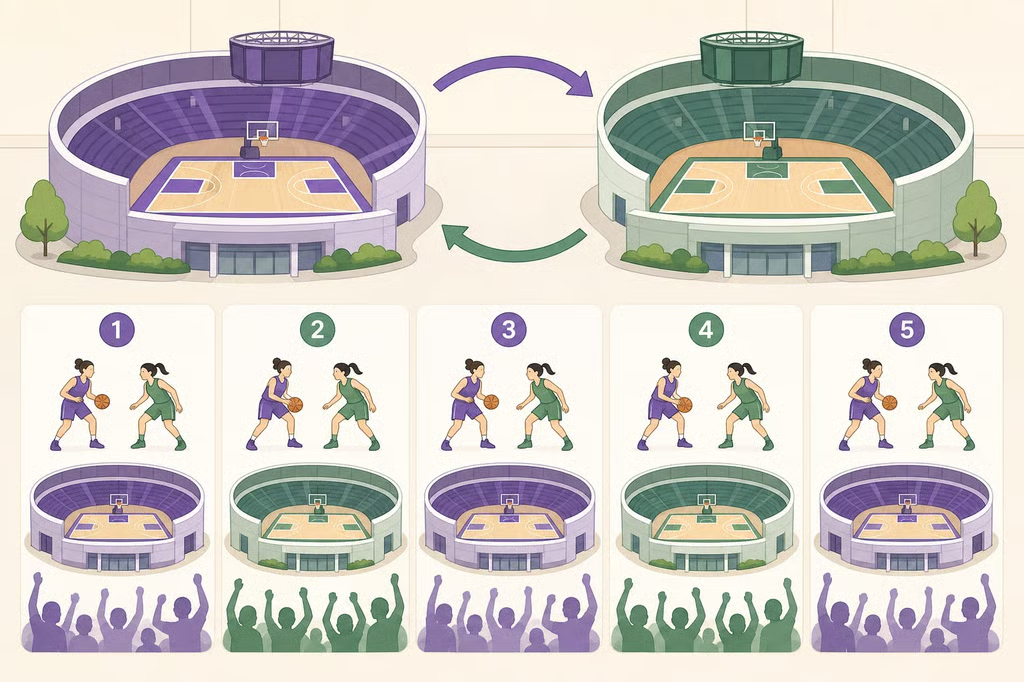
The WNBA's Board of Governors approved a 1-1-1 format for the best-of-three first round ahead of the 2025 playoffs, flipping how home games get assigned between seeds. Under that setup, the higher seed hosts Games 1 and 3 while the lower seed gets Game 2, guaranteeing every playoff team at least one home date while keeping a potential series-deciding game at the better seed's arena (WNBA.com, about a year ago).
That change arrived the same offseason the WNBA Finals expanded to a best-of-seven series for the first time in league history (WNBA.com, about a year ago). This breakdown covers how that 2025 sequence worked, what it replaced, and what that postseason's results showed. It's built from the league's 2025 postseason FAQ and reporting from that September, so before following a current first round, confirm the home-game order on WNBA.com's postseason FAQ rather than assuming last year's rules carried over unchanged.
How the WNBA's 1-1-1 first round format worked
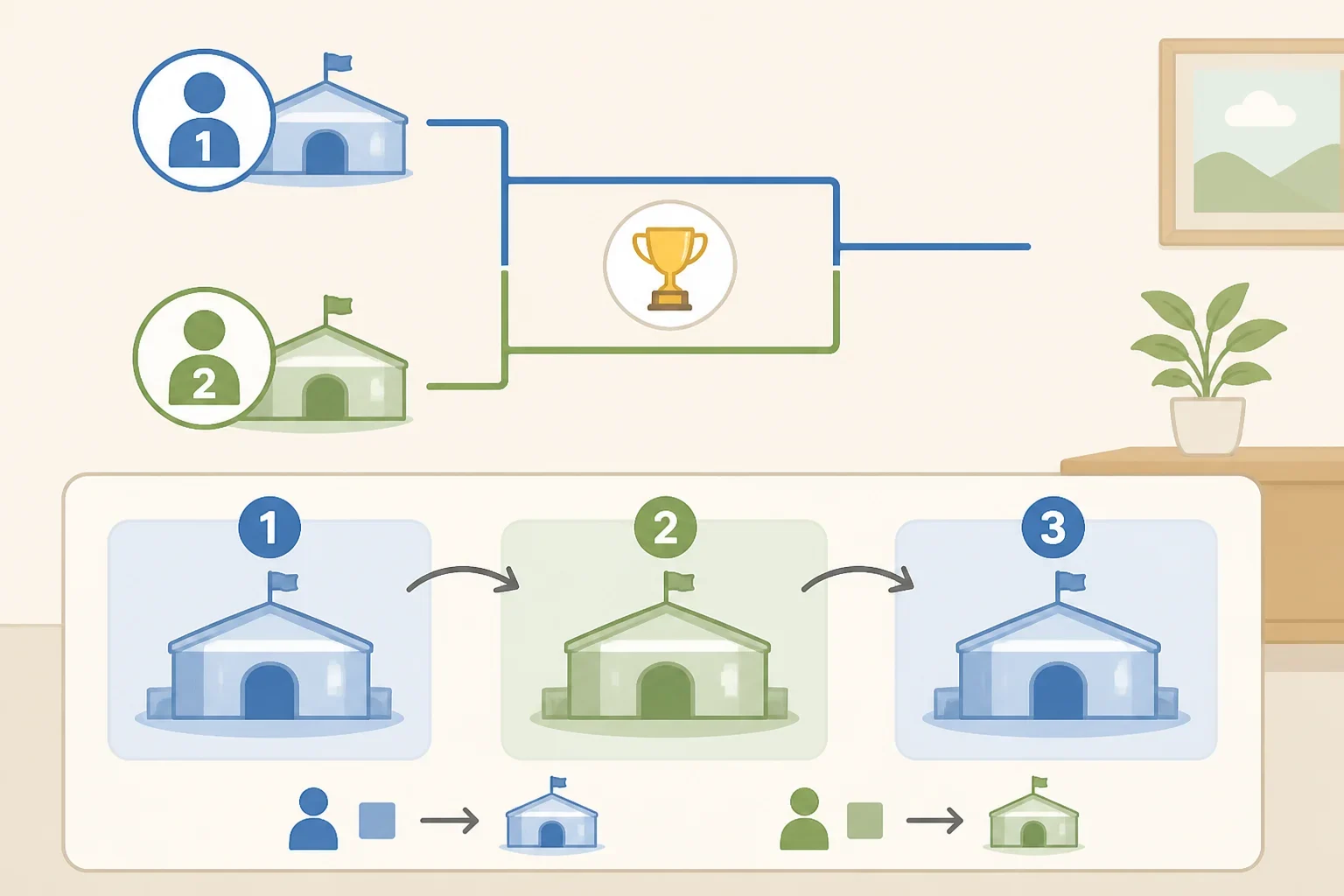
The mechanics are simple once you see them laid out. Game 1 is played at the higher seed's arena, Game 2 moves to the lower seed's building, and if the series needs a third game, it returns to the higher seed's court (WNBA.com, about a year ago).
Say a No. 3 seed drew a No. 6 seed in the first round. Game 1 would tip off at the No. 3 seed's home arena, Game 2 would shift to the No. 6 seed's building, and Game 3, if the series was tied 1-1, would head back to the No. 3 seed's court.
That last part matters for a reason people sometimes miss: "1-1-1" describes where the games are played, not a guarantee of three games. The first round is still a best-of-three series, so whichever team wins two games first advances, and a sweep in either direction ends things after Game 2 (WNBA.com, about a year ago).
This sequence applies only to the first round. The semifinals run 2-2-1 across a best-of-five, and the Finals use 2-2-1-1-1 across a best-of-seven, so home-court advantage looks different at every stage of the bracket (WNBA.com, about a year ago).
Home-court advantage in every round goes to whichever team finished with the better regular-season record among the top eight overall, not by conference or division (NBC Sports, about a year ago).
1-1-1 vs. 2-1 format: what changed and why
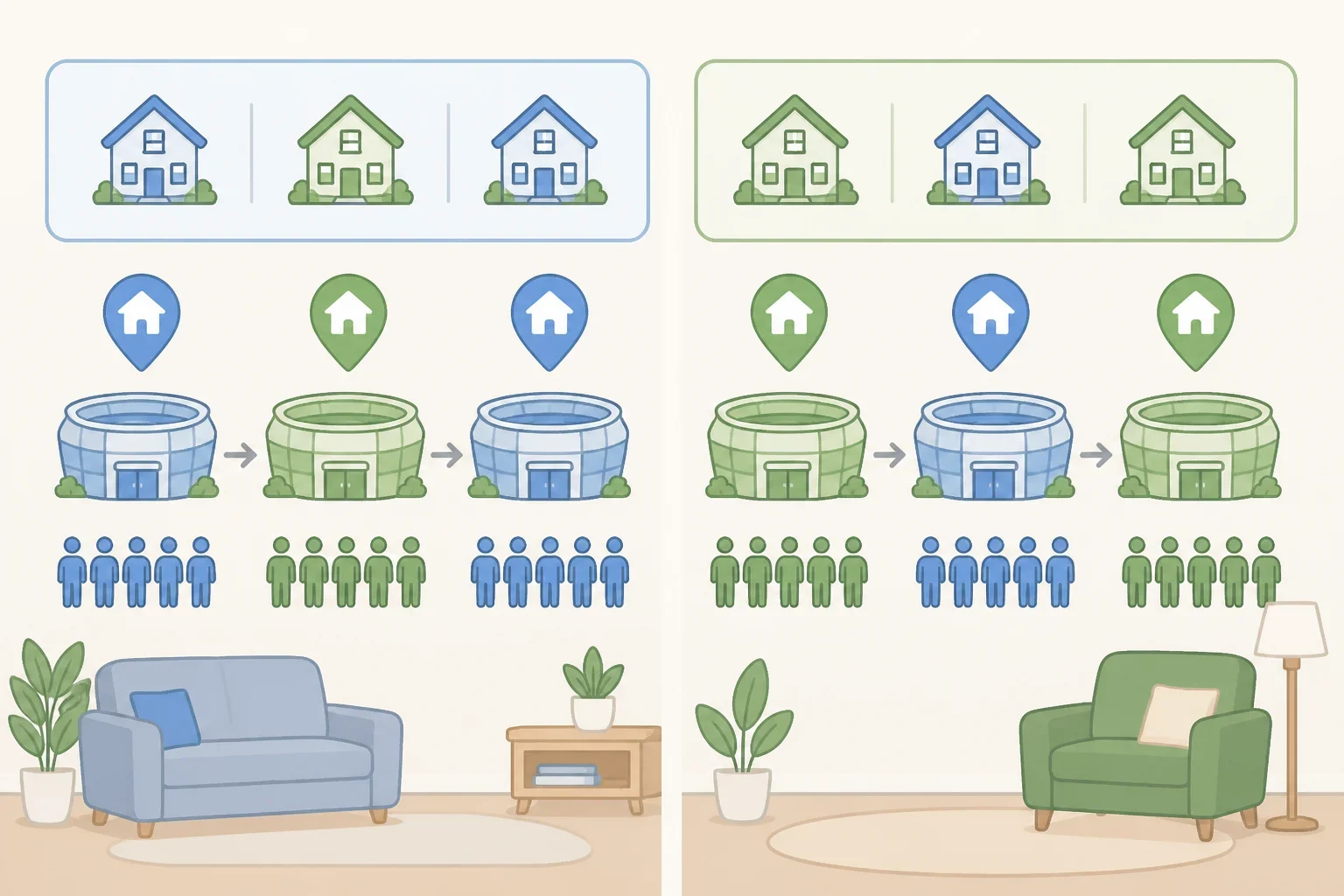
From 2022 through 2024, the first round ran on a 2-1 setup: the higher seed hosted Games 1 and 2, and if the series went the distance, the lower seed hosted the decider (Sports Illustrated, about a year ago). Before that, the playoffs gave the top two seeds first-round byes and had everyone else open with single-elimination games, a structure the league moved away from starting in 2022 (NBC Sports, about a year ago).
The 2-1 arrangement drew criticism for one specific outcome: a series-deciding Game 3 could land on the lower seed's floor even though the higher seed had earned the better record all season. Yahoo Sports' Cassandra Negley called that "an issue in its own right," as summarized by Sports Business Journal (about a year ago), and Negley argued the new venue order "evens the tables" more than the previous setup did.
Sports Business Journal reported that instituting charter flights early in the 2024 season made the added travel of a 1-1-1 sequence workable for teams. Commissioner Cathy Engelbert said at the 2024 Finals that the league had wanted to make the switch since the pandemic-shortened season, according to that same reporting (Sports Business Journal, about a year ago).
What the 2025 first round showed
Reported attendance for Game 2 climbed compared with the year before. The lowest Game 2 crowd in the 2025 first round was 12,500, above the roughly 11,000 that had been the high for any Game 2 in 2024, and the Golden State Valkyries drew 18,543 even after a scheduling conflict with the Laver Cup forced the team to relocate its game to San José (Sports Illustrated, about a year ago). Arena capacities differ across the league, so those figures show the cited 2025 numbers topped the cited 2024 comparison; they don't establish which building filled a larger share of its seats.
Series also ran longer. Three of the four first-round series in 2025 reached a deciding Game 3, according to Yahoo Sports' Negley as reported by Sports Business Journal, a sharp reversal from 2024, when all four series ended in sweeps, and from 2023 and 2022, when three and two series were swept, respectively (Sports Business Journal; Sports Illustrated, about a year ago).
One postseason of results doesn't prove the venue switch caused the extra competitiveness by itself. CBS Sports' Lindsay Gibbs, summarized by Sports Business Journal, pointed out that the top four seeds still advanced to the semifinals in each of the three prior 2-1 seasons, and she wrote it's "unlikely" the new arrangement will produce a wave of first-round upsets, even as it changes the stakes and atmosphere of the games themselves (Sports Business Journal, about a year ago).
The unresolved question: is best-of-three long enough?
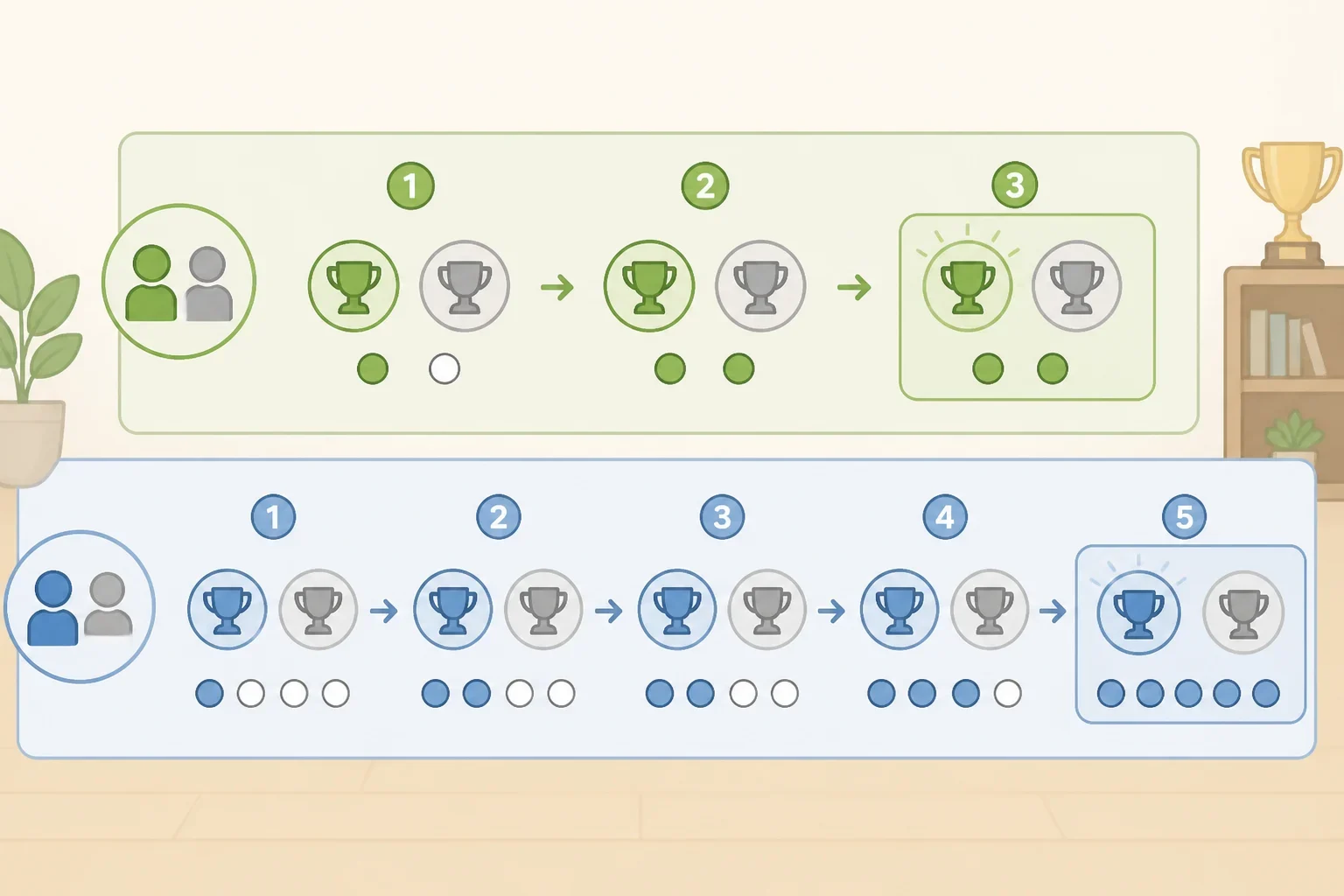
Fixing where games are played didn't settle a separate complaint: whether three games are enough to settle a first-round series at all. Aces coach Becky Hammon said she would rather see a best-of-five first round than either home-court arrangement: "You go best-of-five if you're not going back to the old format. This setup, I prefer a five-game series" (Sports Business Journal, about a year ago).
USA Today columnists Armour and Hall made a similar case in their own column, summarized by Sports Business Journal, writing that the league has "outgrown" the best-of-three quarterfinal round and that the intensity of the 2025 first round was itself "the argument you need" for expanding it to best-of-five (Sports Business Journal, about a year ago).
That gap stood out more once the Finals moved to best-of-seven. The first round, at the opposite end of the bracket, still stopped at three games, meaning the round with the most teams left in it took the fewest games to settle while the championship round could run to seven (WNBA.com, about a year ago).
Sports Business Journal also noted that the league's bracket layout may need another look as five more teams are set to join by 2030, and that a return to conference-based seeding might help with that, though it could reduce some of the competitiveness gained by moving away from conferences in the 2010s (Sports Business Journal, about a year ago).
What to remember
The 1-1-1 format solved a specific problem: it gives the lower seed a guaranteed home game while keeping a potential deciding Game 3 at the higher seed's arena. It doesn't change the first round's length, which stayed best-of-three even after the Finals expanded to seven games, and Hammon and Armour and Hall have already made the case for stretching it further.
Nothing here confirms the current season's rules match 2025's. Check WNBA.com's postseason FAQ for the confirmed home-game order, series lengths, and dates before following this year's first round.