
- 2026 NCAA Women's Volleyball Tournament Format Confirmed
- How the 2026 NCAA women's volleyball tournament selection process works
- The bracket path: six rounds from 64 teams to a champion
- What the 2026 NCAA volleyball tournament seeds and hosting sites will determine
- The confirmed 2026 calendar
- What's confirmed vs. what's only known from 2024
2026 NCAA Women's Volleyball Tournament Format Confirmed
The NCAA has locked in the core dates and bracket size for the 2026 Division I women's volleyball championship. Several details fans ask about most, like which campuses will host the early rounds, are documented only through how the 2024 tournament ran, and the NCAA.com page cited throughout this article doesn't address them for 2026.
Here's what's confirmed: the 2026 NCAA women's volleyball tournament format keeps the 64-team single-elimination bracket, with the Selection Show scheduled for Sunday, Nov. 29, 2026, according to NCAA.com's road-to-the-championship page, dated September 2025. Of those 64 spots, 31 go to automatic qualifiers and 33 are at-large bids picked by the Division I Women's Volleyball Committee, per the same source. The run ends at the Alamodome in San Antonio, with national semifinals on Dec. 17 and the championship match on Dec. 20, 2026, according to NCAA.org, updated in May 2026.
This piece separates what those two specific NCAA pages confirm for 2026 from what those same pages simply don't list, so readers know what's documented right now and where the actual gaps sit.
How the 2026 NCAA women's volleyball tournament selection process works
The bid math splits cleanly. Thirty-one teams earn automatic qualification, and the Division I Women's Volleyball Committee fills the remaining 33 spots with at-large selections, according to NCAA.com. The 2024 field used that identical structure: 31 conferences were awarded automatic qualification, and the remaining 33 positions went to at-large selections, per NCAA.com's December 2024 announcement.
What the NCAA.com page cited here doesn't list is how the committee will weigh those at-large picks for 2026, whether that means strength of schedule, head-to-head results, or some other formula. That's a gap in this particular source, not proof that no criteria exist. Readers can check the NCAA's official championship materials for an updated selection breakdown rather than assuming the 2024 cycle's factors carry over unchanged.
The 2024 field is useful only as historical context for how those judgment calls played out in one prior year, not as a preview of 2026 standards. Pittsburgh entered that tournament with the best record in Division I at 29-1 while winning its third straight ACC title, according to NCAA.com's 2024 announcement. Nebraska and Penn State shared the Big Ten crown after both finished 19-1 in conference play and 29-2 overall, per the same source. Louisville, the fourth top seed that year, closed its regular season 25-5. None of those numbers dictate how the 2026 committee will rank teams; they're simply what earned top seeding in the last documented cycle.
The bracket path: six rounds from 64 teams to a champion

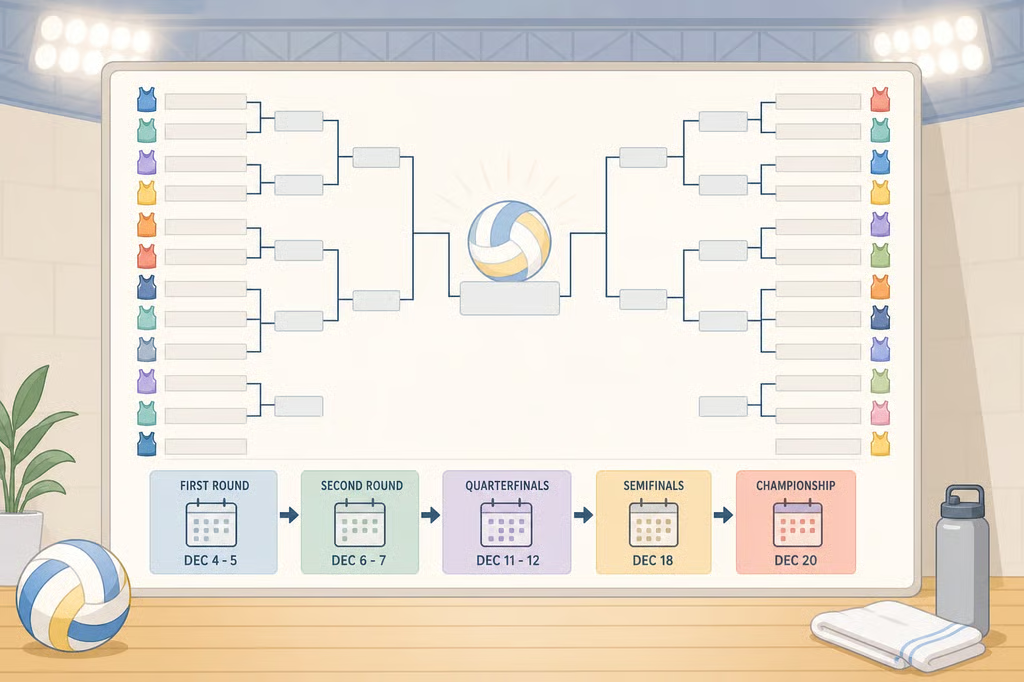
The 2026 bracket runs through six single-elimination rounds: first round, second round, regional semifinals, regional finals, national semifinals and the championship, per NCAA.com. The math behind that structure is confirmed for 2026:
- First round: 64 teams become 32
- Second round: 32 become 16
- Regional round: 16 winners advance
- National semifinals: four regional champions become two
- Championship: two finalists become one
Those 16 second-round winners advance to the regional round. In 2024, that round was staged at four sites with four teams each, producing four regional champions who then met in the national semifinals, with the two semifinal winners meeting for the title, according to NCAA.com's 2024 recap. Whether the 2026 regional round will use that same four-site structure hasn't been confirmed in the sources reviewed for this article, even though the six-round format itself is locked in.
That 2024 bracket also seeded the top 32 teams nationally in pods of four and kept teams from the same conference apart during the first two rounds, per the same source. Pods paired one-seeds against eight-seeds, two-seeds against seven-seeds, three-seeds against six-seeds, and four-seeds against five-seeds. Whether the 2026 committee will use that same pod structure is not addressed in any NCAA championship materials reviewed for this article.
What the 2026 NCAA volleyball tournament seeds and hosting sites will determine
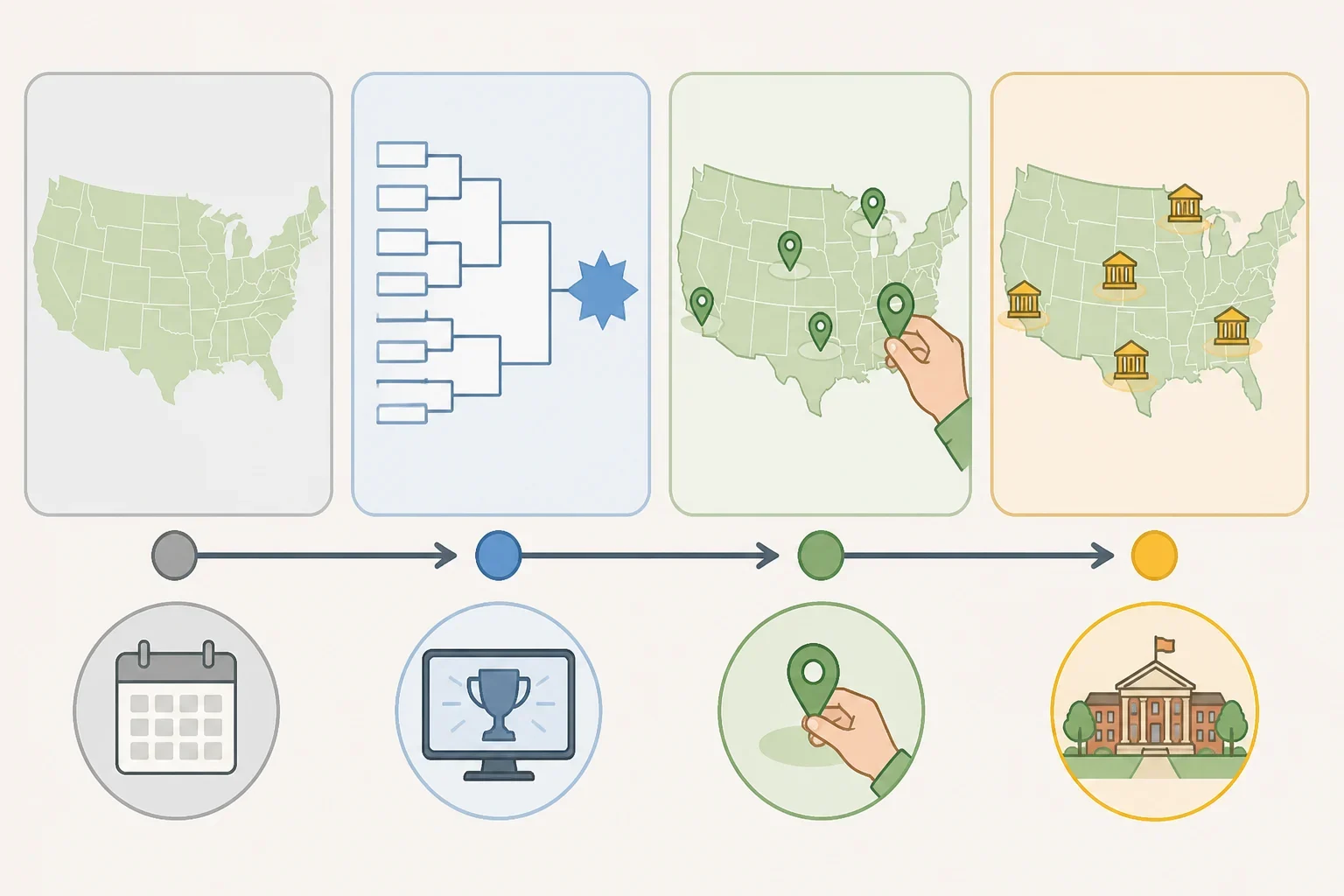
The NCAA describes both the first two rounds and the regional round as taking place at non-predetermined campus sites, according to NCAA.com. That phrasing confirms hosts aren't fixed on the schedule the way the Alamodome is for the Final Four, but the page doesn't spell out the mechanics or timeline for choosing those hosts in 2026.
That matters for readers trying to map out where a team might play. Because sites aren't predetermined, the Selection Sunday bracket reveal doesn't necessarily arrive with every venue attached. In 2024, first- and second-round matches were played Dec. 5-7 at 16 campus sites, and the four regional sites were announced separately on Dec. 8, after those first two rounds were already complete, according to NCAA.com's 2024 report. Whether 2026 follows that same sequence hasn't been confirmed in the sources reviewed here.
The 2024 pod system gave top seeds the opportunity to host regional matches, not a guarantee, per the same source. Whether that arrangement returns for 2026 isn't addressed in the NCAA.com page reviewed for this article, so a home regional for any given team stays unconfirmed until the NCAA states otherwise.
The confirmed 2026 calendar

Several dates are locked in already, according to NCAA.com and NCAA.org:
- Selection Show: Sunday, Nov. 29, 2026
- Regionals: Dec. 10-13, 2026
- National semifinals: Dec. 17, 2026
- Championship match: Dec. 20, 2026, at the Alamodome in San Antonio
What's missing from that list matters too. The NCAA.com road-to-the-championship page, dated September 2025, does not list exact dates for the first and second rounds, even though it confirms dates for every round after that.
For comparison, the 2024 Final Four was hosted by Louisville at the KFC Yum! Center, with national semifinals airing on ESPN and the championship match on ABC, according to NCAA.com. That's simply where the last documented title matches were played, not evidence of a fixed rotation for future championship sites. The 2026 championship is already set for the Alamodome instead.
What's confirmed vs. what's only known from 2024
The NCAA.com and NCAA.org pages cited throughout this article confirm the 64-team field, the 31-to-33 automatic-to-at-large split, the Nov. 29 Selection Show, and the Dec. 17-20 Final Four at the Alamodome. At-large evaluation criteria, seeding or pod structure, first- and second-round dates, and campus host sites for the early rounds simply aren't listed on those same pages.
Any seeding or hosting detail describing how 2026 will play out beyond what's cited here is drawing on the 2024 tournament, not confirmed 2026 policy. Checking the NCAA's official championship page again as Selection Sunday approaches remains the way to confirm those specifics once the NCAA publishes them.