
- New Premier League Rules 2026-27: Five On-Pitch Changes
- Premier League rule changes 2026-27: what's confirmed so far
- Premier League substitution rules: the 10-second exit
- Injury stoppages: the one-minute rule and England's goalkeeper trial
- Premier League timewasting rules: countdowns for restarts
- Goal kicks: live the moment they're kicked
- VAR's narrow new powers
- Other Premier League officiating guidance
- Where confusion is most likely
New Premier League Rules 2026-27: Five On-Pitch Changes
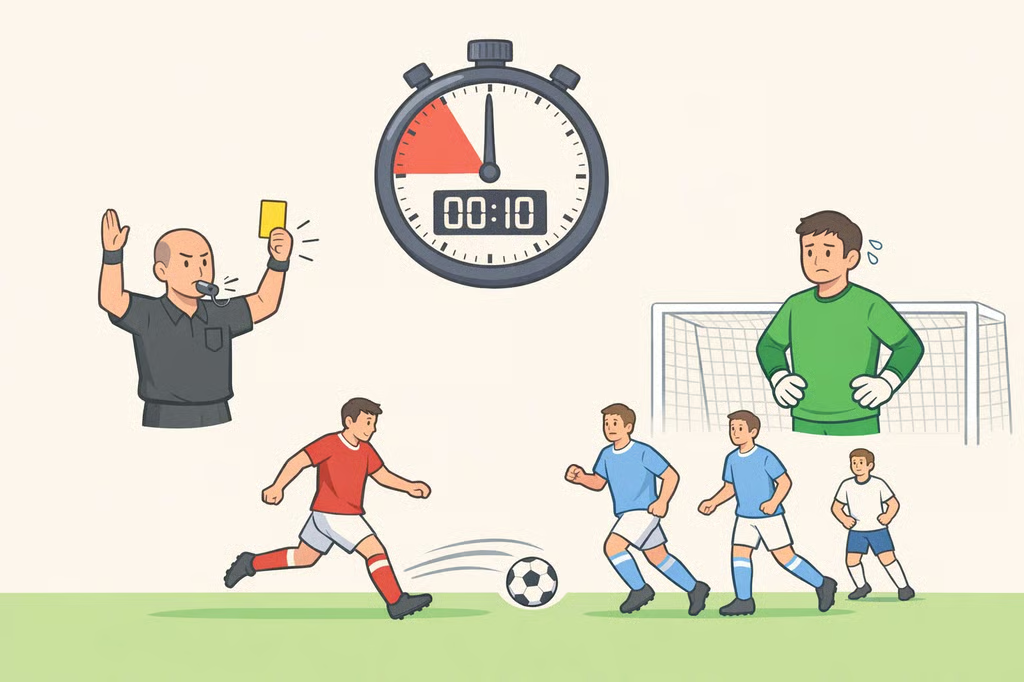
The new Premier League rules 2026-27 turn several kinds of delay into an immediate sporting cost rather than a talking-to from the referee. A player who dawdles off after being substituted leaves his team a man short. A goalkeeper who lets a delayed goal kick's five-second countdown expire, or who holds the ball too long by hand, can concede a corner. IFAB, the game's global lawmaking body, approved this package at its Annual General Meeting to enhance match tempo and reduce time-wasting, effective from July 1, 2026, with competitions starting before that date able to introduce the changes earlier (IFAB).
The changes arrive amid scrutiny of how much football fans actually get to watch. BBC Sport reported that ball-in-play time at this summer's World Cup rose to 60.43%, up from 56.86% in Qatar in 2022, an increase driven mainly by less added time rather than more actual playing minutes (BBC Sport). A separate survey found 85% of respondents flagged goalkeeper "tactical timeouts" as a problem worth fixing, according to BBC Sport (BBC Sport).
Most of these changes are formal Law amendments from IFAB that apply worldwide. One, the goalkeeper injury protocol, is a trial specific to English football approved through the Football Association. Two more, covering hair-pulling and holding, are Premier League officiating guidance with no change to the Laws behind them. Those distinctions caused confusion during the Carabao Cup's opening round last weekend, according to BBC Sport (BBC Sport).
Premier League rule changes 2026-27: what's confirmed so far
Change Status What the supplied sources establish Substitution 10-second exit Global IFAB Law IFAB Law effective July 1, 2026 One-minute injury stoppage Global IFAB Law IFAB Law effective July 1, 2026 Goalkeeper injury trial (outfield player leaves) FA-approved English trial FA-approved English trial (AP News) Five-second restart countdown Global IFAB Law IFAB Law effective July 1, 2026 Goal kick live once kicked Global IFAB Law IFAB Law effective July 1, 2026 VAR review of incorrect second-yellow reds Global IFAB Law IFAB Law effective July 1, 2026 VAR review of mistaken identity Global IFAB Law IFAB Law effective July 1, 2026 Pre-set-piece attacking-foul VAR review IFAB trial/competition option Not established in available research Hair-pulling judgment guidance Premier League officiating emphasis Premier League guidance reported by BBC Holding/grappling emphasis Premier League officiating emphasis Premier League guidance reported by BBC
The entries above reflect what the sources cited in this article confirm. Rows marked "not established" are not confirmed as active in Premier League matches based on the research reviewed here.
Premier League substitution rules: the 10-second exit
A substituted player now has 10 seconds to leave the field at the nearest point once the board goes up or the referee signals (BBC Sport). Miss that window, and IFAB's Law states the substitute cannot enter until the first stoppage after one running minute has passed, leaving the team a player short in the meantime (IFAB).
A related but separate rule addresses confusion over who's actually coming off. The fourth official has 10 seconds to identify the player, and if that isn't resolved, the captain must specify (BBC Sport). That's an administrative fix rather than a second penalty layered onto the walk-off rule.
In practice, a substituted player who remains on the pitch past the 10-second count leaves his side playing with 10 players until the first stoppage after the one-minute mark, under the Law IFAB approved earlier this year (IFAB).
Injury stoppages: the one-minute rule and England's goalkeeper trial
Players who receive on-field treatment or assessment must now stay off for one running minute after the restart, up from the 30 seconds fans have grown used to (BBC Sport). The rule applies even when the player didn't ask for treatment but is the reason the referee stopped play. If the fouling player receives a yellow or red card, the injured player does not have to stay off in all circumstances, according to BBC Sport's summary of the change (BBC Sport).
The English Football Association said English football received IFAB approval for a goalkeeper injury trial for the 2026-27 season, describing it as part of an ongoing commitment to maintaining match pace and flow (AP News). Under the trial, a coach-selected outfield player must leave the field for one minute when the goalkeeper asks for treatment, and the team plays with 10 players while that player is off, according to BBC Sport (BBC Sport).
That mechanism sits alongside, not inside, the broader one-minute rule. The general rule covers any player treated or assessed after a stoppage; the English trial addresses only a goalkeeper who specifically requests treatment, and it applies to English competitions rather than the global Laws.
Premier League timewasting rules: countdowns for restarts
Referees can now start a five-second visual countdown when a throw-in or goal kick is being delayed. If the ball still isn't in play once the countdown ends, the throw-in goes to the opposition, and a delayed goal kick becomes an opposition corner (IFAB).
IFAB said the new countdown builds on positive global feedback about a rule already in place since last season, which penalizes goalkeepers for holding the ball too long by hand (IFAB). Since 2025-26, a goalkeeper controlling the ball with the hands for more than eight seconds has conceded a corner, with the referee signaling the final five seconds with a raised hand (IFAB Law changes summary).
These are two separate countdowns with different triggers and different restarts: eight seconds for a goalkeeper holding the ball, five seconds for a delayed throw-in or goal kick. That overlap was one feature of the confusion BBC Sport reported during the Carabao Cup's opening round last weekend (BBC Sport).
Goal kicks: live the moment they're kicked
A goal kick now counts as taken the instant it's kicked by the goalkeeper or a defender (BBC Sport). Once the kick has been taken, any subsequent handball or back-pass incident is judged under the existing Laws: a defender's handball can be penalized under normal handball criteria, and a goalkeeper who handles a teammate's kick risks conceding an indirect free kick for a back-pass (BBC Sport). Neither offense is new; only the point in the restart sequence at which it can be called has changed.
VAR's narrow new powers
VAR can now assist in reviewing a red card that resulted from a clearly incorrect second yellow card. It cannot review a potential second booking before it's shown, and IFAB requires clear factual evidence rather than a subjective difference of opinion about the card (IFAB; BBC Sport).
The second new power covers mistaken identity, narrowly: it applies only when the referee penalizes the wrong team, or shows a card to the wrong player, for an offense that resulted in a red or yellow (IFAB).
IFAB has also described a trial that would let VAR review an attacking foul before a set piece if it directly leads to a goal, penalty or card, with the restart becoming a retaken corner rather than a free kick (BBC Sport). The trial does not extend to defensive fouls before the ball is in play, since a penalty cannot be awarded in that situation, according to BBC Sport (BBC Sport). This is listed as a trial or competition option rather than a settled global Law, and the research reviewed for this article does not establish whether it is active in Premier League matches this season.
The Premier League is not adopting a World Cup-style option that would let VAR check incorrectly awarded corners. In survey results reported by BBC Sport, 65% of respondents backed the existing review threshold, compared with 37% in favor of adding corner reviews (BBC Sport).
Other Premier League officiating guidance
Two additional shifts affect how referees apply judgment on the pitch, but neither changes the Laws of the Game itself.
Three Premier League players, Michael Keane, Lisandro Martínez and Dan Ballard, were sent off for hair-pulling via VAR review last season (BBC Sport). Referees have now been told to weigh intent and force rather than treat every instance as automatic red, looking for a "clear and deliberate action" involving "excessive force and/or brutality" (BBC Sport).
Officials have also been told to pay closer attention to grappling with "clear material impact" at corners and set pieces, and to penalize challenges on goalkeepers where there's no genuine attempt to play the ball (BBC Sport). BBC Sport reported that the Premier League agreed both points at its AGM earlier this year, as part of the season's "football principles" and officiating points of emphasis for 2026-27, rather than as amendments to the Laws themselves (BBC Sport).
Where confusion is most likely
The five-second countdown for a delayed throw-in or goal kick operates separately from the existing eight-second limit on a goalkeeper holding the ball by hand, and the two share a similar hand signal despite different triggers and different restarts. That overlap was part of what BBC Sport described as confusion during the Carabao Cup's opening round last weekend (BBC Sport).
A second layer of confusion separates global IFAB Law, the FA's English-only goalkeeper trial, and the Premier League's own officiating guidance on hair-pulling and holding. A decision that resembles a firm Law change can actually be a discretionary call agreed at a domestic AGM, and the reverse is also true. For competition-specific questions, including whether the pre-set-piece VAR trial applies in a given match, the current Premier League or PGMOL matchday guidance is the reference point rather than a ruling carried over from another competition or from last season.