
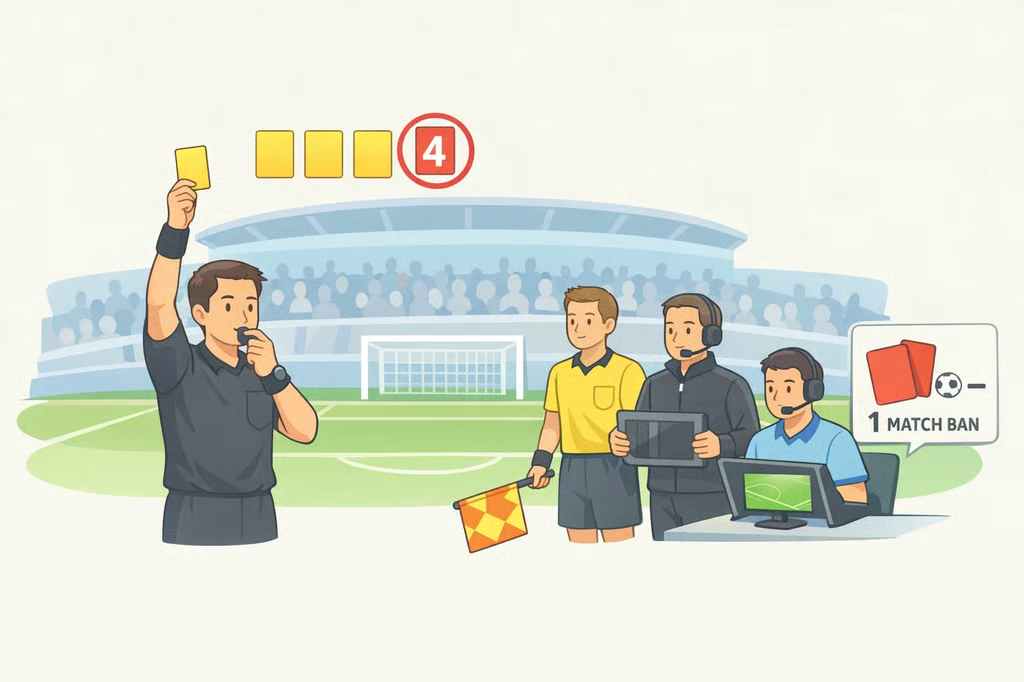
UEFA has reportedly approved a higher yellow-card suspension threshold for the 2026-27 league phases of the Champions League, Europa League and Conference League. The proposed change would allow players and team officials to receive three cautions before serving a one-match ban, rather than being suspended after their third.
The governing documents currently available on UEFA’s website tell a different story. As of August 6, 2026, the published Champions League regulations still impose a suspension after the third yellow card and after subsequent odd-numbered cautions, including the fifth, seventh and ninth.
That conflict means the four-card threshold should be treated as a reported amendment, not a confirmed rule, until UEFA updates its regulations or releases a formal directive.
- What the reported rule would change
- Official rule versus reported amendment
- Qualifying cards reset before the league phase
- League-phase cards carry into the knockout rounds
- Red-card suspensions follow a separate process
- Why the threshold may be changing
- When the 2026-27 league phase begins
- Which suspension threshold applies?
What the reported rule would change
British newspaper The Sun reported on August 5, 2026, that UEFA had amended Article 63.02 to move the first league-phase suspension from the third yellow card to the fourth. The report also described further one-match bans after the sixth, eighth and subsequent even-numbered cautions.
Under that reported system, a player could receive three league-phase yellow cards without missing a match. A fourth caution would trigger a suspension for the club’s next UEFA competition fixture.
The reference to the next competition match is important. A fourth caution received on the final league-phase matchday could result in a suspension during the knockout-phase play-offs or a later knockout round, rather than another league-phase match.
The reported change would also apply to team officials. Coaches, assistants and other eligible bench personnel can accumulate cautions and serve suspensions under UEFA’s repeated-yellow-card provisions.
Official rule versus reported amendment
The difference between the published regulations and the reported amendment can be summarized as follows:
Competition stage | UEFA regulations currently online | Reported amendment |
| Qualifying rounds and play-offs | Suspension after the third, fifth, seventh and subsequent odd-numbered yellow cards | No reported change |
| League phase onward | Suspension after the third, fifth, seventh and subsequent odd-numbered yellow cards | Suspension after the fourth, sixth, eighth and subsequent even-numbered yellow cards |
| Current status | Published by UEFA and effective March 1, 2026 | Reported by media but not reflected in UEFA’s online regulations |
The same three-card wording remains in UEFA’s published Europa League regulations and Conference League regulations.
Unless UEFA issues an amended document, clubs should continue using the regulations and disciplinary notices applicable on the date of each match.
Qualifying cards reset before the league phase
UEFA’s published rules clearly explain how cautions are handled before the league phase.
A player’s unsuspended yellow-card total is reduced by one after every two completed qualifying rounds in which the player was registered and eligible to play. The reduction does not erase a suspension that has already been triggered.
All remaining yellow cards and pending suspensions caused by accumulated yellow cards expire after the play-offs. They do not carry into the league phase.
A player who ends the play-offs with one or two unsuspended cautions therefore begins the league phase with a clean record. A pending suspension caused by repeated qualifying-round cautions also expires once the play-offs are complete.
This reset is separate from the reported four-card amendment. The available reports concern the threshold beginning with the first league-phase match, not the handling of qualifying cards.
League-phase cards carry into the knockout rounds
Once the league phase begins, individual yellow cards and pending suspensions generally carry into the next round for which the player or team official is eligible.
A player who finishes the league phase one caution below the applicable threshold remains at risk in the knockout-phase play-offs, round of 16 and quarterfinals. The count does not reset simply because the competition moves from the league phase to the knockout rounds.
Accumulated yellow cards expire after the quarterfinals and are not carried into the semifinals. This reduces the chance of a player missing the final solely because of cautions received across several earlier rounds.
The reset does not necessarily erase a suspension already triggered. If a player reaches the applicable threshold during the second leg of a quarterfinal, the resulting suspension may still have to be served. Clubs should confirm eligibility through UEFA’s disciplinary notices instead of relying only on an informal card count.
All yellow cards and pending yellow-card suspensions expire at the end of the season.
Red-card suspensions follow a separate process
The reported amendment concerns yellow cards accumulated across different matches. It does not change the consequences of a dismissal.
A player or team official sent off by the referee is ordinarily suspended automatically for the next UEFA club-competition match. UEFA’s disciplinary bodies may increase the sanction for a serious offense or extend it to other competitions.
Yellow cards that result in a red card are not counted toward the repeated-caution threshold in the same manner as standalone cautions. A direct red card or a dismissal following two cautions in one match is handled under the applicable dismissal and disciplinary rules.
Why the threshold may be changing
The Champions League and Europa League each have eight league-phase matches, compared with six matches under the previous group-stage format. The Conference League has a six-match league phase.
A longer opening stage gives players and team officials more opportunities to accumulate cautions before the knockout rounds. Moving the first suspension from three cards to four would reduce the likelihood of a ban being triggered early in an eight-match league phase.
The adjustment would be especially relevant to defenders and defensive midfielders, whose roles frequently involve challenges, tactical fouls and one-on-one defensive situations. Coaches would also have slightly more flexibility when selecting players who are approaching the suspension threshold.
Any UEFA amendment would apply only to the competitions identified in the revised rules. It would not automatically change the yellow-card systems used by domestic competitions such as the Premier League, La Liga, Bundesliga or Major League Soccer.
When the 2026-27 league phase begins
The official Champions League schedule lists the opening league-phase matches for September 8-10, 2026. The eighth and final matchday is scheduled for January 27, 2027.
Clubs advancing from qualifying will enter the league phase without yellow cards or pending yellow-card suspensions from the play-offs. From that point, their players and team officials will begin accumulating cautions under whichever version of Article 63 is officially in force.
Which suspension threshold applies?
UEFA’s online 2026-27 regulations currently require a one-match suspension after the third, fifth and subsequent odd-numbered yellow cards. Media reports describe an amendment that would move those triggers to the fourth, sixth and subsequent even-numbered cautions from the league phase onward.
Until UEFA publishes revised regulations or another official instruction, the three-card rule remains the threshold supported by its publicly available governing text. Players, coaches and clubs should check the latest version of Article 63 and UEFA’s official disciplinary notices before determining availability for a match.