
Why do NHL teams get a point for losing? Standings guide
An NHL team never earns a point for a regulation loss. The point only shows up when a game is still tied after 60 minutes: both teams collect one before overtime starts, and the overtime or shootout winner picks up a second. That's the short answer to why NHL teams get a point for losing, and this NHL overtime loss point is built directly into the NHL standings points system that decides playoff seeding every spring.
This guide breaks down how the points actually work, where the loser point came from, and why some hockey writers argue it should change.
How the NHL standings points system works
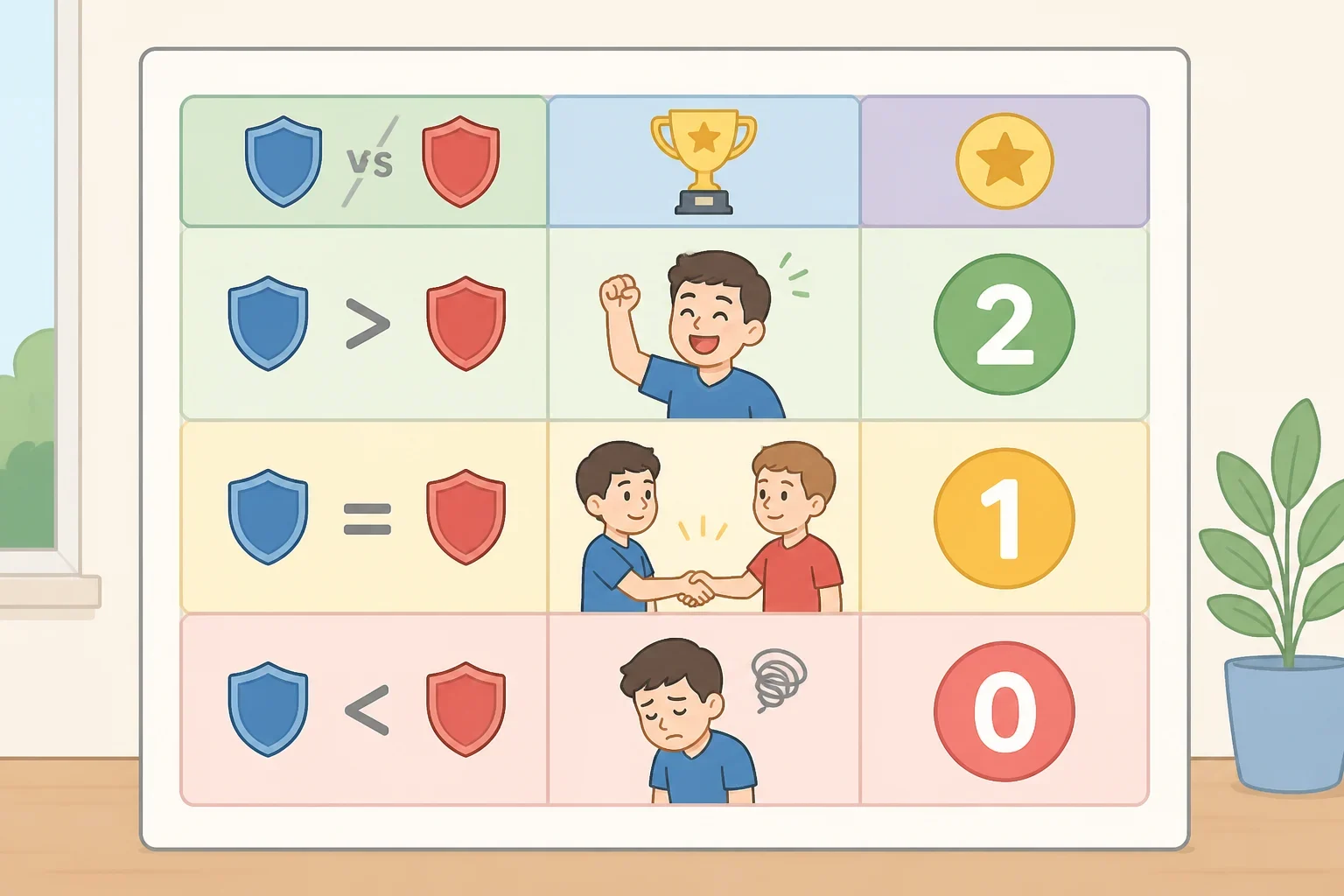
The scoring is simple once it's laid out in one place. The NHL's own standings page, which updates after every game, confirms a win is worth two points whether it comes in regulation, overtime, or a shootout (NHL Standings).
Result Points awarded Win (regulation, overtime, or shootout) 2 Loss in overtime or shootout 1 Loss in regulation 0
(Sound Of Hockey; NHL Official Rules)
The finer mechanics, who gets the overtime point and when, come from the NHL rulebook covering the 2024-25 season. That rulebook states that if the score is tied after three 20-minute periods, both teams are awarded one point before overtime begins. The team that scores first in the five-minute, three-on-three overtime earns the second point; if nobody scores, a shootout follows, and the shootout winner is credited with that second point instead (NHL Official Rules). A shootout isn't technically an overtime period under that language, but it decides the same thing: who takes home the extra point once regulation ends tied.
That point shows up in a team's record in the shorthand commonly written as W-L-OTL: wins, regulation losses, and overtime or shootout losses. A hypothetical team finishing 40-20-12 would have 40 wins worth two points each, plus 12 overtime or shootout losses worth one point each, for 92 points total (40 × 2 + 12 × 1 = 92). The OTL column adds one point per qualifying loss; it isn't a zero, but it isn't a win either.
Why do NHL teams get a point for losing after overtime?
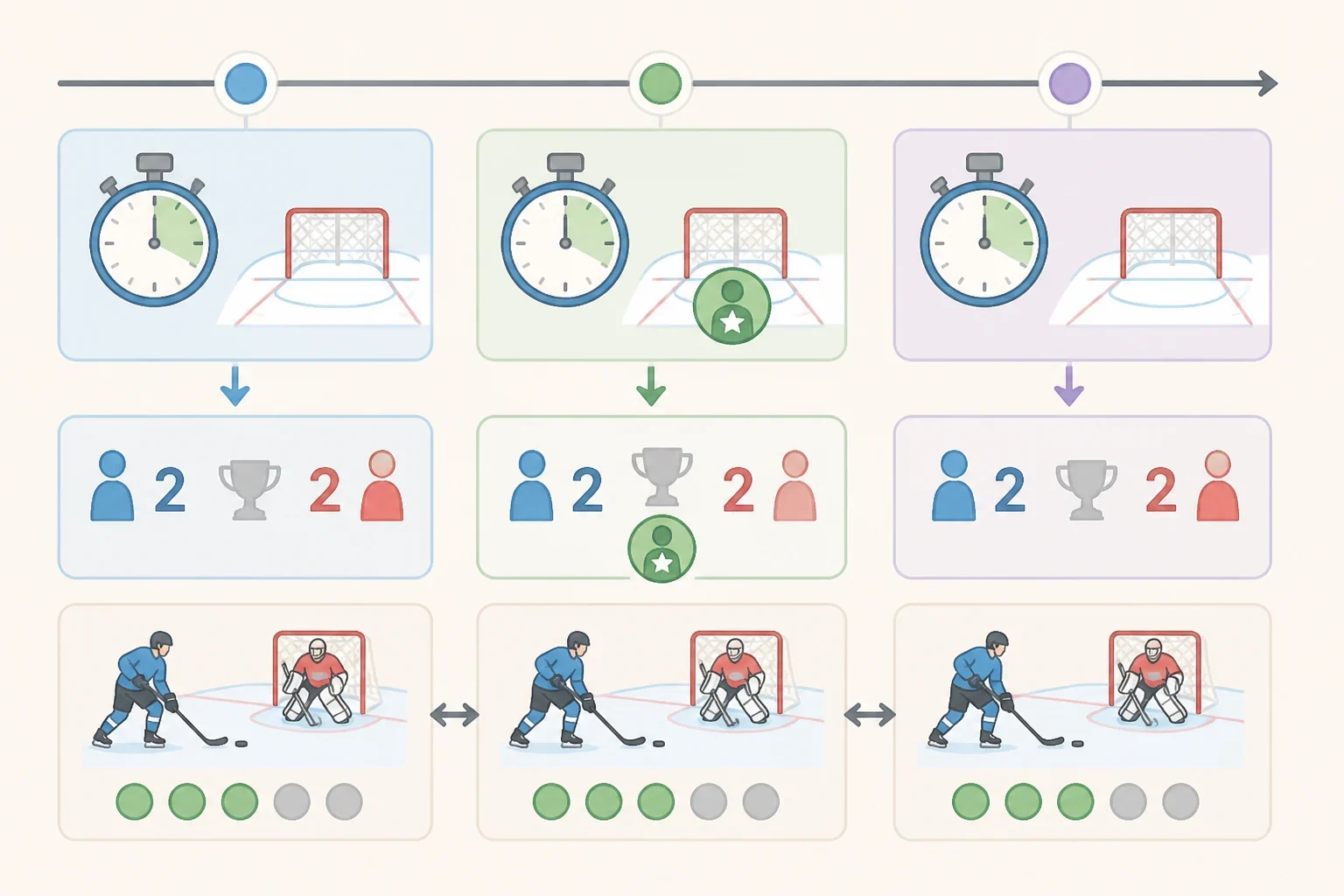
The rule predates the shootout by several years. The NHL began awarding a point to any team that reached overtime in the 1999-2000 season, back when regular-season games still ended in ties after a five-minute overtime, with each team collecting one point (Sound Of Hockey).
That 1999-2000 change gave the overtime loser the same point a tie would have earned, while the winner collected an extra one. When the shootout arrived in 2005 to eliminate regular-season ties, the same point structure stayed in place: games still award one point for reaching overtime and a second for winning it (Sound Of Hockey).
One result of that history: a regulation game puts two total points into the standings, while a game that reaches overtime or a shootout puts three (Sound Of Hockey).
That extra point disappears in the playoffs. Shootouts and standings points apply only during the regular season. The 2024-25 rulebook states that in the Stanley Cup Playoffs, a tie after regulation leads into full 20-minute sudden-death periods, with no shootout and nothing on the table but the win itself (NHL Official Rules).
How NHL standings work when teams are tied on points

That extra overtime point matters most once playoff seeding is on the line. Sixteen teams qualify for the Stanley Cup Playoffs through a bracket built mostly around divisions, with the top three teams in each division claiming 12 of those spots and the remaining four going to the next-best teams in each conference by record, regardless of division (NHL Standings).
That wild-card math can get lopsided. One division in a conference can send five teams to the postseason while the other sends only three, since the wild-card spots aren't reserved by division (NHL Standings).
The bracket rewards finishing position directly, too. In the first round, each conference's top division winner faces the wild-card team with the weaker record, while the wild card with the better record draws the other division winner; the teams that finished second and third in a division meet each other inside that same bracket. Survivors from those matchups then play one another in the second round to decide who reaches the Conference Finals (NHL Standings).
Home-ice advantage through the first two rounds goes to whichever team finished higher in the regular-season standings, so a single overtime-loss point can separate a team hosting Game 1 from one traveling for it. By the Conference Finals and Stanley Cup Final, home ice switches to whichever team had the better overall regular-season record, regardless of how the divisions shook out (NHL Standings).
When two teams land on the same point total, the league works through a set order of tiebreakers rather than simply comparing win totals: fewer games played first (a higher points percentage), then Regulation Wins (RW), then Regulation-plus-Overtime Wins (ROW), then total wins, then head-to-head points, then goal differential, then goals scored (NHL Standings). RW and ROW only enter the picture once two teams are already tied on points; they're tiebreakers, not separate scoring categories.
The overtime point can separate teams with identical win totals, too. A hypothetical team that goes 42-26-6 finishes with 90 points; one that goes 42-30-2 finishes with 86. Both have 42 wins, but the first team banked six overtime-loss points against the second team's two, a four-point gap built entirely out of how each team lost.
The push for a different points system
theScore criticized the points system earlier this year, arguing that crediting every win the same way, regulation, overtime, or shootout, lets a team that's simply good at shootouts gain ground on a stronger club that isn't. The piece also noted that the NHL is the only major professional sports league that awards a point for a loss at all (theScore).
As evidence, theScore pointed to the Anaheim Ducks, who sat second-last in the Western Conference earlier this year but had gone 4-1 in shootouts, compared to the Boston Bruins, second in the Eastern Conference, who had gone 0-7 (theScore).
One commonly discussed alternative is the model the IIHF and PWHL already use: three points for a regulation win, two for an overtime or shootout win, one for an overtime or shootout loss, zero for a regulation loss. Every game under that format distributes exactly three points, rather than the NHL's mix of two and three (Sound Of Hockey).
Sound Of Hockey's own analysis tested the 3-2-1-0 model against real NHL standings and found it produced only minor shifts in playoff positioning, while giving every team a more consistent points percentage, since no single game would be worth more total points than another (Sound Of Hockey).
theScore also raised a separate idea: extending overtime, as the ECHL did by two minutes this past season, would likely mean fewer games reaching a shootout in the first place, though the piece acknowledged getting the players' association to sign off on that kind of change could be difficult (theScore).
Neither idea fully resolves the shootout-skill complaint on its own. Under the 3-2-1-0 model, a shootout win would still count for more points than a regulation loss; what shifts is the relative value of winning in regulation versus winning later, and how many total points a given game distributes. A longer overtime period tackles the problem differently, by cutting down how often games reach a shootout at all.
Three outcomes, one point value
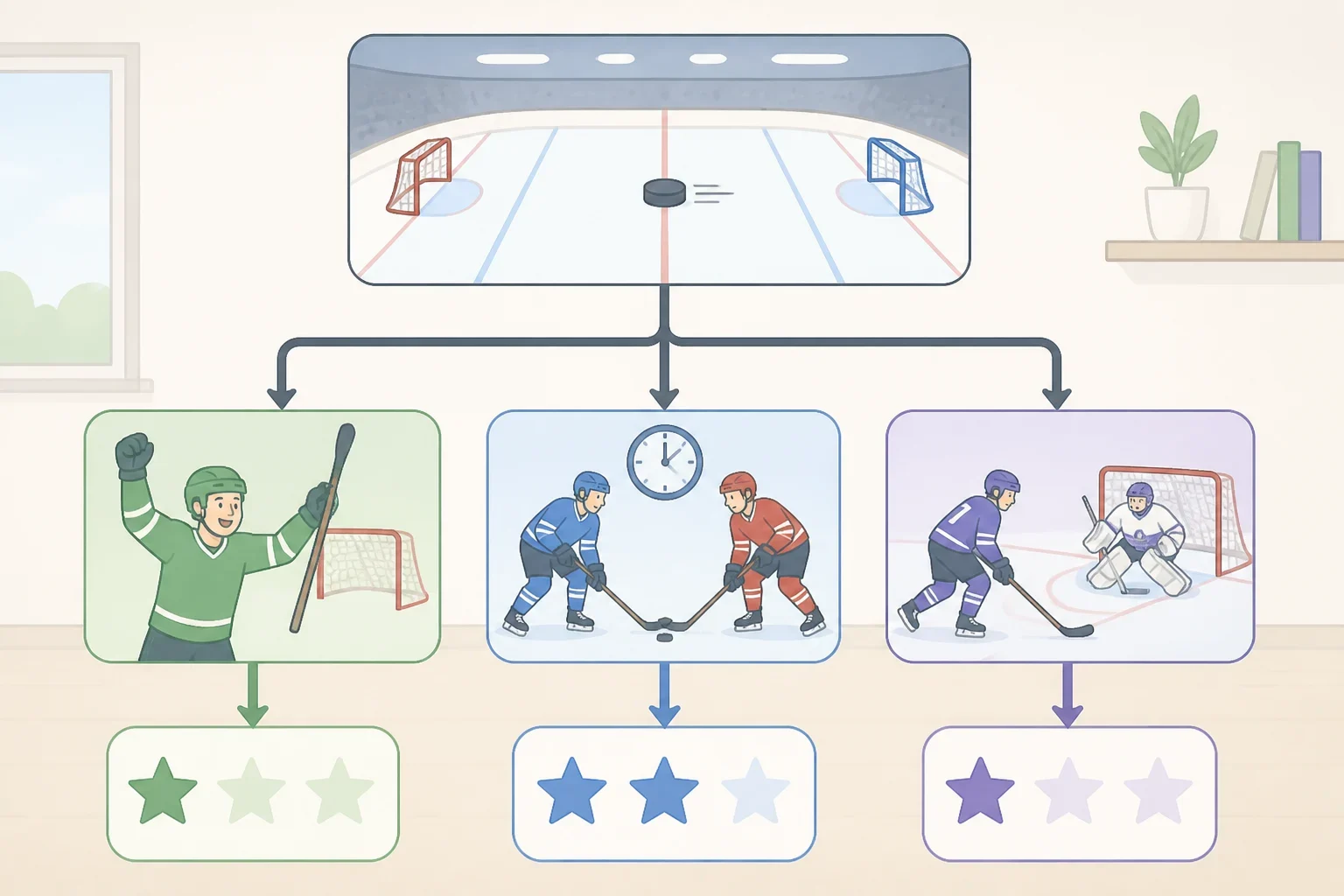
Breaking a single game down makes the system easier to track:
- Regulation win or loss: the winner takes two points, the loser takes zero.
- Overtime win or loss: the winner still takes two points, but the team that gave up the overtime goal keeps the one point it banked by reaching overtime.
- Shootout win or loss: the split matches overtime, two points to the shootout winner, one point to the team that lost the shootout.
The system was designed around games that reached a tie or overtime, not around ordinary losses. An OTL on a team's record means it reached overtime, not that the loss itself was somehow lighter.
When comparing two teams close in the standings, check the OTL column first to see how many of those single points came from overtime or shootout losses. Only look at RW and ROW if the two teams are already tied on total points; those columns are tiebreakers, not a separate way to score.