
- 2026-27 High School Basketball Rule Changes: 5 Key Updates
- High school basketball clock rule changes: the 0.3-second standard
- How officials fix a game clock malfunction
- Offsetting technical fouls under the new dead-ball rule
- Where throw-in violations are now spotted
- One old rule is gone: Rule 6-4-4g
- What to check before relying on this summary
2026-27 High School Basketball Rule Changes: 5 Key Updates
The 2026-27 high school basketball rule changes bring five new provisions to the rulebook, and two of them directly change how officials manage the final seconds of a quarter. The NFHS Basketball Rules Committee recommended the changes at its April 27-29 meeting in Indianapolis, and the NFHS Rules Review Committee and Board of Directors approved all five, according to NFHS.
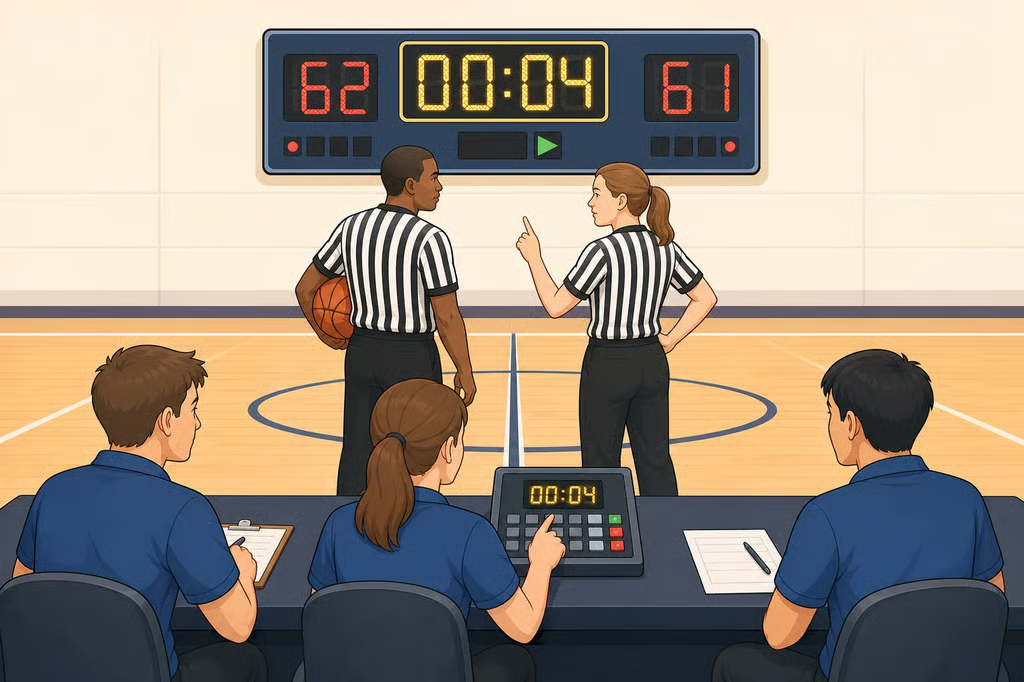
Two of the five land in Rule 5 and cover game-clock administration. Rule 5-9-5 sets a minimum timing standard tied to end-of-period plays, and Rule 5-10-2 Note gives officials a defined procedure for correcting a malfunctioning clock, according to NFHS.
The remaining three address offsetting technical fouls, where officials spot throw-in violations on the floor, and the removal of a rule left obsolete by procedural changes adopted last year, according to NFHS.
For context on reach: boys basketball counts 540,704 participants across 18,690 schools nationally, and girls basketball counts 356,240 participants across 18,208 schools, according to NFHS.
High school basketball clock rule changes: the 0.3-second standard
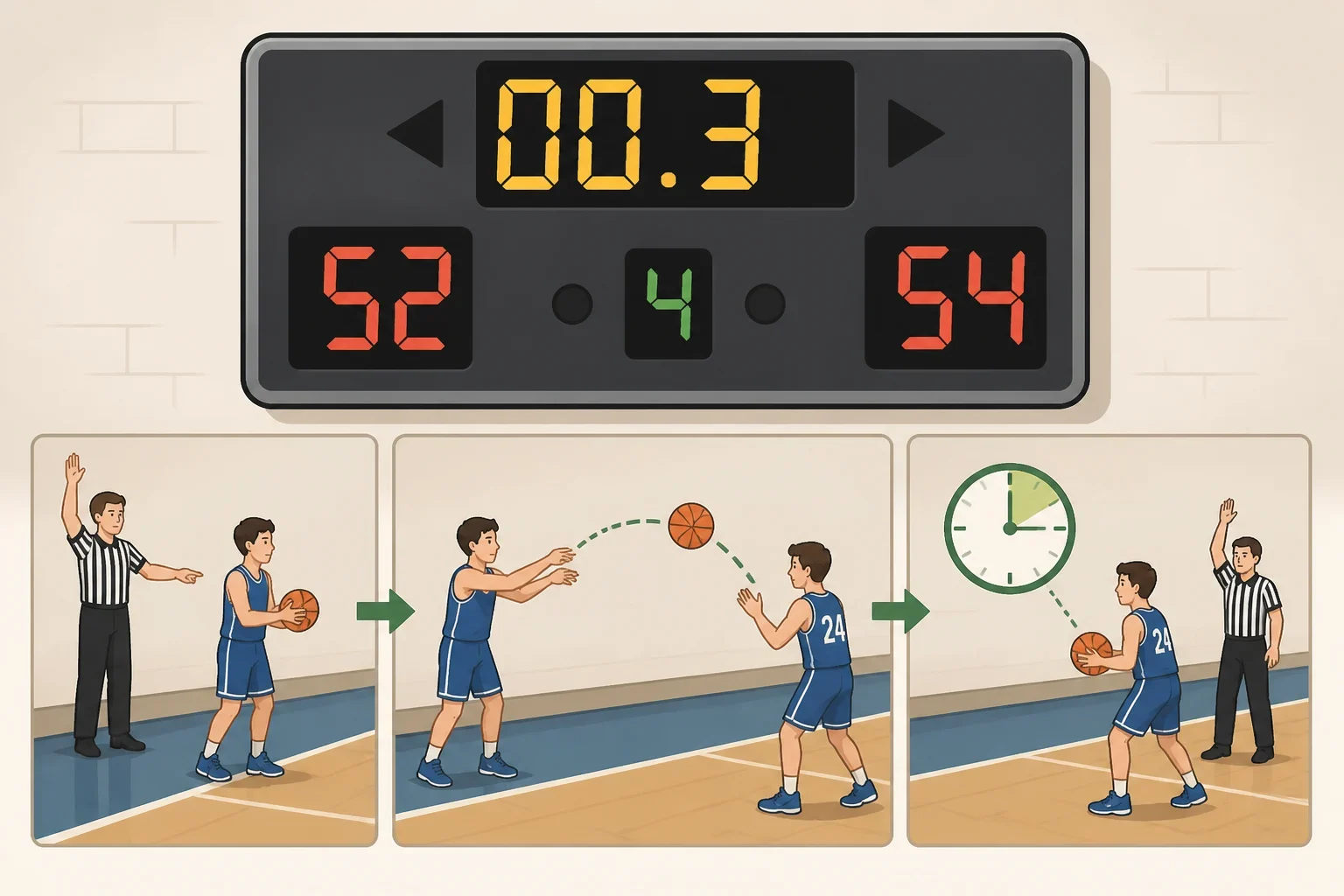
Rule 5-9-5 requires at least 0.3 seconds to expire on the clock once a player legally touches an inbounds throw-in during the final 59.9 seconds of a quarter or overtime, according to NFHS and OHSAA. That 59.9-second window matters because the standard only triggers in the closing minute of a period; it has no bearing on clock administration during the rest of the game.
NFHS built the standard on one already in the book. It mirrors the same 0.3-second floor used for successful tap-ins under Rule 5-2-5, extending an existing timing concept to a new situation, according to NFHS.
Sources describe the rule's scope a little differently. IAABO's rule summary states that Rule 5-9-5 covers a legal touch inbounds after a throw-in or an unsuccessful free throw, according to IAABO. NFHS's public announcement and OHSAA's coverage describe the same provision only in the throw-in context, according to NFHS and OHSAA. Officials and coaches working from a printed rules book should confirm the free-throw language directly rather than assume either summary is complete on its own.
The rule also carries one hard limit worth remembering: it applies only at venues where the scoreboard displays tenths of a second, according to OHSAA. If 0.5 seconds show on the clock when a player legally touches an inbounds pass, the timer and administering official now check that sequence against a fixed floor of at least 0.3 seconds instead of relying on a visual read alone.
How officials fix a game clock malfunction
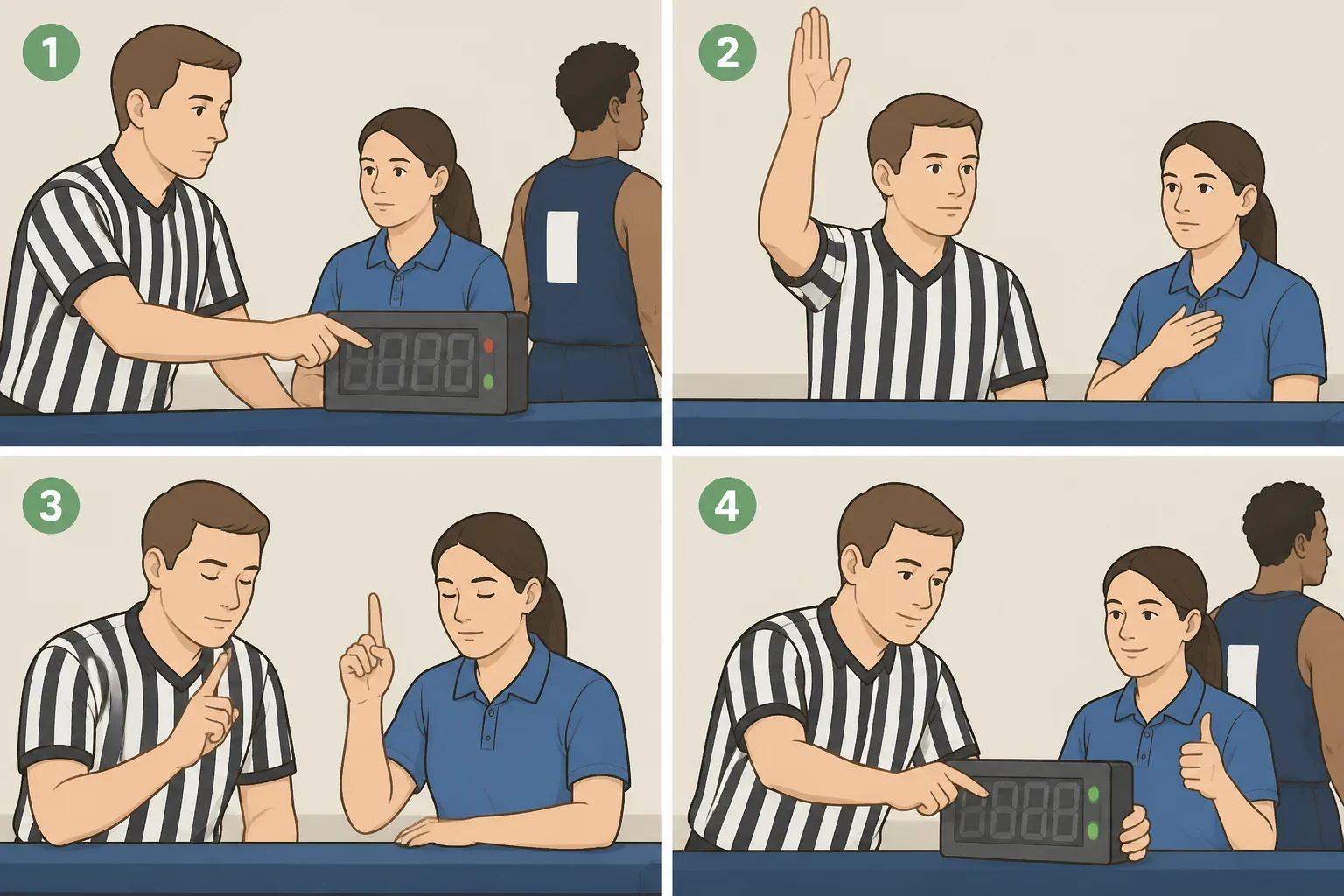
Rule 5-10-2 Note gives officials a defined way to correct a malfunctioning clock. If an official determines the clock did not start or stop properly, a silent count can serve as definite knowledge used to fix the timing error, according to NFHS and OHSAA.
IAABO's mechanics guidance describes a broader menu than the NFHS and OHSAA announcements spell out. Officials may generally choose between a visible or silent count, but a silent count becomes mandatory when a last-second scoring try is still possible, according to IAABO.
NFHS director of sports Monica Maxwell framed the addition as a practical fix rather than a new penalty. The change gives officials "clearer guidance" and "practical solutions" for timing errors instead of leaving the correction to guesswork, she said, according to NFHS.
Picture a throw-in that's legally touched but the clock never starts. An official who kept a silent count, because a scoring try was still live, can use that count to reset the clock before play resumes. The administering official carries the responsibility here, not the scorer or timer alone, since the count has to be kept in real time as the play unfolds.
Offsetting technical fouls under the new dead-ball rule
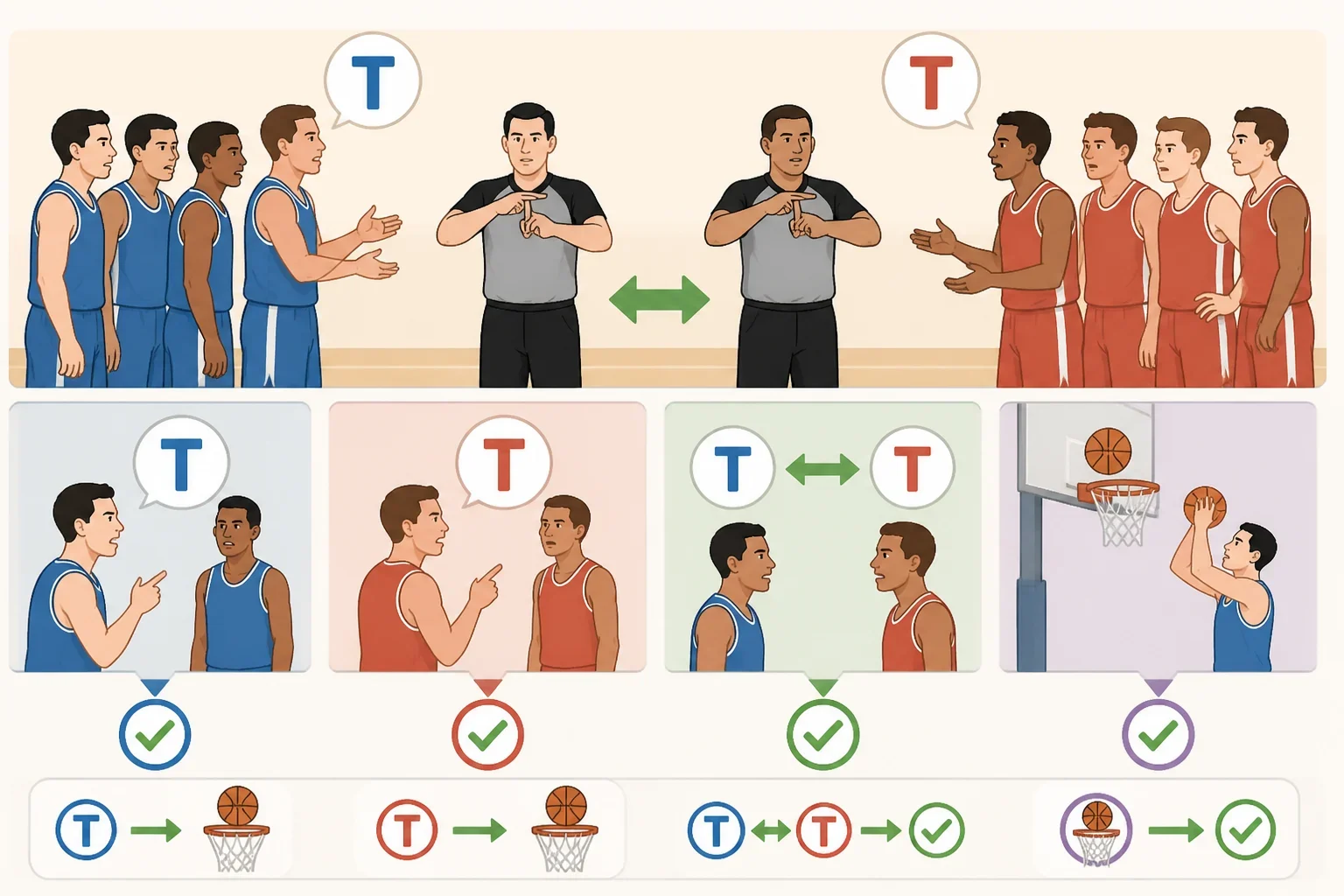
Rule 8-6-4 treats technical fouls committed by opposing teams during the same dead-ball interval as happening at approximately the same time for offsetting purposes, according to NFHS and OHSAA. IAABO's guidance adds that this same treatment applies to technical fouls called during pregame warm-ups, according to IAABO.
When each team commits an equal number of technicals in that window, no free throws are shot and play resumes at the point of interruption, according to OHSAA.
When the counts don't match, only the extra, non-offsetting fouls get penalized, and officials administer the situation as if the final unmatched technical were the only one called, according to IAABO. Say Team A's bench draws two technicals during a stoppage and Team B's player draws one during the same interval. One foul from each side offsets, leaving Team A's second technical to be penalized on its own, with Team B shooting free throws for that unmatched foul.
Scorers need to track these counts carefully during any dead-ball scrum, since the math determines whether anyone shoots free throws at all.
Where throw-in violations are now spotted
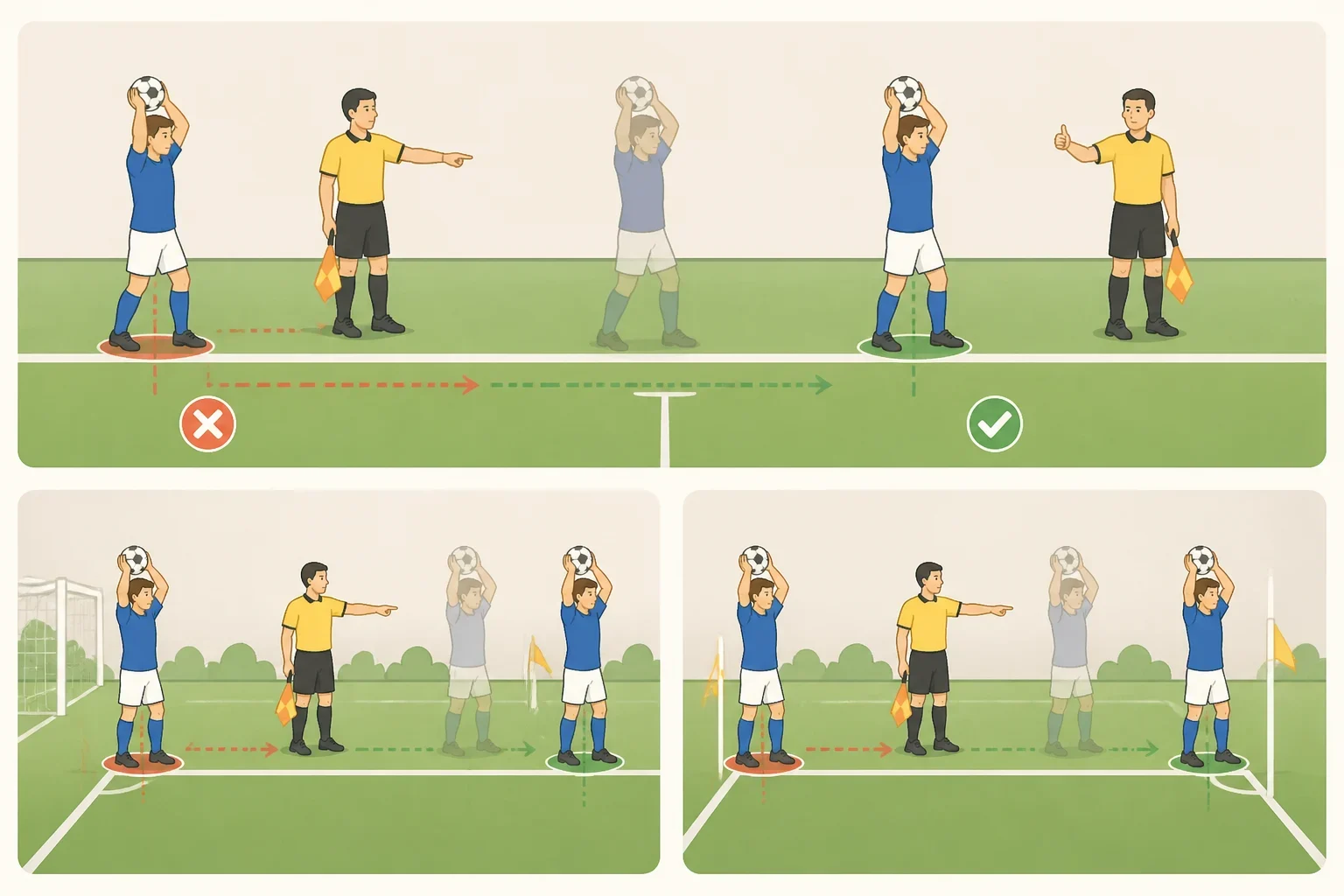
Rule 9-2 Penalty fixes the location of a throw-in violation at the original throw-in spot. If that spot is not a designated location, meaning one of the marked spots along the sideline or end line where throw-ins are permitted to restart, the ensuing throw-in moves to the nearest one, according to NFHS and OHSAA.
IAABO's guidance covers a related baseline scenario. When a thrower is allowed to move along the end line and commits a violation during that movement, the violation is located where the ball was released, not wherever the thrower ended up, according to IAABO.
The same guidance touches the alternating-possession arrow. A team loses its alternating-possession opportunity only when that specific team commits the throw-in violation, not automatically because a violation happened nearby, according to IAABO. That distinction matters most for the table crew tracking the arrow in a scramble near the sideline, where two teams might be involved in the same sequence.
One old rule is gone: Rule 6-4-4g
NFHS removed Rule 6-4-4g entirely as part of the 2026-27 package, according to NFHS.
The provision covered procedures tied to faking being fouled. Changes adopted last year altered how officials handle that situation and left the old rule inapplicable, making this a cleanup deletion rather than a new standard, according to NFHS. Officials already work under last year's procedure; this just removes leftover language that no longer matched it.
What to check before relying on this summary
A few things are worth confirming with a state association or the printed rules book rather than taking this article as the final word. Start with whether the home venue's scoreboard displays tenths of a second, since that determines whether Rule 5-9-5 applies at all, according to OHSAA.
Next, check whether the local rules book confirms the free-throw application of Rule 5-9-5 that IAABO describes, since the NFHS and OHSAA announcements only discuss throw-ins, according to IAABO and NFHS.
Finally, NFHS's original announcement projected the print rules book for sale at NFHS.com and the digital version through NFHS.org starting in late July, according to NFHS. Those projected release windows have since passed, but this article has no way to independently confirm current availability, so check NFHS.com or NFHS.org directly for the current listing rather than assuming it matches the May projection. Coaches, officials, and program administrators should treat that printed book, not this summary, as the controlling source once the season gets underway.