
- High school sports safety checklist: 8 things to confirm
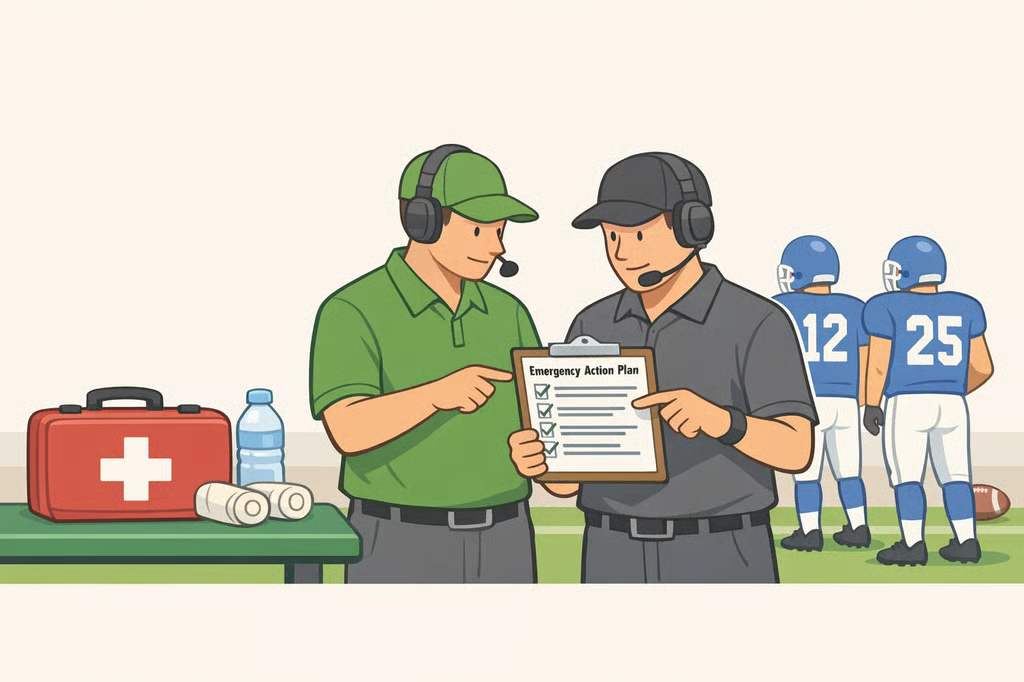
- Before the season: build a sport-specific emergency action plan
- Before the season: train coaches on concussion response and map the heat-acclimatization window
- Pre-practice sports safety checklist for coaches: cardiac readiness and safety briefings
- Before every practice: hydration, gear checks, and warm-up habits
- When to modify or postpone practice
High school sports safety checklist: 8 things to confirm
High school athletic programs rarely have a doctor standing on the sideline. Only 37% of U.S. high schools have access to a full-time athletic trainer, and once someone calls 911, emergency medical services take an average of 7 to 8 minutes to reach the scene (NATA; Korey Stringer Institute). That gap means on-site coaches, athletic directors, and parent volunteers are often the ones responding first to a cardiac emergency or heat stroke, not paramedics.
The National Athletic Trainers' Association updated its national guidance in 2024 to call for emergency action plans (EAPs) built for each sport-and-venue combination rather than one generic campus document (NATA). Research on secondary-school EAP planning published last year found that many schools already have a written EAP on file but still face a higher risk of failing to execute it correctly without regular rehearsal and maintenance (PubMed).
This high school sports safety checklist splits eight essential checks into two timeframes: what an athletic director or athletic trainer should lock down before the season starts, and what a head coach needs to verify before every practice. Coaches and parent volunteers can execute assigned emergency roles, like calling 911, grabbing an AED, or meeting EMS at the gate. They aren't substitutes for a certified athletic trainer or physician. Korey Stringer Institute guidance is direct on this point: a coach should never serve as an athlete's primary medical provider, though coaches should be trained in emergency care (Korey Stringer Institute).
Before the season: build a sport-specific emergency action plan

1. A written, sport- and venue-specific EAP. An EAP details how staff should respond to a catastrophic injury before EMS arrives. Since the 1982-83 school year, researchers have logged more than 3,000 catastrophic sport-related injuries among high school and college athletes, with football, basketball, track and field, wrestling, soccer, and baseball carrying the highest rates (NATA).
Owner: athletic director or athletic trainer. Verify: an actual document listing the venue address, entry and exit routes, AED location, who calls 911, who retrieves equipment, who meets EMS, and a logged rehearsal date. A plan that exists only as a filed PDF doesn't count. EAPs measurably reduce emergency response time, but only when rehearsed and maintained regularly, ideally under an athletic trainer who assigns each bystander's role ahead of time (PubMed). Use this as a starting point for a high school emergency action plan for sports, then check it against your state association's specific requirements before treating it as final.
2. Pre-participation medical clearance on file. The pre-participation exam (PPE) screens for injuries, illnesses, or risk factors before an athlete practices. No single standardized screening tool currently exists across sports medicine (Korey Stringer Institute).
Owner: athletic director or school health office. Verify: a signed form on file for every roster athlete, using whatever form your state athletic association requires, not a verbal assurance that paperwork is "in the mail."
Before the season: train coaches on concussion response and map the heat-acclimatization window
3. Coach concussion training completed. State athletic associations typically build their own concussion-education requirements for coaches, and the Korey Stringer Institute recommends every state require training that covers how to recognize a suspected concussion and manage a safe return to sport (Korey Stringer Institute).
That kind of training covers recognition and management skills. It doesn't spell out who at your school has the authority to pull an athlete from practice, who contacts parents, or who signs off on a return to play. Check that your school's or state association's own concussion policy answers those questions in writing, before a head impact happens, not after.
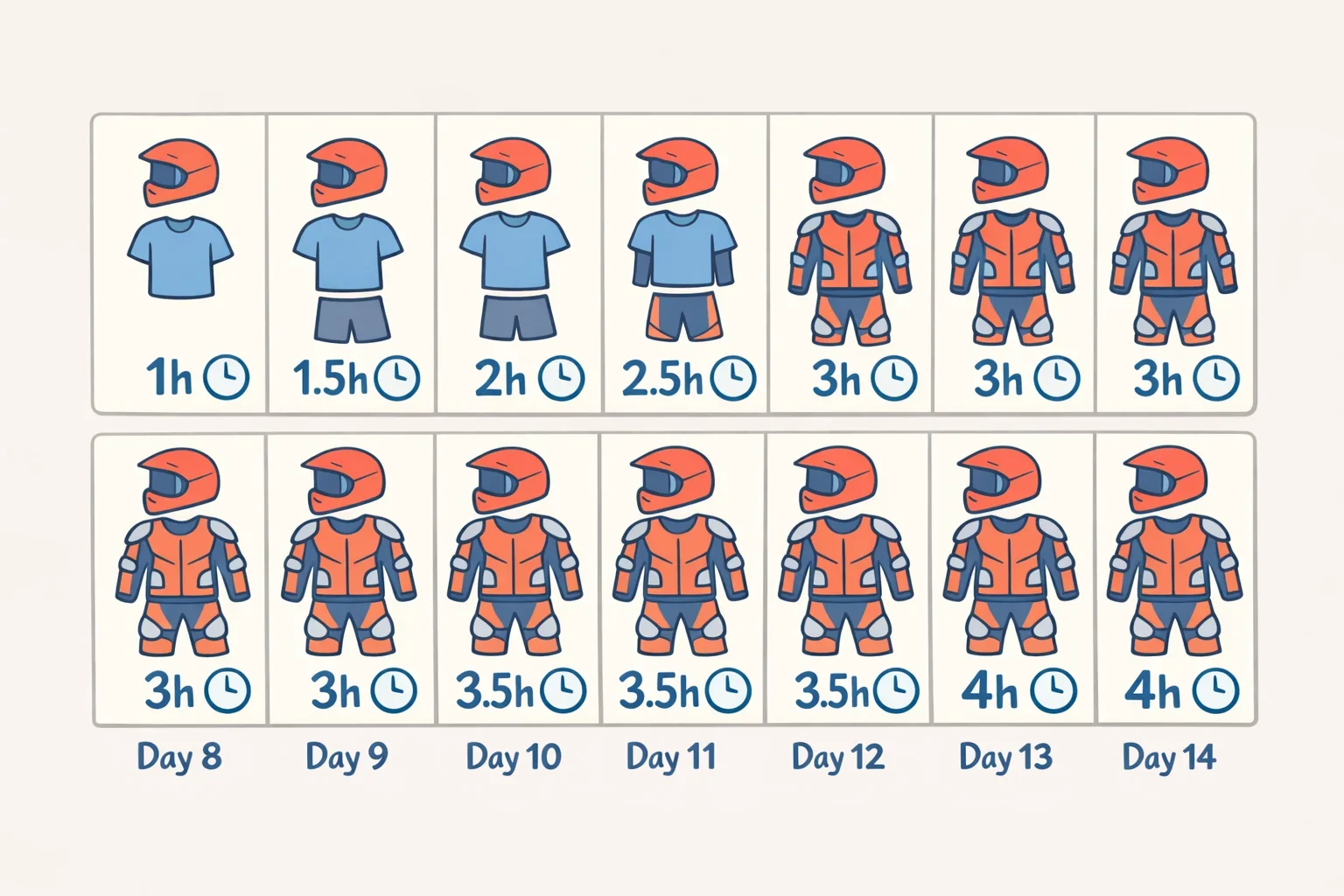
4. Heat-acclimatization schedule mapped for the first two weeks. Heat acclimatization is a 7- to 14-day physiological adjustment that improves sweat response, heart rate, and body temperature control during exercise (Korey Stringer Institute). Secondary-school guidelines call for no more than one practice per day and no more than three total hours during the first five days, with full gear and live-contact drills held off until day six.
Double-practice days must be followed by a single-practice day or a rest day, each session on a double-practice day should stay under three hours, and total practice time from day six through day fourteen shouldn't exceed five hours on double-practice days (Korey Stringer Institute).
Owner: head coach and athletic director, mapped against the calendar before the first practice is scheduled. States that don't mandate these guidelines leave athletes at greater risk of exertional heat stroke, according to the Korey Stringer Institute, which recommends checking your state association's current policy rather than assuming a national default applies (Korey Stringer Institute).
Pre-practice sports safety checklist for coaches: cardiac readiness and safety briefings
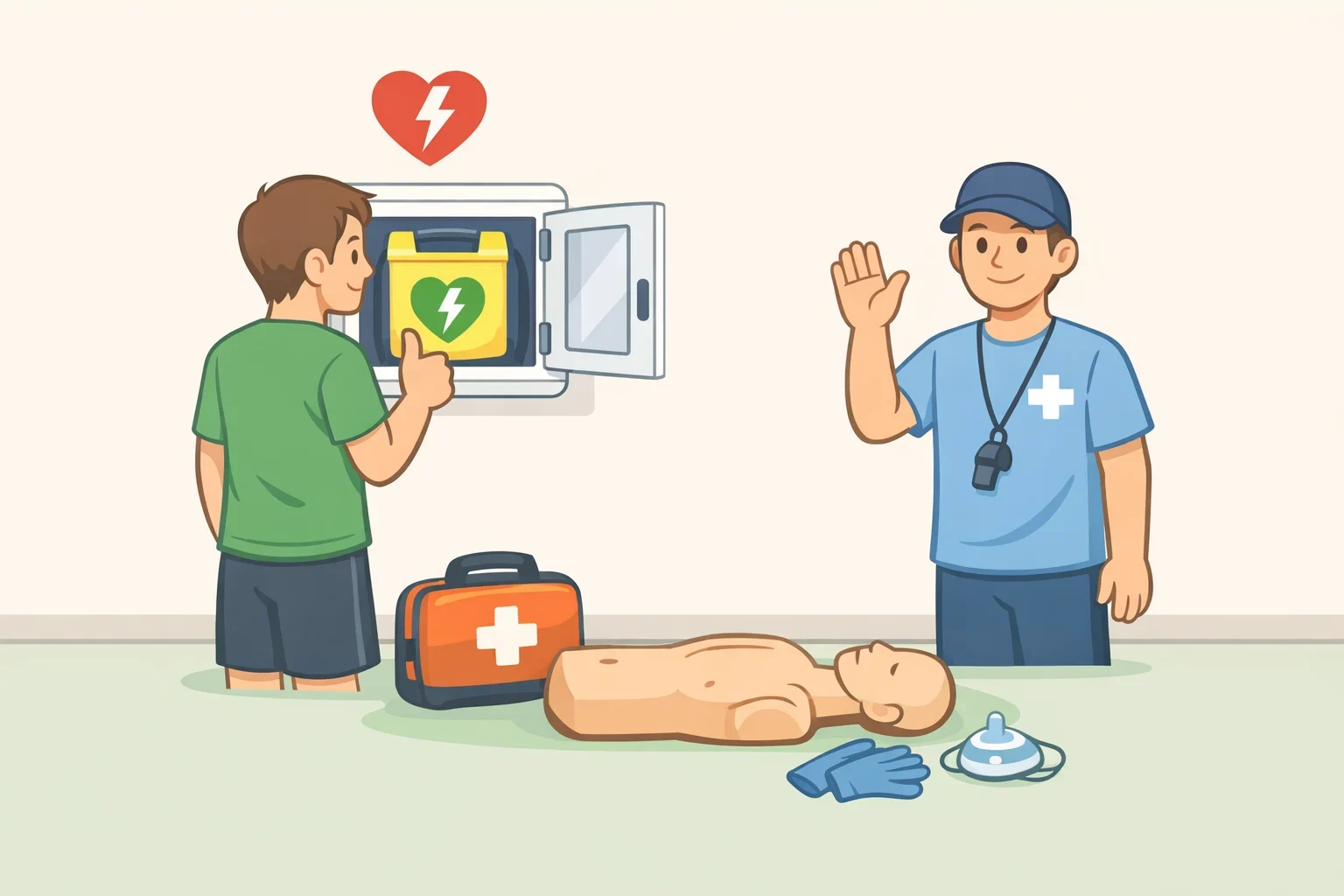
5. AED accessible with a trained responder identified. Sudden cardiac arrest is among the leading causes of death during or resulting from sport participation, and AED use combined with CPR is the gold-standard response for cardiac arrest and commotio cordis (NATA; Korey Stringer Institute). Survival odds fall an estimated 7 to 10% for every minute CPR is delayed (Korey Stringer Institute).
Owner: head coach or designated staff member. Verify: before each practice, confirm the AED is unlocked and reachable, and that someone present knows how to use it. Specific placement distances and staffing minimums vary by district and state association, so check those requirements locally rather than assuming a universal standard applies everywhere.
6. A short pre-practice safety briefing. NATA's updated guidance introduces the pre-event medical meeting, replacing the older "medical timeout" term, where stakeholders confirm emergency procedures, equipment locations, and emergency signals before competition (NATA). That guidance addresses game days and events directly.
Many coaches and athletic trainers extend the same idea to daily practice as a practical habit rather than a cited requirement. A two-minute verbal check on who calls 911, who grabs the equipment, and who meets EMS at the gate costs almost nothing and keeps everyone aligned if something actually goes wrong.
Before every practice: hydration, gear checks, and warm-up habits
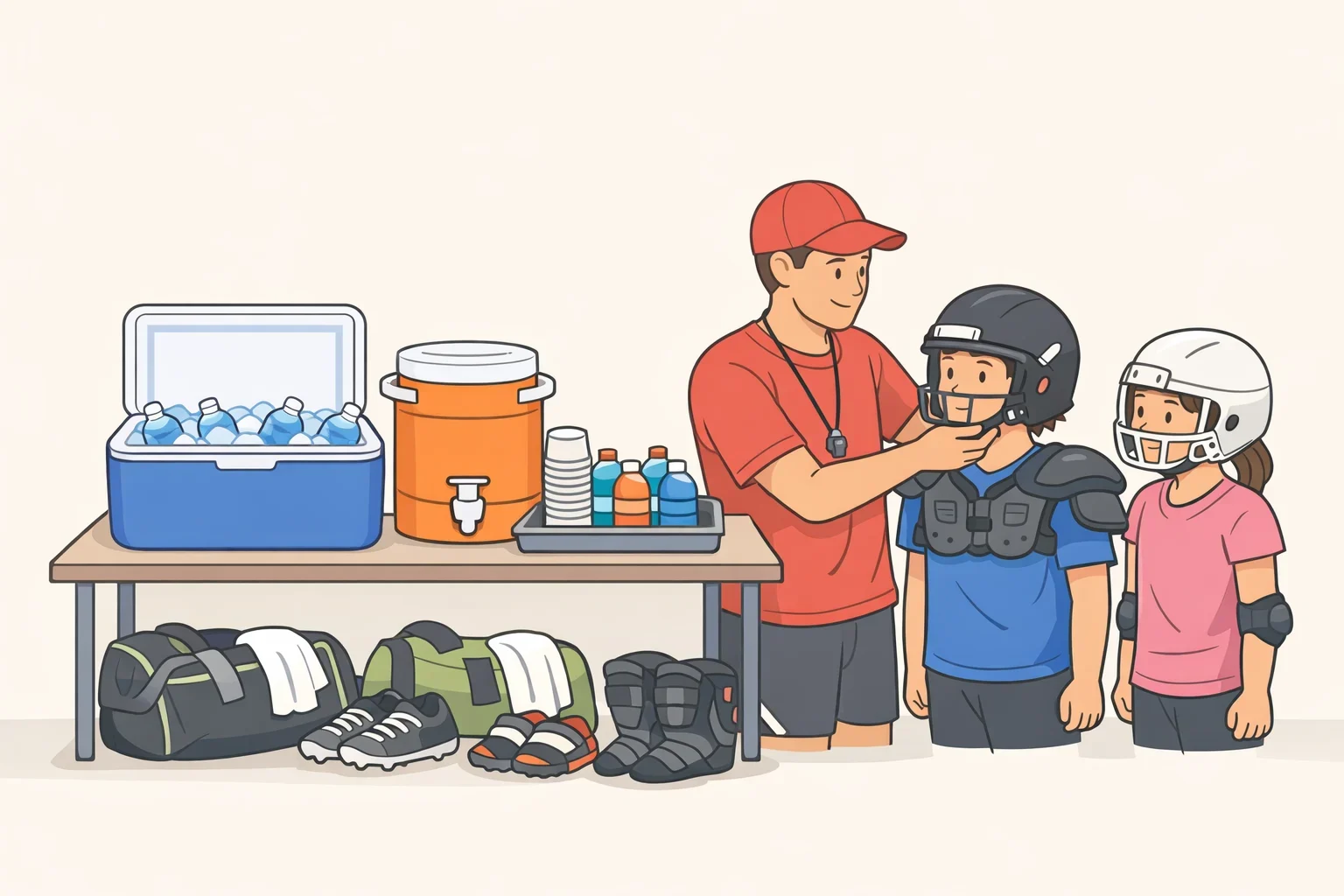
7. Hydration and cooling supplies staged on-site. Staying properly hydrated lets athletes exercise at lower body temperatures and heart rates, and losing just 2% of body mass through fluid loss produces measurable performance impairment that worsens with further dehydration (Korey Stringer Institute).
A Wet Bulb Globe Temperature (WBGT) reading, which factors in temperature, humidity, wind, and solar radiation, is used to assess heat risk and can guide modifications like work-rest ratios and hydration breaks in hot conditions. Cooling methods such as ice towels or ice tubs should be available during practice, not stored in a locker room (Korey Stringer Institute; Korey Stringer Institute). Owner: head coach or athletic trainer, checked before athletes step outside.
8. Equipment fit check and a warm-up built for adherence. Protective gear only performs as designed when it's fitted and used according to manufacturer and sport governing-body guidelines, without modification. Even well-made equipment loses protective value with a poor fit, whether that's a football helmet, a catcher's chest protector, or shin guards (Korey Stringer Institute).
A systematic review of 68 studies on youth team-sport warm-ups found injury reductions of 36 to 72% in programs that combined neuromuscular training warm-ups with coach workshops and supporting resources, with higher adherence linked to stronger results (PubMed). The same review noted that few of the included studies actually measured injury-prevention effectiveness directly, so treat that range as a signal tied to strong implementation, not a guaranteed outcome for any given team. The practical version: use a structured neuromuscular warm-up and put real effort into making coaches and athletes stick with it, since adherence is what the evidence links to better results.
When to modify or postpone practice
None of these checks work as a one-time box to tick. If a trained AED responder isn't confirmed, if the safety briefing gets skipped, or if hydration and cooling supplies aren't staged, follow your school's written emergency policy and treat that as a real reason to modify or delay practice rather than run it as scheduled.
Sudden cardiac arrest, traumatic brain injury, and exertional heat stroke are the leading causes of death connected to sport participation (NATA). Coaches should watch for signs of exertional heat stroke, heat exhaustion, and heat syncope during the early weeks of a season especially (Korey Stringer Institute). Any athlete showing confusion, collapse, chest pain, or symptoms consistent with heat illness during practice needs the emergency plan activated immediately, not a wait-and-see approach.
Treat this eight-point list as a floor, and think of it as a working set of student athlete safety guidelines rather than a substitute for your district's or state association's official policy, since local rules can set a higher bar. Pull your state association's current EAP, heat-acclimatization, and concussion-training requirements before the first day of practice, and build items 5 through 8 into a routine the coaching staff actually runs every session, not something remembered only during the first week of the season.